
World Liberty Financial Borrows $75M Against Own Tokens Amid Concentration Risks
 Aime Summary
World Liberty Financial (WLFI) has drawn intense scrutiny after its treasury borrowed approximately $75 million in stablecoins by pledging 5 billion of its own WLFIWLFI-- tokens as collateral on the DolomiteDOLO-- lending protocol according to reports. On-chain data indicates that this single position now represents over 50% of the protocol's total value locked, creating a significant concentration risk for other participants as data shows. Critics argue the structure creates a circular dependency where the project's solvency relies on its own asset price research indicates.
The transaction pushed the USD1 pool on Dolomite to a utilization rate exceeding 93%, making timely withdrawals difficult for ordinary depositors according to analysis. Following the borrowing, over $40 million of the stablecoins was transferred to Coinbase Prime wallets as reported. Despite the team's assertions of ample resources to defend the position, the WLFI token price has fallen sharply as investors weigh the implications of this related-party transaction.
DeFi analysts warn that the WLFI token's thin market depth could trigger forced sales if prices decline, potentially leading to bad debt for depositors as analysis shows. Additionally, concerns were compounded by the discovery that WLFI's advisor, Corey Caplan, is a co-founder of Dolomite, raising questions about conflict of interest and independent oversight according to reports.
What Are The Liquidity Risks For Depositors?
Entities linked to World Liberty FinancialWLFI-- deposited $484 million worth of WLFI tokens as collateral on Dolomite, borrowing $50.44 million USDC according to reports. This single position pushed the pool's utilization past 100%, causing liquidity to turn negative at -232,000 tokens as data shows. This means the platform's USDC supply is effectively drained, leaving no real liquidity for other users to withdraw according to analysis.
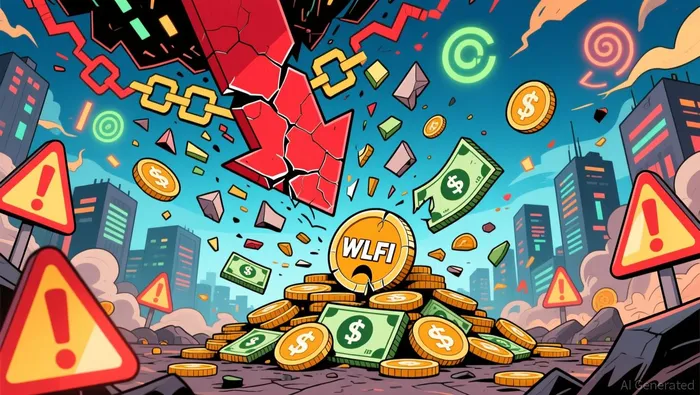
The immediate impact was a 12% drop in the WLFI token price according to reports. The artificial scarcity caused deposit rates to surge to 35.81% APR, but lenders are now trapped as they cannot withdraw funds until the massive borrow position unwinds as data shows. This creates a dangerous feedback loop where the treasury's actions erode the value of its own collateral, increasing liquidation risk according to analysis.
Systemic risks are high as the protocol's health hinges on a single, illiquid token as reports indicate. WLFI has almost no organic secondary market depth, meaning the collateral cannot be liquidated without catastrophic price impact according to analysis. Additionally, the protocol's native token, DOLO, has a market cap of roughly $15 million, serving as the entire buffer against insolvency as data shows.
How Does The Project Defend Its Position?
World Liberty Financial defended its borrowing activity on the Dolomite platform, labeling concerns over its debt health as "FUD" (fear, uncertainty, and doubt) according to the project. The project stated it is "nowhere near liquidation" and would simply supply more collateral if necessary as claimed. The team argued that their presence as an "anchor borrower" provides higher yields for other participants compared to traditional markets according to analysis.
However, blockchain analysis firm ArkhamARKM-- Intelligence showed that World Liberty posted around $400 million worth of WLFI as collateral on Dolomite across two wallets as reported. Critics, including DeFi analyst DefiIgnas, argued that the project has not explained how it would repay the stablecoin debt and claimed that WLFI is too illiquid to sell in size without causing significant slippage according to analysis.
The project noted it has repurchased 435 million tokens over the last six months to support the ecosystem according to reports. The treasury disclosed $65.58 million in open-market buybacks at an average price of $0.1507, but the token now trades roughly 48% below this average. Consequently, the treasury's own purchases are significantly underwater.
What Are The Implications For Token Valuation?
WLFI's sharp decline is being driven by a combination of leveraged positioning and weakening market confidence according to analysis. The sell-off accelerated after revelations that the project used its own token as collateral to secure a $75 million stablecoin position as reported. This has been perceived as an aggressive strategy, particularly in a low-liquidity environment according to analysis.
Derivatives data confirms that the current decline is being driven by active position unwinding rather than passive weakness according to reports. Trading volume surged nearly 79% to over $517 million, indicating a volume-led sell-off as data shows. Meanwhile, open interest declined by around 3%, signaling that traders are exiting the market rather than opening new positions according to analysis.
The decline reflects a broader confidence-driven sell-off, triggered by internal financial decisions rather than external market conditions according to reports. The combination of leveraged exposure, liquidity constraints, and supply concerns has created a fragile setup where downside risks remain elevated as analysis shows. Unless WLFI reclaims key levels and sentiment stabilizes, the token is likely to remain under pressure in the near term according to reports.
Concerns were further compounded by a governance proposal to unlock tokens for early holders, which has triggered preemptive selling in an already fragile market according to reports. The project clarified that the unlock would feature a long-term vesting schedule, but the prospect of increasing circulating supply has exacerbated the sell-off as reported. The math works against WLFI on every side as lower prices mean less borrowing power per token.
DeFi analysts on X warned that if WLFI's price hits liquidation levels, the lack of market depth could result in massive bad debt for the protocol's other lenders according to analysis. Analyst EthanDeFi advised users to withdraw stablecoins from any pools that accept WLFI as collateral as recommended. In traditional finance, such a scale of related-party transaction would typically require disclosure and independent board approval, which WLFI has not provided according to reports.

Blending traditional trading wisdom with cutting-edge cryptocurrency insights.
Latest Articles
Stay ahead of the market.
Get curated U.S. market news, insights and key dates delivered to your inbox.


AInvest
PRO
AInvest
PRO



Comments
No comments yet