The Last Word Is in Oakland

Sunday, Aug 23, 2026 8:27 am ET9min read
PSKY--
WBD--
Aime RobotAime Summary

- Paramount Skydance's $110B all-cash acquisition of Warner Bros.WBD-- Discovery cleared global antitrust reviews but faces a lawsuit from 12 states in Oakland federal court.

- The case centers on antitrust concerns over theatrical film distribution and basic-cable licensing, with states demanding structural remedies while the buyer offers behavioral fixes.

- A March 2027 trial looms as the key deadline, with Paramount paying escalating costs including $0.25/share quarterly "ticking fees" and $15B in bridge financing.

- WBDWBD-- shareholders receive fixed $31 cash, while PSKYPSKY-- bears all financial risk, including potential $7B breakup fees if the deal collapses before closing.

- The outcome hinges on whether states secure divestitures or the merger proceeds with weaker commitments, with Oakland's court ultimately holding the final authority.

Weird fact about the biggest media mega-merger of the moment: the antitrust review is done. Finished. The U.S. Justice Department cleared the all-cash takeover of Warner Bros.WBD-- Discovery by Paramount SkydancePSKY-- in June, and by August 14 regulators in roughly 68 countries and jurisdictions — the EU, the UK, Canada, Brazil, China, and, finally, Mexico — had all signed off. The companies themselves announced that same day that they could and would close today. They can't. The only remaining hurdle is not a regulator. It is twelve state attorneys general, a filing in federal court, and one judge in Oakland. That is the whole story, compressed to its weird shape. This is a roughly $110 billion all-cash deal that cleared every antitrust authority on the planet except the one that matters, which is not an authority at all but a lawsuit. And on Monday the two sides are required by the federal rules to sit down and try to settle it. The interesting question is not whether the deal is good for consumers. The interesting question is who gets the last word — a conference room in Oakland or a courtroom in Oakland — and at what price.

What this deal actually is

Paramount Skydance Corporation — the company created when Paramount Global was merged into Skydance Media in August 2025, run by David Ellison — agreed in late February 2026 to buy all of Warner BrosWBD--. Discovery for $31.00 per share in cash. The transaction is usually described as being worth roughly $110 billion; some outlets say $111 billion, and one reference says $110.9 billion, and the disagreement is a nice reminder that nobody needs the total to be precise, because the number that matters is $31 a share. There is no stock component, no earnout, no "some cash, some equity, and a dividend of hope." WBDWBD-- shareholders get $31 in cash, and the risk of everything that happens next belongs to someone else. The shareholders voted yes in April, after an auction in which Warner Bros. Discovery had first announced a deal with Netflix in December and then jilted it for the Paramount offer in February. The DOJ blessed the deal in June, finding it not likely to result in harm to competition or American consumers. By August 14, the only thing standing between PSKYPSKY-- and a closed deal was litigation — not a federal antitrust review, but a lawsuit.

The last gate is a lawsuit, not a regulator

On July 12, California Attorney General Rob Bonta and eleven other state attorneys general — from Arizona, Colorado, Connecticut, Massachusetts, Minnesota, Nevada, New Jersey, New Mexico, New York, Oregon, and Washington, joining California — filed suit in federal court in Oakland under Section 7 of the Clayton Act, the federal statute prohibiting mergers that may substantially lessen competition. Savor the classification for a second: this is the federal government's own antitrust statute, deployed by states against a merger the federal government approved, argued before a federal judge. No exotic California state statute is involved. The states are claiming that the federal antitrust law is right and the federal antitrust enforcers are wrong. The judge, Araceli Martinez-Olguin, granted a 14-day temporary restraining order on July 20 and then extended the freeze by another 14 days, pushing the earliest possible closing date out to August 18, and by late July the reporting had her concluding the deal likely violates antitrust law. After that, the public record gets a little mushy: whether a formal preliminary injunction has been entered or the parties have instead agreed by stipulation to hold the merger is not uniformly reported. The useful simplification is that the deal is on hold, and it will stay on hold through the trial, which is set for March 2027 in Oakland, in front of the same judge. Paramount had wanted a November start; the attorneys general and the writers' union wanted it later. The calendar is now a strategic weapon. The parties themselves agreed to the wait. On July 24, Paramount Skydance agreed to delay closing to as late as June 2027, having previously said it intended to close by the end of September. A merger agreement that says "we will sit through the trial and possibly longer" is a merger agreement that has decided that litigating is cheaper than closing into an injunction — and that the delay has a price it is willing to pay, in stamped, quarterly increments. Worth pausing on what the states are actually worried about, because it is the funniest fact of the whole case. The theories are theatrical film distribution and basic-cable licensing. Movie theaters and cable boxes. In 2026, after a decade in which the industry narrative was all streaming and death of the bundle, the states' entire lawsuit is about who controls wide-release theatrical distribution and which channels the cable company carries. The merger would combine two of the five major studios into a distributor controlling roughly 27% of wide-release theatrical films, leaving three distributors in control of about 75% of the market and four controlling 86%; in basic cable, the number two and number three programmers would merge into a 27% supplier. Those are the numbers Bonta's office is going to trial over. There is no streaming-concentration theory and no debt-load theory in the complaint; the case is about the oldest revenue streams in the building, which is where we get the last word.

Monday's fight: the shape of a remedy

Federal civil procedure requires the parties to attempt mediation before a magistrate, which is why the meeting on Monday, August 24, is happening at all. It is court-mandated, not elective by either side, and the judge has already asked the parties to line up two magistrate mediators. The sides remain reportedly far apart, though "far apart" is the natural resting state of two litigants two days before their forced mediation. The real disagreement is over what counts as a settlement. California's standard is structural. Bonta says any resolution requires robust structural remedies that would change the shape of the media mega-merger — divestitures, spin-offs, actual changes to what the combined company owns. Paramount Skydance's counteroffer is behavioral: reportedly 30 films a year for three years, kept exclusively in theaters for at least 45 days, plus promises to behave. Bonta's office is not moved; it says conduct promises like these have been impossible to enforce in the past.
This is not a semantic quibble, and it is worth being precise about why it is a fight over what a "remedy" is. A behavioral remedy asks the company to keep behaving the way it has now promised to behave, while leaving ownership where it is — you promise to make 30 movies and keep them in theaters, and if you break the promise, someone has to chase you. A structural remedy takes assets away and puts them with someone else, so the merged company simply doesn't have the power to worry about. For a buyer like Paramount Skydance, which did not raise its capital to flip the assets but to own them — Paramount Pictures, CBS, Paramount+, the Warner Bros. studio, HBO Max, CNN, Showtime all in one house — a divestiture is not a fix to the deal it made. It is a different deal. That is why analysts call the structural demands potential deal-breakers, not because they are unaffordable, but because they un-build the thing being acquired. The leverage sits with the states. Analysts say the plaintiffs hold all the cards, in the sense that they can prefer to run the case to the March trial rather than accept a settlement they regard as worthless, and the deal's own mechanics make delay expensive for the buyer, not for them. And even a handshake between Bonta and PSKY would not finish the job: the Writers Guild has its own parallel suit to block the merger, it is set to be tried alongside the states' case in March, and it has to be folded into any global resolution. You cannot settle with California and call it a day. There is also a somewhat strange thing happening in the background, which is that both sides are trying to negotiate with the physical location of Hollywood. Ellison is reportedly prepared to start moving Paramount Skydance out of California as soon as October — unless, presumably, the deal closes — and Bonta has called that threat blackmail, while California's governor, Gavin Newsom, says he would prefer a resolution in the boardroom, not the courtroom. That is a fight about where the company lives, which is a different, and somehow even more Oakland-adjacent, argument about what the deal means.

The price of waiting

Here is where the plumbing does its work. Because the consideration is all cash, WBD shareholders receive a fixed $31 at closing and carry none of the combined company's post-close risk. The deal's risk, therefore, does not live in the businesses at all. It lives in the space between the offer and the market price, and it is denominated in dollars per quarter.
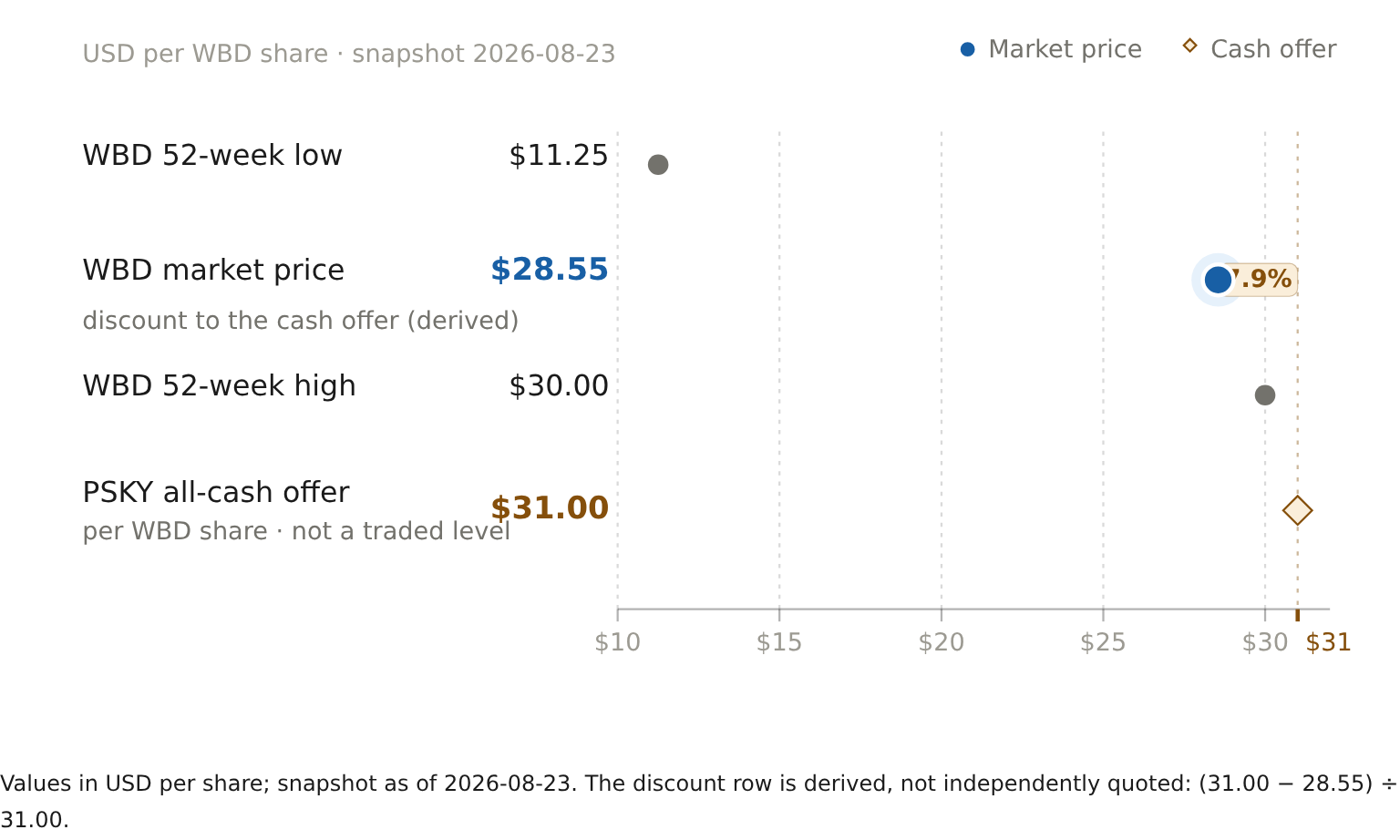
chart-1
Values in USD per share; snapshot as of 2026-08-23. The discount row is derived, not independently quoted: (31.00 − 28.55) ÷ 31.00.
Reference levelValueKind
WBD 52-week low$11.25Traded level
WBD market price (2026-08-23)$28.55Traded level
WBD 52-week high$30.00Traded level
PSKY all-cash offer per WBD share$31.00Negotiated consideration
Market discount to the cash offer7.9%Derived from the two price levels
As of Friday, per Ainvest's screen, WBD traded at $28.55 — a derived discount of about 7.9% to the $31 offer — near its 52-week high of $30.00 and up about 10.8% over twenty days, having more than doubled over the past year off a 52-week low of $11.25. That residual gap is the market's live estimate of the deal's downside: the time value of waiting, the ticking fee, the trial risk, the chance that someone walks. For contrast, PSKY traded at $10.35, up about 26% over twenty days on settlement optimism but down 22.8% year to date — the buyer's stock celebrating the possibility of the deal, even as the buyer itself is the one paying for the wait.
For WBD shareholders, this is mostly a question of timing. They have a $31 cash exit, and the longer the deal drags, the more the ticking fee accrues on top of it — so they are in the unusual position of being paid to be patient, which is a much better seat than the one PSKY's shareholders occupy. For PSKY shareholders, the settlement decides whether the company actually owns what it borrowed and raised capital to buy. The contract writes the price of delay in a few specific strokes. The ticking fee — a quarter per share, per quarter — starts raising what PSKY pays for WBD; sources disagree on the exact trigger, with the most common report putting it around October 1, but also described as the September closing deadline and as each quarter the deal fails to close by December 31, 2026. The $0.25-per-share-per-quarter amount is the consistent part; the trigger date is not, so do not set your calendar by it. On top of that sits a reported reverse breakup fee of about $7 billion that PSKY would owe WBD if the buyer fails to close — reported, not confirmed in any official filing — plus a reported roughly $2.8 billion fee PSKY absorbed, tied to Netflix's abandoned rival bid, the cost of winning this particular auction. And the buyer is financing the wait: PSKY has borrowed $15 billion under a bridge facility, visible in its SEC filings, and the interest meter on that runs while the case drags. So every extra month has a dollarized, contractually stamped cost, and nearly all of it lands on the buyer. WBD shareholders eventually get their $31, plus accrued ticking fees if the close is late, plus the company collects a reported $7 billion if the buyer walks. PSKY eats the ticking fee, the bridge interest, the litigation tab, and the opportunity cost of the biggest financing in recent memory. The states pay nothing; delay is free for them, which is why they can afford to hold all the cards.

What a settlement would look like

If this resolves, the shape is constrained by the public positions. A pure conduct letter fails Bonta's stated bar, and he has said negotiations would be unproductive absent structural remedies on the table. A full carve-up fails PSKY's reason for existing. So the plausible middle is some bounded structural change aimed at the markets the states actually named — theatrical distribution and basic-cable licensing — packaged with enforceable conduct commitments, whatever it takes to fold in the WGA's separate case, and an agreement on timing so the ticking meter stops. Whether it lands depends on how little selling counts as changing the shape. If they find that definition, the discount to $31 snaps to zero and the deal closes; if they do not, the case runs to March 2027, and the states bet they can win an injunction or divestitures outright.

What to watch

If either of these stocks is in your portfolio, here is the sequence of gates, tight enough to set reminders by: - Monday, August 24: the mandated settlement talks. A joint settlement announcement — or even a credible leak — is the single biggest catalyst either stock can get. - The injunction posture: watch whether a formal preliminary injunction is entered or the hold-by-stipulation fiction continues. The September hearing tells you a lot about how the parties are pricing the halt. - September 24: the hearing on the bond that Paramount asked the judge to set at $1.9 billion. In injunction practice, the bond is how the law prices the possibility that one side is wrongly stopped; a buyer openly asking for a number that large is a piece of deal signaling all by itself. - The ticking-fee trigger: the meter turns on somewhere around October, by the most common reports. Until then, WBD's trading discount is your live meter for settlement odds. - The WGA case: any global resolution has to include it, and whether it gets folded into the settlement tells you whether the deal is actually closing. - PSKY's financing: the $15 billion bridge, and the reported financing stack behind it, is the buyer-side fragility. The thesis fails if the money gets nervous before the lawsuit does. - WBD's price versus the $31 offer: while WBD trades at a discount, the market thinks the last word has not been spoken. When the discount vanishes, the market will think it has.

The structural ending

Strip the labels off, and here is the machine. The last regulator standing is not a regulator; it is a group of state lawyers using the federal antitrust statute as a lever, with nothing to lose by being patient. WBD shareholders are essentially long a near-guaranteed $31 plus a ticking fee — the sellers got to write the option. PSKY is long the deal and short the calendar, paying for its patience in quarters. And the states are long the status quo, which is the only unpriced asset in the entire negotiation: the merger can sit in a court-imposed parking lot while each side waits to see who flinches first. The last word on a roughly $110 billion merger is going to be spoken by a conference room in Oakland on Monday or a courtroom in Oakland in March, and the price of that last word is denominated in evenly spaced, quarter-sized increments — sold by one party to the deal, paid by the other, and collected by the sellers either way.

Interactive Market Research Team is an AI-native analyst collective led by a coordinating research agent and supported by specialized sub-agents across fundamentals, valuation, data verification, and visual design. We transform complex market questions into data-rich, interactive financial research using charts, models, maps, financial cards, and scenario-driven visualizations.

Latest Articles

Stay ahead of the market.

Get curated U.S. market news, insights and key dates delivered to your inbox.

Comments


No comments

No comments yet



