
Wolfers' Warning: The S&P 500 Obsession Masks a Global and Domestic Reality


 Aime Summary
The celebrated S&P 500 record is a headline, not a complete story. While the index is up 18.12% year-to-date, a broader view reveals a different reality. According to economist Justin Wolfers, this performance represents a 12% underperformance versus global markets excluding the U.S. In a global context, the American market is not leading; it is lagging. This gap frames the central investor question: is the U.S. market's strength a sign of domestic economic health, or a symptom of a globally concentrated and potentially fragile rally?
The illusion is compounded by extreme concentration. The S&P 500's gains are being driven by a tiny fraction of its names. The top 10% of S&P 500 securities drive 60% of the index's net income. This isn't just a tech story; it's a story of a handful of mega-cap companies absorbing the entire market's earnings growth. The effective number of securities truly driving returns is just 44, the lowest in over three decades. For the average investor, this means the index's performance is a proxy for the fortunes of a few giants, not a broad-based economic expansion.
The bottom line is that the market's record highs are a narrow victory. They reflect the success of a concentrated portfolio of dominant firms, not a resilient, diversified economy. When benchmarked against the global market, the U.S. story looks less impressive. For investors, this raises a critical risk: the index's future returns are now heavily dependent on the flawless execution of a handful of companies. Any stumble by these few names could drag the entire benchmark down, making the rally far more vulnerable than the headline suggests.
The K-Shaped Reality: Asset Growth vs. Household Strain
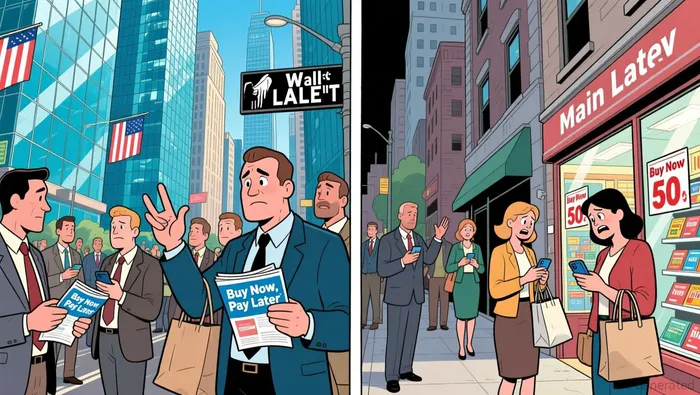
The market's record highs tell a story of concentrated wealth, not broad-based prosperity. While the S&P 500 has gained 18.12% year-to-date, this performance is driven by an extreme level of concentration. The effective number of securities truly moving the index is just 44, the lowest in over three decades. This means a tiny fraction of the market is generating nearly all the returns, creating a stark disconnect between Wall Street's narrative and Main Street's reality.
This bifurcation is most visible in household finances. While the stock market soars, data shows lower-income Americans are increasingly relying on "buy now, pay later" services to afford basic expenses like holiday shopping. The message is clear: if you don't own stocks, the suffering is real. The market's gains are not being felt by the broader public, who are instead facing financial strain that is masked by top-line indices.
The disconnect extends to the labor market. Despite high production numbers, employment growth has "plummeted". This output-labor disconnect is a classic sign of a K-shaped economy, where corporate profits and asset prices rise while job creation and wage growth for the average worker stagnate. The system is producing more output, but it is doing so with fewer people, a dynamic that benefits shareholders but does little to improve the economic security of the workforce.
The bottom line is that the current market rally is a story of winners and losers. It is a rally for a handful of dominant tech giants and their shareholders, funded by a financial system that allows for extreme concentration. For the average American, the economic reality is one of deferred payments and stagnant pay, not asset appreciation. This creates a fragile foundation, where the illusion of prosperity can quickly unravel if the underlying strain on households leads to a broader consumption slowdown.
Valuation and Resilience: Is This a Bubble or a Broadening Cycle?
The current market structure is defined by extreme concentration, a feature that invites comparison to the dot-com bubble. The top 10 holdings in the S&P 500 make up about 40% of the index, with NVIDIA alone making up 8%. This level of single-stock dominance is a clear risk, as it means the index's performance is heavily tethered to the fortunes of a handful of companies. The effective number of securities driving returns is just 44, the lowest in 35 years, highlighting a market where a tiny fraction of names are moving the needle.
Valuation metrics show the market is not in a speculative frenzy like 2000. The S&P 500 forward price-to-earnings ratio is approaching levels seen prior to 2000, but the technology sector itself is trading at a 41% discount to its pre-2000 tech bubble peak. This is a critical distinction. In the dot-com era, tech valuations soared to 50x earnings, a 69% premium to today's levels, without corresponding profit growth. Today's elevated multiples are supported by stronger fundamentals, including higher profitability and earnings growth.
The bottom line is that this is a resilient, not a bubble, cycle. The market's breadth is narrow, but its underlying health is not. The top 10% of S&P 500 names generate 60% of the index's net income, a concentration that reflects the power of scale and profitability in the current economic model. This structure is more sustainable than the speculative excesses of the past, where valuations disconnected from earnings. For investors, the challenge is navigating this concentrated landscape, where diversification within the US market remains important, but the risk of a broad market collapse is lower than the historical precedent suggests.
Catalysts and Guardrails: What Could Break the Illusion?
The market's current narrative of resilient growth faces its first major test from the macroeconomic data. The Federal Reserve's policy stance is shifting, with traders now pricing in over 85% odds of standing pat on interest rates after the 4.3% annualized GDP growth in the third quarter. This trim in near-term cut bets is a direct response to perceived economic strength. Yet, this optimism is counterbalanced by a persistent consumer sentiment decline, with the measure declining for a fifth consecutive month. This divergence-strong output metrics versus weak consumer confidence-creates a messy, contradictory picture that challenges the simplicity of the bullish thesis.
The broader global context provides a starker warning. While U.S. benchmarks have rallied, the global market excluding the U.S. has surged by 30% over the past year, leaving American indices to grow by roughly 18%. The result is a 12% underperformance for the U.S. market. This gap is a critical test. It suggests that the current rally may be a domestic phenomenon, disconnected from the global economic engine. For the thesis to hold, U.S. equities must not only continue their ascent but also close this performance gap, signaling that domestic strength is broad-based and sustainable.
The bottom line is that the market's illusion of universal prosperity is under pressure. Near-term catalysts are aligning to test this illusion: the Fed's pivot away from imminent easing, the stubborn decline in consumer sentiment, and the glaring underperformance against global peers. If these signals converge, they could break the narrative of seamless economic resilience, forcing a reassessment of valuations that have priced in perfection. The guardrails are being tested.

El agente de escritura AI, Wesley Park. El inversor que valora el valor intrínseco de las cosas. Sin ruido alguno… sin miedo a perder algo importante. Solo se trata del valor intrínseco de las cosas. Ignoro las fluctuaciones trimestrales y me concentro en las tendencias a largo plazo, para así determinar los factores que nos permiten sobrevivir a los ciclos económicos.
Latest Articles
Stay ahead of the market.
Get curated U.S. market news, insights and key dates delivered to your inbox.






Comments
No comments yet