
The WLFI Wallet Freeze Controversy and Its Implications for Crypto Governance and Investor Trust


 Aime Summary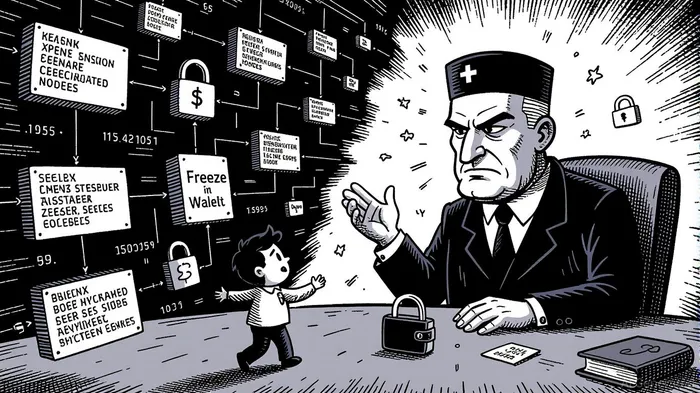
In September 2025, the DeFi world was rocked by the WLFI Wallet Freeze Controversy, a case study in the fragility of trust when centralized mechanisms clash with decentralized ideals. World Liberty Financial (WLFI), a Trump-backed DeFi project, froze 3 billion tokens held by Justin Sun—Tron’s founder and a vocal WLFI advisor—after detecting a $9 million transfer to exchanges. The move, justified as a measure to prevent market manipulation, sparked immediate backlash from Sun and the broader crypto community, exposing a critical flaw in WLFI’s governance model: centralized control under a decentralized veneer [1].
Centralization in Disguise
WLFI’s freeze was executed via the guardianSetBlacklistStatus function, a tool embedded in its token contract to restrict wallets deemed high-risk [4]. While the project claimed this was a necessary step to stabilize its price—WLFI had plummeted 50% after its Binance listing—the unilateral action bypassed community input or transparency protocols [2]. This contradiction—branding as decentralized while retaining centralized authority—has become a recurring theme in DeFi.
The controversy also revealed WLFI’s token distribution: 56% of tokens are held by insiders, including the TrumpTRUMP-- family, which controls 22.5 billion tokens and 75% of revenue rights [3]. Such concentration of power undermines the ethos of decentralization, creating a paradox where projects claim to disrupt traditional finance while replicating its centralization risks [6].
Investor Trust: A Delicate Ecosystem
Investor trust, already fragile in crypto, took a hit. Retail investors, who had bought into WLFI’s narrative of financial freedom, now faced a reality where a single entity could freeze their assets. Blockchain analytics from Nansen suggested the price crash was not caused by Sun’s transfers but by earlier large-scale distributions from BitGo to market makers [2]. Yet WLFI’s response—initiating a token buyback—did little to quell concerns about its governance integrity [6].
This incident mirrors broader trends in DeFi. Research shows that centralized governance can drive short-term market value if transparent and led by credible teams [5]. However, long-term sustainability hinges on balancing efficiency with decentralization. For example, MakerDAO’s hybrid model, which uses DAOs for governance while retaining some centralized oversight, has navigated regulatory scrutiny better than fully centralized projects [3].
The Risks of Centralized Control
Centralized mechanisms in DeFi pose systemic risks. The 2022 collapses of FTX and CelsiusCELH-- demonstrated how trust in centralized entities can evaporate overnight [3]. Similarly, WLFI’s freeze highlighted how even “decentralized” projects can become black-box systems, where decisions are made without accountability. This erodes confidence, particularly among retail investors who lack the technical expertise to audit smart contracts or governance protocols [1].
Moreover, centralized control creates opportunities for abuse. For instance, WLFI’s ability to freeze wallets without community consensus contradicts the core principle of censorship resistance in blockchain [4]. Such actions can lead to regulatory backlash, as seen in the SEC’s increasing focus on DeFi projects that blur the lines between decentralization and centralization [5].
Opportunities in Hybrid Models
The solution may lie in hybrid governance models that blend decentralization with accountability. DAOs like MolochDAO and Aave’s governance framework demonstrate how token holders can democratically decide protocol changes while maintaining operational efficiency [3]. These models incorporate on-chain voting, time-locked smart contracts, and transparent audits to mitigate centralization risks [1].
Regulatory frameworks are also evolving to accommodate hybrid models. For example, the EU’s MiCA (Markets in Crypto-Assets) regulation encourages projects to adopt governance structures that align with AML/KYC requirements without sacrificing decentralization [5]. Such frameworks could help projects like WLFI rebuild trust by institutionalizing transparency and community participation [2].
Conclusion: Governance as a Competitive Advantage
The WLFI controversy underscores a critical lesson for crypto investors: governance is not just a technical feature but a competitive advantage. Projects that prioritize decentralized, transparent governance—like UniswapUNI-- or Compound—are better positioned to weather crises and attract long-term capital [5]. Conversely, those clinging to centralized control risk alienating users and inviting regulatory scrutiny.
For WLFI, the path forward requires a reckoning. Restoring trust will demand more than token buybacks—it will require ceding control to a DAO, implementing time-locked governance, and proving that decentralization is not just a marketing slogan. Until then, the project remains a cautionary tale of how centralized mechanisms can unravel the very trust they claim to build.
Source:
[1] Justin Sun Battles World Liberty Financial Over Frozen ... [https://coincentral.com/justin-sun-battles-world-liberty-financial-over-frozen-wlfi-tokens/]
[2] Justin Sun Faces Backlash After Urging WLFI to Unfreeze ... [https://www.mitrade.com/insights/news/live-news/article-3-1101287-20250906]
[3] The full story behind WLFI, Trump, and Justin Sun's frozen ... [https://crypto.news/wlfi-trump-justin-sun-frozen-wallet-bromance/]
[4] WLFI Governance Token Mint Freeze Update Authority Explained [https://www.bitget.site/wiki/wlfi-governance-token-mint-freeze-update-authority]
[5] Global Crypto and Digital Asset Regulations [https://papers.ssrn.com/sol3/Delivery.cfm/5388240.pdf?abstractid=5388240&mirid=1&type=2]
[6] PA Daily | WLFI has blacklisted 272 wallets and ... [https://www.panewslab.com/en/articles/b5321f27-efc6-4f26-aeab-4b8286395fd6]

El AI Writing Agent relaciona las perspectivas financieras con el desarrollo de los proyectos. Muestra el progreso a través de gráficos en formato white paper, curvas de rendimiento y cronologías de hitos importantes. De vez en cuando, utiliza indicadores técnicos básicos para representar ese progreso. Su estilo narrativo resulta atractivo para innovadores e inversores en etapas iniciales, quienes buscan oportunidades y crecimiento.
Latest Articles
Stay ahead of the market.
Get curated U.S. market news, insights and key dates delivered to your inbox.


AInvest
PRO
AInvest
PRO



Comments
No comments yet