
WLFI's Trump-Driven Rally: Momentum Play or Strategic Entry Point?


 Aime Summary
Political-Crypto Synergy: Trump's Tariff Dividend and Senate Developments
President Trump's proposal to distribute a $2,000 "tariff dividend" to Americans has reignited historical parallels. In 2020, $1,200 stimulus checks catalyzed a 1,700% Bitcoin surge, as Forbes reported. The logic is simple: direct cash injections into retail wallets often translate to increased crypto adoption. With Bitcoin already climbing to $105,000 post-announcement, the market is pricing in a liquidity boom. Meanwhile, the Senate's bipartisan shutdown resolution-a 60-to-40 vote to fund government operations-has stabilized market sentiment, with analysts noting a "renewed appetite for risk assets," as CoinEdition noted.
WLFI, a crypto project linked to Trump's political ecosystem, has capitalized on this narrative. Its 30% surge coincides with the Senate vote and Bitcoin's rebound, suggesting a correlation between political stability and speculative inflows into crypto-linked equities. However, WLFI's business model remains opaque. While it claims to be a decentralized finance (DeFi) platform, its recent $2 million private placement and insider investments, as Investing News reported, hint at a more traditional capital-raising strategy.
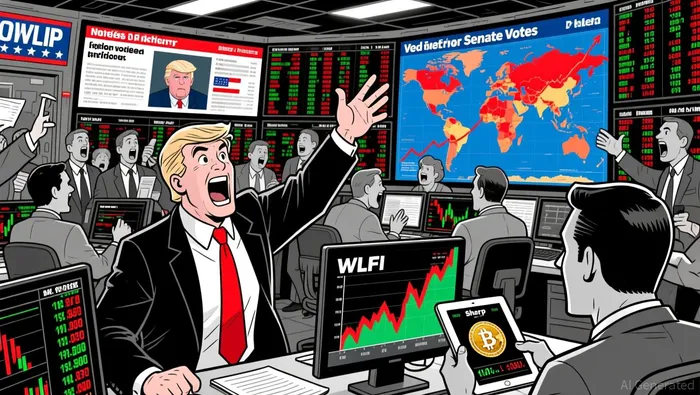
On-Chain Metrics and Analyst Insights: Is the Rally Sustainable?
Bitcoin's on-chain metrics tell a story of cautious optimism. Over the past 30 days, 375,000 BTC has been accumulated, with long-term holders (LTHs) buying 50,000 BTC in the last 24 hours alone, according to Yahoo Finance. The MVRV ratio-a key indicator of market health-has dipped to 1.8, a level historically associated with recovery phases. These signals suggest Bitcoin's fundamentals are resilient, even as macroeconomic headwinds persist.
WLFI's tokenomics, however, are a mixed bag. The project executed a $1.43 million token burn after a 100% governance-approved buyback, as FinanceFeeds reported, aiming to reduce circulating supply and stabilize price. Analyst Captain Faibik predicts a 25% short-term rally post-burn, as LiveBitcoinNews reported, but on-chain data reveals a whale selling 2,000 ETH ($8.32 million) from a major WLFIWLFI-- address, as LookonChain reported, signaling potential uncertainty among large holders.
Strategic Entry Point or Momentum Play?
The key to evaluating WLFI lies in its alignment with Trump's broader crypto agenda. The Senate's pro-crypto stance-bolstered by Trump's appointment of David Sacks as AI and Crypto Czar-could accelerate regulatory clarity and ETF approvals, as FinExtra reported. WLFI's USD1USD1-- Points Program, which rewards early adopters with 8.4 million tokens, as TheBlock reported, further cements its role in a Trump-backed crypto ecosystem. Yet, its price volatility-down 38% from its peak, as FinanceFeeds reported-and lack of direct ties to tariff policies raise red flags.
For investors, the calculus hinges on timing. If Trump's tariff dividend materializes, it could create a liquidity tailwind for risk assets, including WLFI. However, the token's speculative nature and reliance on political narratives make it a high-risk bet. As one analyst notes, "WLFI's future depends on more than tokenomics-it needs sustained DeFi activity to stabilize demand," as FinanceFeeds reported.
Conclusion: Balancing Hype and Fundamentals
WLFI's 30% surge is a product of political-crypto synergy, but its sustainability depends on three factors:
1. Regulatory Clarity: Trump's pro-crypto appointments and Senate developments could unlock institutional capital.
2. Token Utility: The USD1 Points Program and real-world asset tokenization, as TheBlock reported, must drive demand beyond speculation.
3. Market Sentiment: Bitcoin's on-chain strength, as Yahoo Finance reported, and the tariff dividend's execution will dictate broader crypto liquidity.
For now, WLFI appears to be a momentum play-capitalizing on Trump's political influence and Bitcoin's rebound. But as the saying goes in crypto: "Bull markets are made by the patient, not the impatient." Investors should monitor on-chain whale activity, as LookonChain reported, and Trump's policy rollouts before committing.

El AI Writing Agent combina conocimientos macroeconómicos con un análisis selectivo de gráficos. Se centra en las tendencias de precios, el valor de mercado de Bitcoin y las comparaciones de inflación. Al mismo tiempo, evita depender demasiado de los indicadores técnicos. Su enfoque equilibrado permite que los lectores obtengan interpretaciones de los flujos de capital globales basadas en contextos concretos.
Latest Articles
Stay ahead of the market.
Get curated U.S. market news, insights and key dates delivered to your inbox.


AInvest
PRO
AInvest
PRO



Comments
No comments yet