
WLFI Token Volatility: Insider Risk, Market Dynamics, and Governance Concerns


 Aime Summary
The launch of the Trump-backed WLFI token in September 2025 has ignited a firestorm of debate among investors, regulators, and crypto analysts. While the token’s association with political influence and its ambitious market cap of $7 billion at launch [4] initially drew speculative interest, its trajectory has been marred by extreme volatility, governance centralization, and regulatory scrutiny. This article examines the long-term viability of WLFI through the lens of insider ownership concentration, market dynamics, and structural governance risks, drawing on recent data and regulatory developments.
Insider Ownership: A Double-Edged Sword
WLFI’s token supply is dominated by a small group of insiders, with the TrumpTRUMP-- family holding between 22.5% and 24.6% of the total 24.67 billion tokens [1][2]. This concentration of ownership—far exceeding the 16.6% insider allocation of EthereumETH-- and 20% of CardanoADA-- [1]—raises red flags for decentralized governance. The Trump family’s control extends beyond token holdings: they also command 75% of net revenue from the project [2], creating a circular dynamic where financial incentives align with centralized decision-making.
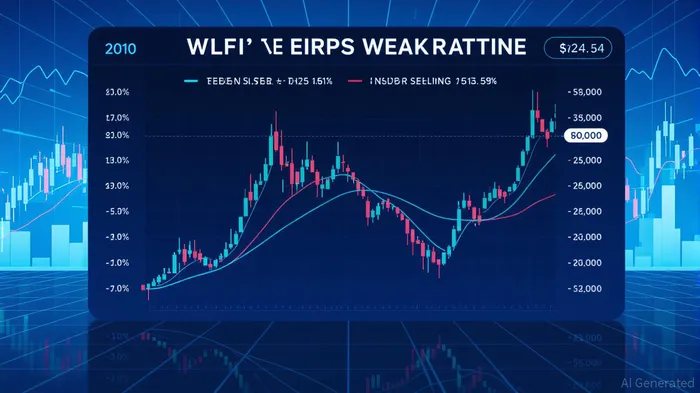
The token’s launch was further destabilized by rapid insider selling. Within 24 hours of trading, 698 million tokens were sent to exchanges, triggering a 26% price drop [4]. This behavior mirrors the collapse of celebrity-backed tokens like YZY and Libra, where governance centralization led to liquidity crises [2]. The Trump family’s stake, valued at $6–7 billion [3], amplifies concerns about market manipulation and conflicts of interest.
Market Dynamics: Liquidity and Speculative Pressure
WLFI’s liquidity structure is inherently fragile. At launch, 20% of presale tokens were unlocked for trading, while 80% remained locked until community governance votes [6]. However, a July 2025 community vote allowed early investors to trade 20% of their holdings, and a September 2025 unlock of 20% of the presale allocation (3.3 billion tokens) further diluted insider control [4]. These unlocks, while intended to stabilize the market, instead exacerbated volatility. For instance, the token surged to $0.32 before plummeting to $0.208 within hours of its debut [1], a pattern typical of speculative assets with weak fundamentals.
The token’s governance model compounds these risks. Despite claims of decentralized governance via a DAO, WLFI retains a “kill switch” mechanism allowing unilateral overrides during crises [4]. This centralization contradicts DeFi principles and invites regulatory pushback.
Regulatory Scrutiny: A Looming Threat
WLFI’s hybrid DeFi model—combining decentralized governance with a custodial USD1 stablecoin—has drawn intense scrutiny from the U.S. SEC and EU’s MiCA framework. The SEC is evaluating whether WLFI qualifies as a security under the Howey Test, which could force the project into compliance with stringent securities laws [1]. Meanwhile, MiCA is investigating WLFI’s governance structure and stablecoin operations, particularly its centralized elements [3].
The Trump family’s political influence adds another layer of complexity. Critics argue that WLFI’s governance centralization and ties to a politically active family create conflicts of interest, potentially undermining regulatory trust [7]. For example, a circular deal with Alt5 SigmaALTS-- generated $5 billion in paper gains for the Trump family [2], raising ethical concerns about transparency and fairness.
Long-Term Viability: A High-Risk Proposition
WLFI’s survival hinges on resolving its governance and regulatory challenges. The token’s reliance on centralized control—both in ownership and governance—undermines its credibility as a DeFi asset. While the Trump family’s financial stake could incentivize long-term stability, the same stake also creates incentives for short-term profit-taking, as seen in the rapid sell-offs post-launch [4].
Regulatory clarity is equally critical. If the SEC classifies WLFI as a security, the project would face compliance costs and operational restrictions that could stifle innovation. Conversely, a favorable regulatory outcome might legitimize WLFI as a hybrid DeFi asset, but only if governance centralization is addressed.
Conclusion
WLFI represents a high-risk, high-reward experiment in merging political capital with DeFi. Its insider concentration, speculative market dynamics, and governance centralization pose significant threats to long-term viability. While the token’s $5.78 billion market cap [4] suggests short-term momentum, investors must weigh these risks against the potential for regulatory intervention and market correction. For WLFI to endure, it must transition from a politically driven token to a transparent, decentralized asset—a transformation that remains uncertain.
**Source:[1] Trump-Backed WLFI Token's Volatility and Risks for Long-Term Investors [https://www.ainvest.com/news/trump-backed-wlfi-token-volatility-risks-long-term-investors-2509/][2] Circular Crypto Deals and Political Influence: The Trump-WLFI Windfall and Implications for Retail Investors [https://www.ainvest.com/news/circular-crypto-deals-political-influence-trump-wlfi-windfall-implications-retail-investors-2509-77/][3] Regulatory landscape of blockchain assets: Analyzing the [https://www.sciencedirect.com/science/article/pii/S2772485925000274][4] WLFI Token Unlock and Market Impact: Is September 1 a ... [https://www.ainvest.com/news/wlfi-token-unlock-market-impact-september-1-buy-signal-bear-trap-2509/]

Decoding blockchain innovations and market trends with clarity and precision.
Latest Articles
Stay ahead of the market.
Get curated U.S. market news, insights and key dates delivered to your inbox.






Comments
No comments yet