
WLFI Token Unlock: Assessing Volatility as a Strategic Opportunity


 Aime Summary
The recent WLFI token unlock event has ignited a surge in market activity, with derivatives volume spiking 530% to $4.6 billion and open interest nearing $950 million [1]. This volatility, while daunting, presents a unique opportunity for investors who understand how to leverage derivatives and governance participation to mitigate risks and capitalize on high-return potential.
Volatility as a Double-Edged Sword
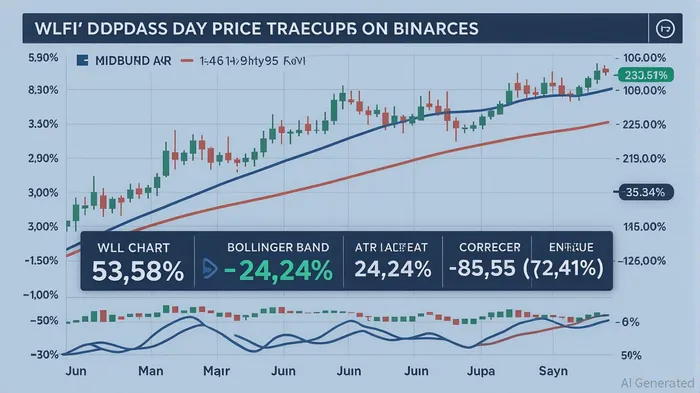
WLFI’s historical volatility underscores its potential for both reward and risk. Over the past quarter, the token has experienced daily price swings of 4-8% under normal conditions, with spikes to 15-20% during major news events [1]. For instance, a 53.58% surge on Binance within 30 days was followed by a 24.24% correction, illustrating the token’s susceptibility to liquidity and governance-driven price swings [4]. These dynamics make WLFI a prime candidate for derivative strategies.
Derivatives markets have already responded to this volatility. Open interest in WLFI derivatives reached $1 billion, while trading volume exceeded $8 billion, reflecting intense speculative activity [3]. Traders can use futures contracts to hedge against downside risk or options to profit from directional bets. For example, a long call option could lock in gains during upward trends, while a short put might capitalize on corrections. Technical indicators like the 14-day Average True Range (ATR) and BollingerBINI-- Band Width can further refine entry and exit points [1].
Governance as a Risk Mitigation Tool
Beyond derivatives, active participation in WLFI’s governance model offers a strategic edge. At launch, only 24.67% of the total 100 billion token supply was tradable, with the remaining 80% locked and subject to community governance votes [1]. This structure allows tokenholders to influence unlock schedules, balancing short-term liquidity gains with long-term stability. For instance, delaying unlocks during periods of high volatility could prevent oversupply-driven sell-offs, preserving value for long-term holders.
However, governance participation is not without risks. The flexibility of the model means unlock conditions can be altered via future votes, introducing uncertainty [1]. Investors must weigh the potential for governance-driven stability against the risk of abrupt changes. Those who align their strategies with governance outcomes—such as voting to stagger unlocks during low-volatility periods—can reduce exposure to sudden market shocks.
Strategic Synergy: Derivatives + Governance
The interplay between derivatives and governance creates a powerful framework for managing WLFI’s volatility. For example, during a governance vote to unlock tokens, derivatives traders could use options to hedge against potential sell-offs. Conversely, if governance decisions prioritize stability, derivatives markets might see reduced volatility, offering safer entry points for long-term investors.
Consider the September 1, 2025, unlock of 3.3 billion WLFI tokens, valued at $1.15 billion [2]. This event increased liquidity but also heightened short-term sell-off risks. Investors who anticipated this could have used short-term put options to protect against price drops. Meanwhile, those confident in the project’s governance model might have held tokens, betting on long-term value creation as community-driven unlock schedules stabilize supply.
Conclusion: Balancing Risk and Reward
WLFI’s volatility is neither a flaw nor a virtue—it is a feature of its governance-first design. For investors, the key lies in combining derivative tools with active governance participation. Derivatives provide immediate risk management solutions, while governance ensures alignment with long-term tokenomics. Together, they transform WLFI’s volatility from a liability into a strategic asset.
As the market evolves, those who master this dual approach will be best positioned to navigate WLFI’s unique challenges and opportunities.
**Source:[1] Assessing WLFI's Token Unlock and Derivatives Surge [https://www.ainvest.com/news/assessing-wlfi-token-unlock-derivatives-surge-high-risk-high-reward-defi-play-2509/][2] WLFI Token Unlock Event Generates Market Excitement [https://intellectia.ai/news/crypto/wlfi-token-unlock-event-sparks-market-anticipation][3] World Liberty Financial token unlock drives sentiment ... [https://www.mitrade.com/insights/news/live-news/article-3-1085990-20250901][4] WLFI's Volatility: Navigating Strategic Entry Points Amid ... [https://www.ainvest.com/news/wlfi-volatility-navigating-strategic-entry-points-binance-corrections-2508/]

Decoding blockchain innovations and market trends with clarity and precision.
Latest Articles
Stay ahead of the market.
Get curated U.S. market news, insights and key dates delivered to your inbox.






Comments
No comments yet