
WLFI Token Slumps 88% Amid Insider Selling Scrutiny and Political Backlash
 Aime Summary
- WLFI token has fallen 88% from its all-time high of $0.46, currently trading around $0.054, while broader cryptocurrency market capitalization rose by 6.8% in July.
- A World Liberty Financial-linked wallet recently deposited 170 million WLFIWLFI-- tokens, valued at approximately $9.17 million, into Binance, marking the second such transfer within a month.
- Investor skepticism is intensifying due to disclosures that President Donald Trump earned over $580 million from the platform, alongside legal disputes and concerns over centralized governance.
- Prominent crypto investors have publicly declined involvement, citing lack of viable products and insufficient industry understanding by key founders.
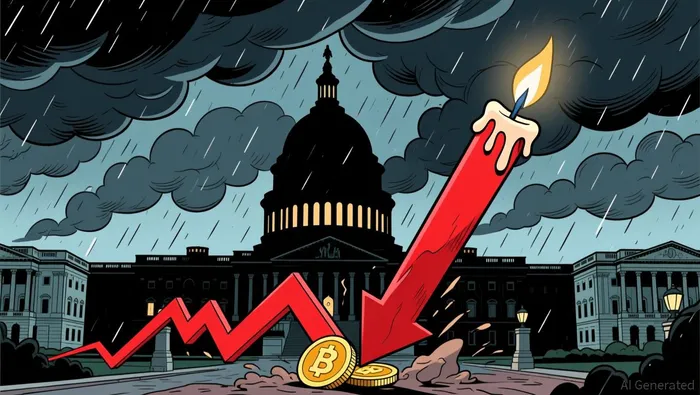
The governance token of World Liberty FinancialWLFI-- has significantly lagged the broader cryptocurrency market rally, failing to participate in the positive momentum observed across blue-chip assets like BitcoinBTC-- and EthereumETH-- . While the total crypto market capitalization increased by 6.8% in July, WLFI erased $6 billion in investor wealth since its peak. The token, which launched for trading in September 2025, experienced a brief initial spike before plummeting to its current level of $0.05426 . This underperformance highlights disconnect between political backing and its actual market performance and utility.
Why Is WLFI Dropping Despite The Crypto Rally?
Market sentiment has been heavily dampened by disclosures regarding the financial gains of the project's founders . President Donald Trump earned more than $580 million from World Liberty Financial, a decentralized finance platform co-founded by his sons . These financial revelations have fueled investor skepticism, particularly among major holders who face structural limitations on their investments .
AirdropAlert founder Morten Christensen noted that four-fifths of his holdings are locked in a two-year vesting period . This lock-up structure has led to doubts about the project's long-term potential and perceived value among retail investors . The combination of insider wealth disclosures and restrictive tokenomics has created a bearish environment that ignores broader market gains .
Compounding the negative sentiment are ongoing legal conflicts involving the project . World Liberty Financial filed a defamation lawsuit against cryptocurrency entrepreneur Justin Sun, who had previously sued the company alleging fraud and the illegal freezing of his token holdings . These legal tensions add to the uncertainty surrounding the project's operations and governance .
What Do Recent On-Chain Moves Signal?
On-chain data has revealed a recurring pattern of large WLFI transfers to centralized exchanges, raising concerns about potential selling pressure . A wallet associated with the World Liberty Financial team deposited 170 million WLFI tokens, valued at approximately $9.17 million, into Binance . This transaction represents second significant transfer from the same address to the exchange within a 29-day period.
Such large transfers to exchanges are typically interpreted by market participants as precursors to token sales or liquidity provisioning . While the exact intent remains unconfirmed, the recurring nature of these movements suggests a deliberate strategy that could impact token prices . Investors are monitoring these on-chain activities closely to gauge whether the project is managing its treasury or preparing for significant sell-side pressure .
The scrutiny over token distribution is further intensified by the project's governance structure . A significant portion of the token supply is allocated to insiders, leading to questions about centralization and the viability of its decentralized model . The top 100 wallets hold 98.74% of the supply, underscoring the concentration of control .
How Do Governance And Political Factors Impact WLFI?
WLFI faces significant regulatory and reputational challenges that extend beyond typical market volatility . Senate Democrats have introduced the Anti-Corruption Bureau Creation Act, which specifically cites President Donald Trump’s $1.4 billion in crypto income, including WLFI token sales . This legislative move elevates WLFI from a market speculation asset to a subject of high-stakes political scrutiny .
The project's governance model also faces skepticism due to its centralized 'Super Node' tier . This tier requires a stake of 50 million WLFI, locked for 180 days, granting top governance privileges . While designed to prioritize serious ecosystem partners, this capital-intensive structure underscores concerns about centralization and the project's commitment to decentralization .
High-profile criticism has further damaged public perception, with mainstream media segments labeling WLFI as a potential vehicle for funneling money . Additionally, prominent crypto investor Nic Carter publicly declined a stake in the venture, citing a lack of a real product and insufficient crypto knowledge among co-founders . This rejection from a diligent investor adds weight to the view that the token may continue to underperform despite its political associations .

Blending traditional trading wisdom with cutting-edge cryptocurrency insights.
Latest Articles
Stay ahead of the market.
Get curated U.S. market news, insights and key dates delivered to your inbox.


AInvest
PRO
AInvest
PRO




Comments
No comments yet