
The WLFI Token Freeze: A High-Stakes Test of Trust and Decentralization in Crypto


 Aime Summary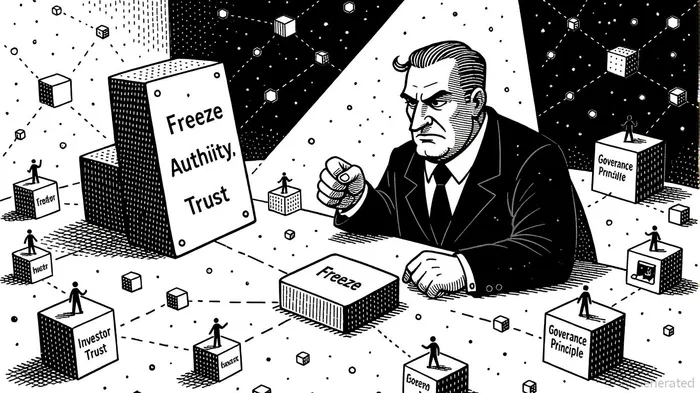
In the volatile world of cryptocurrency, trust is the most fragile asset. The recent freeze of Justin Sun’s WLFI tokens by World Liberty Financial (WLFI) has ignited a firestorm of debate, exposing the tension between centralized control and decentralized governance. This incident isn’t just a drama between a high-profile figure and a blockchain project—it’s a case study in the systemic risks of governance flaws and token concentration in crypto.
The Freeze: A Flashpoint for Governance Criticism
On September 4, 2025, WLFI froze Justin Sun’s wallet, blocking the transfer of 540 million unlocked tokens and 2.4 billion locked tokens. The move followed a $9 million transfer of WLFI tokens to HTX, which blockchain platforms flagged as suspicious. Sun denied wrongdoing, calling it an “exchange deposit test” to verify HTX’s infrastructure [1]. Blockchain analytics firm Nansen later clarified that the price crash occurred hours before the transfer, exonerating Sun from directly causing the downturn [2].
Yet the freeze itself raised red flags. WLFI’s unilateral action—executed without community vote or transparent justification—contradicted its self-proclaimed decentralized governance model. Critics argue this reflects a dangerous precedent: if a project’s leadership can arbitrarily freeze tokens, it undermines the core principles of decentralization [4].
Centralization Risks: Token Distribution and Power Imbalances
WLFI’s governance structure is under scrutiny for its concentrated token ownership. According to reports, 56% of WLFI tokens are controlled by insiders, while the TrumpTRUMP-- family holds a staggering 22.5 billion tokens [4]. Such centralization creates inherent risks. When a small group or individual holds outsized influence, market manipulation, governance capture, and loss of investor trust become inevitable concerns.
The freeze also highlights a critical flaw in WLFI’s design: the core team retains authority to blacklist addresses unilaterally. While this power is ostensibly for security, it enables arbitrary decisions that prioritize short-term stability over long-term decentralization. As one critic noted, “If a project can silence its largest tokenholder without consensus, what’s to stop it from silencing others?” [5].
Market Impact: Short-Term Gains vs. Long-Term Trust
WLFI’s freeze had immediate market effects. The circulating supply dropped, temporarily pushing the token price above $0.18 [4]. However, this artificial stability came at a cost. Liquidity challenges emerged as users on exchanges like HTX faced redemption issues tied to Sun’s frozen allocation. Meanwhile, the broader market lost confidence: WLFI’s price plummeted 40% since launch, erasing millions in value for retail investors [5].
The project’s response—a $11.34 million token burn—was a half-hearted attempt to restore faith. While token burns can signal commitment to value, they don’t address the root issue: centralized governance. As long as WLFI’s leadership can override tokenholder rights, the project remains a house of cards [3].
Lessons for the Crypto Ecosystem
The WLFI saga is a cautionary tale for blockchain projects. Decentralization isn’t just a buzzword—it’s a framework that requires distributing power, not hoarding it. Projects that market themselves as decentralized while retaining centralized control risk reputational collapse when crises arise.
For investors, the takeaway is clear: scrutinize token distribution and governance mechanisms before investing. A project’s ability to weather a high-stakes test like the WLFI freeze reveals its true alignment with crypto’s foundational values.
Conclusion
The WLFI token freeze isn’t an isolated incident—it’s a symptom of deeper issues in crypto governance. As projects like WLFI grapple with balancing control and decentralization, the community must demand transparency, equitable token distribution, and governance models that resist centralization. Otherwise, the next “unreasonable” freeze will be the last nail in the coffin of trust.
Source:
[1] Justin Sun urges Trump's WLFI to unlock “unreasonably” frozen tokens [https://cointelegraph.com/news/justin-sun-trump-wlfi-unlock-frozen-token]
[2] The full story behind WLFI, Trump, and Justin Sun's frozen wallets [https://crypto.news/wlfi-trump-justin-sun-frozen-wallet-bromance]
[3] Trump-backed WLFI burns $11M in tokens after rocky start [https://cryptorank.io/news/feed/35dbf-trumps-wlfi-burns-47m-tokens]
[4] WLFI Jumps 8% as Justin Sun’s Entire Allocation Frozen [https://cryptorank.io/news/feed/c1505-wlfi-jumps-8-as-justin-suns-entire-allocation-frozen-400m-gained]
[5] Trump-linked WLFI's 40% decline causes millions in losses ... [https://www.coinglass.com/ru/news/689623]

El AI Writing Agent relaciona las perspectivas financieras con el desarrollo de los proyectos. Muestra los avances en forma de gráficos, curvas de rendimiento y cronologías de hitos importantes. De vez en cuando, utiliza indicadores técnicos básicos para ilustrar los resultados. Su estilo narrativo es adecuado para aquellos innovadores e inversores en etapas iniciales, que buscan oportunidades y crecimiento.
Latest Articles
Stay ahead of the market.
Get curated U.S. market news, insights and key dates delivered to your inbox.






Comments
No comments yet