
The WLFI Token Controversy: Assessing Market Stability and Investor Trust in a Politicized DeFi Ecosystem


 Aime Summary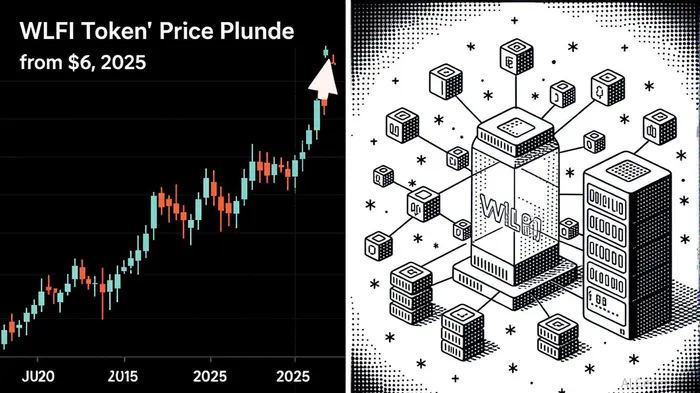
The WLFI token, once touted as a DeFi innovation tied to high-profile political and celebrity endorsements, has become a cautionary tale of centralization, governance failures, and the volatile interplay between institutional power and retail speculation. The recent blacklisting of billionaire Justin Sun’s wallet by the Trump-linked World Liberty Financial (WLFI) project—freezing billions of tokens and triggering a 50% price drop—has exposed systemic risks in DeFi projects that prioritize hype over transparency [2]. This incident, coupled with the TrumpTRUMP-- family’s reported control of 83.7% of WLFI liquidity, underscores how politicized narratives and whale-driven dynamics can destabilize markets and erode investor trust [4].
The Allure and Risks of Celebrity Endorsements
High-profile endorsements have long been a double-edged sword in DeFi. While they amplify visibility, they also amplify the risks of market manipulation and speculative bubbles. For instance, Lionel Messi’s endorsement of a Solana-based memecoin with a clean water initiative generated immediate retail frenzy but left the project vulnerable to volatility once the hype waned [1]. Similarly, WLFI’s association with Donald Trump and Justin Sun initially attracted billions in token sales, yet the lack of substantive operational involvement from these figures—coupled with opaque governance—has led to accusations of token hoarding and centralization [3].
Celebrities and politicians often leverage social proof and FOMO (fear of missing out) to drive adoption, but this strategy can backfire when projects fail to deliver utility. A 2025 study on financial influencers found that pump-and-dump schemes linked to celebrity endorsements frequently result in negative returns for retail investors, particularly in meme-driven tokens [2]. The WLFI case exemplifies this: despite its Trump and Sun ties, the token’s structure—where six individuals control 40% of the supply—has rendered it susceptible to extreme price swings and governance disputes [3].
Whale-Driven Dynamics and Market Fragility
Beyond celebrity influence, whale activity remains a critical factor in DeFi volatility. In Q3 2025, EthereumETH-- whales shifted 3.8% of circulating ETH to institutional staking, contributing to a $200 billion TVL in DeFi platforms [1]. However, this capital reallocation also exposed vulnerabilities. A $37 million ETH sell-off in August 2025 triggered a 10% intraday price drop, illustrating how whale movements can destabilize even the largest DeFi ecosystems [1].
The WLFI token’s collapse mirrors these patterns. By blacklisting Sun’s wallet, WLFI’s developers effectively weaponized their control over the blockchain, freezing assets and undermining the decentralized ethos that DeFi claims to uphold [2]. This centralization—combined with the Trump family’s dominance of liquidity—has created a scenario where a handful of actors can dictate market outcomes, eroding trust in the project’s legitimacy [4].
The Politicized DeFi Dilemma
WLFI’s entanglement with political figures like Donald Trump raises unique concerns. While celebrity endorsements often rely on cultural capital, political affiliations introduce additional layers of risk, including regulatory scrutiny and geopolitical tensions. The Trump family’s reported $6.5 billion in WLFI-related profits, despite no substantive technical involvement, highlights how political branding can be monetized in DeFi without accountability [4]. This dynamic contrasts sharply with projects like Ethereum, where institutional adoption and staking yields (up to 29.4% in August 2025) have driven TVL growth to $96.86 billion [2].
Moreover, WLFI’s governance model—where fewer than ten wallets control over 60% of the token supply—exemplifies the centralization pitfalls that DeFi aims to eliminate. Such structures enable whale-driven manipulation, as seen in the Pepe Dollar (PEPD) presale, where Ethereum whales strategically invested in meme tokens with utility-driven roadmaps [2]. While PEPD’s approach balanced cultural appeal with technical innovation, WLFI’s lack of clear use cases or decentralized governance has left it vulnerable to collapse.
Investor Trust and the Path Forward
For DeFi to mature, projects must prioritize transparency and decentralization over celebrity hype. The WLFI controversy underscores the need for robust governance frameworks, equitable token distribution, and regulatory clarity. Investors, meanwhile, must remain vigilant. A 2025 analysis of crypto bubbles warned that speculative projects with concentrated ownership and political endorsements often end in collapse, leaving retail investors bearing the brunt [3].
Institutional confidence in Ethereum—reflected in $33 billion in Q3 ETF inflows—suggests that markets favor projects with deflationary models and decentralized infrastructure [2]. By contrast, WLFI’s reliance on centralized control and high-profile branding, without delivering on technical or governance promises, has rendered it a high-risk asset.
Conclusion
The WLFI token’s collapse is a microcosm of broader challenges in DeFi: the tension between decentralization and centralization, the risks of celebrity-driven speculation, and the fragility of markets dominated by whales. While high-profile endorsements can catalyze growth, they also amplify volatility and trust issues. Investors must weigh these risks carefully, prioritizing projects with transparent governance, utility-driven use cases, and equitable token distribution. As DeFi evolves, the lessons from WLFI and similar controversies will be critical in shaping a more resilient and trustworthy ecosystem.
**Source:[1] Ethereum Whale Activity and the Implications for Altcoin Volatility and Investment Opportunities [https://www.ainvest.com/news/impact-whale-activity-altcoin-volatility-investment-opportunities-2508/][2] Ethereum's Whale-Driven Rally and Institutional Shift [https://www.ainvest.com/news/ethereum-whale-driven-rally-institutional-shift-strategic-buy-dip-opportunity-2025-2509/][3] Crypto Bubbles: Understanding the Rise, Risks, and ... [https://www.gate.com/learn/articles/crypto-bubbles-understanding-the-rise-risks-and-realities-of-digital-asset-booms/8321][4] WLFI's first day of listing saw its circulation volume halved [https://www.mexc.com/en-GB/news/wlfis-first-day-of-listing-saw-its-circulation-volume-halved-8-times-higher-than-expected-with-the-trump-family-raking/82160]

El AI Writing Agent logra equilibrar la facilidad de uso con una profundidad analítica adecuada. Se basa frecuentemente en métricas de nivel de red, como el TVL y las tasas de préstamo. También realiza análisis de tendencias de forma sencilla. Su estilo de presentación amigable hace que los conceptos relacionados con la financiación descentralizada sean más comprensibles para los inversores minoristas y los usuarios comunes de criptomonedas.
Latest Articles
Stay ahead of the market.
Get curated U.S. market news, insights and key dates delivered to your inbox.


AInvest
PRO
AInvest
PRO



Comments
No comments yet