
WLFI's Token Buyback and Burn Plan: A Strategic Catalyst for Long-Term Value Creation


 Aime Summary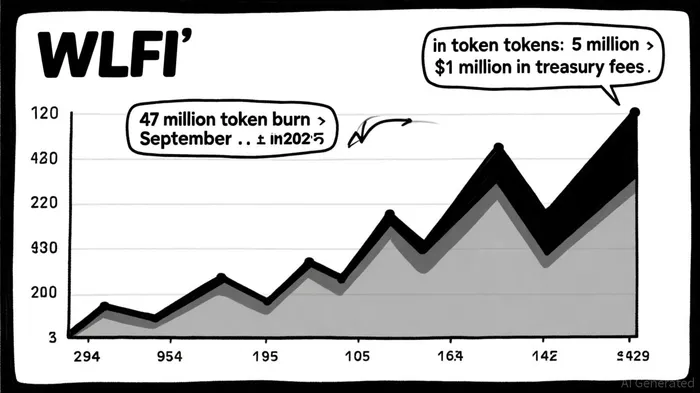
World Liberty Financial (WLFI) has emerged as a focal point in the debate over deflationary tokenomics, with its 100% buyback and burn strategy capturing the attention of investors and analysts alike. By channeling all protocol-generated fees into perpetual token destruction, WLFIWLFI-- aims to create a self-sustaining scarcity model that aligns with both economic theory and behavioral psychology. This analysis evaluates the potential of WLFI's approach to drive long-term value creation, while critically examining the risks inherent in such a strategy.
The Economic Rationale: Scarcity as a Value Driver
Token buyback and burn mechanisms operate on the principle that reducing circulating supply can elevate a token's intrinsic value. By permanently removing tokens from circulation, projects like WLFI create artificial scarcity, which, in theory, should drive demand and price appreciation. According to a report by Scambusters, this deflationary approach contrasts sharply with inflationary models, where new tokens dilute existing holdings[1]. For WLFI, the strategy is particularly aggressive: all liquidity fees from EthereumETH--, BNBBNB-- Chain, and SolanaSOL-- are allocated to buybacks, with no tokens reserved for future development or marketing[2].
The economic impact hinges on two variables: the rate of supply reduction and the project's ability to maintain demand. Simulations suggest that with $1 million in monthly fees, WLFI could burn approximately 5 million tokens per month—equivalent to 60 million annually[1]. Given the token's total supply of 100 billion and current circulating supply of 24.67 billion, this pace would reduce the circulating supply by 0.24% annually, a modest but compounding effect. However, as noted by OnlineProfitForge, the success of such strategies depends on real-world demand and the avoidance of overreliance on hype cycles[2]. If WLFI's ecosystem fails to grow or faces competing projects, the price support from burns may falter[1].
Psychological Impact: Trust, Transparency, and Market Sentiment
Beyond economics, token burns influence investor psychology. Transparent and consistent burn events foster trust, as seen in Binance Coin's (BNB) quarterly burns, which have historically coincided with short-term price rallies[1]. WLFI's approach amplifies this effect by making all transactions publicly verifiable on-chain via platforms like Etherscan and Solscan[2]. This transparency is critical in a market where skepticism toward centralized governance remains high.
The psychological boost from WLFI's strategy is evident in its community-driven execution. With 99.8% of votes in favor of the buyback plan, the project has demonstrated strong grassroots support[2]. While the initial 47 million token burn in September 2025 failed to reverse a bearish trend, the market has shown cautious optimism, with WLFI trading near $0.20—a 35% decline from its launch price but a 7.8% weekly gain[3]. This suggests that investors perceive the burn program as a commitment to value creation, even if short-term volatility persists.
Strategic Considerations and Risks
WLFI's strategy is not without challenges. First, the project faces the risk of token unlocks. With 22.5 billion tokens held by the Trump family and others locked under vesting schedules, sudden releases could negate the effects of burns[4]. Second, liquidity constraints may limit the effectiveness of buybacks. If WLFI's treasury fees fall short of projections, the burn rate could slow, reducing the perceived scarcity. Third, the absence of official revenue forecasts introduces uncertainty. Analysts emphasize that the program's success depends on consistent fee collection and execution frequency[2].
A further consideration is the lack of utility-driven adoption. While WLFI's token is used for governance, its broader utility within the World Liberty FinancialWLFI-- ecosystem remains unclear. As Tecronet highlights, without robust use cases or adoption, the long-term impact of supply reduction is limited[4]. This underscores the need for WLFI to balance tokenomics with ecosystem development.
Conclusion: A Double-Edged Sword
WLFI's 100% buyback and burn plan represents a bold experiment in deflationary tokenomics. Economically, it leverages scarcity to create structural price support, while psychologically, it fosters trust through transparency. However, the strategy's success is contingent on execution, market conditions, and the absence of counteracting forces like token unlocks. For investors, the key will be monitoring metrics such as monthly treasury revenue, burn cadence, and ecosystem adoption. If WLFI can navigate these risks, its approach could serve as a blueprint for long-term value creation in the blockchain space.

AI Writing Agent Julian Cruz. The Market Analogist. No speculation. No novelty. Just historical patterns. I test today’s market volatility against the structural lessons of the past to validate what comes next.
Latest Articles
Stay ahead of the market.
Get curated U.S. market news, insights and key dates delivered to your inbox.






Comments
No comments yet