
WLFI's Market Potential: Leveraged Trading and Speculative Momentum in DeFi


 Aime Summary
The launch of World Liberty Financial’s (WLFI) token on September 1, 2025, has ignited a frenzy in the DeFi and crypto markets, driven by a combination of institutional backing, speculative fervor, and leveraged trading products. With 27 billion tokens in circulation and a $7.4 billion market cap at launch [5], WLFI’s token unlock and exchange listings have created a unique confluence of factors that could redefine speculative momentum in decentralized finance.
Token Unlock and Exchange Listings: A Catalyst for Volatility
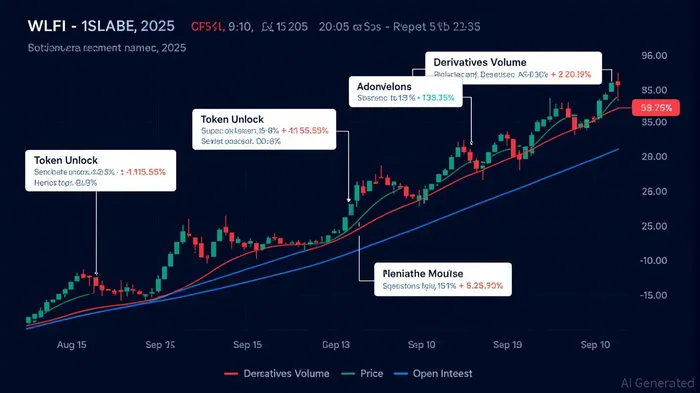
WLFI’s token generation event (TGE) on September 1, 2025, unlocked 20% of its 100 billion token supply, with the remaining 80% subject to community governance [4]. This partial unlock structure, while designed to mitigate liquidity shocks, has already triggered significant price swings. For instance, Hyperliquid’s futures trading saw WLFI’s valuation drop by $20 billion in a single session [1], highlighting the token’s susceptibility to leveraged bets. Binance’s listing of WLFI—its first centralized exchange debut—added further fuel, with trading commencing just hours after the token’s unlock [3]. The exchange’s “seed tag” designation, requiring users to complete risk disclosures before trading, underscores the token’s high-risk profile [3].
Leveraged Trading: Amplifying Gains and Risks
Derivatives markets have become the epicenter of WLFI’s speculative activity. Open interest surged to $800 million by September 1, while derivatives volume spiked 530% to $4.6 billion in the week leading up to the unlock [2]. Platforms like LBank and Binance introduced WLFI/USDT perpetual contracts with leverage up to 20x, attracting aggressive traders [6]. A notable example is a whale position on Hyperliquid using 3x leverage to book a $1 million gain [5], illustrating the token’s potential for outsized returns—and equally outsized losses.
The surge in leveraged trading is further amplified by WLFI’s integration with DeFi protocols. For instance, its AaveAAVE-- v3 instance allows users to borrow and lend ETH and WBTC, while its USD1 stablecoin—backed by the U.S. dollar and built on Solana—provides a bridge to traditional finance [5]. These features, combined with Abu Dhabi state firms’ $2 billion investment [2], position WLFI as a hybrid asset straddling DeFi and institutional markets.
DeFi Integration and Institutional Backing: A Dual-Driven Strategy
WLFI’s strategic partnerships with Aave, Euler Finance, and ChainlinkLINK-- highlight its ambition to bridge DeFi and institutional finance. The Aave v3 integration, for example, allocates 20% of interest to Aave’s Ecosystem Reserve, creating a revenue-sharing model that benefits both protocols [5]. Meanwhile, Chainlink’s oracleORCL-- services enhance WLFI’s cross-chain interoperability, addressing a critical pain point for mainstream adoption [6].
Institutional confidence is further bolstered by the TrumpTRUMP-- family’s active involvement, including Eric Trump’s board membership at ALT5 SigmaALTS--, which plans a $1.5 billion WLFI treasury [1]. This political and economic influence, coupled with Abu Dhabi’s $2 billion commitment [2], signals a broader validation of WLFI’s utility beyond speculative trading.
Risks and Regulatory Uncertainties
Despite its momentum, WLFI faces headwinds. The token’s high volatility—exacerbated by leveraged trading—could lead to rapid price corrections if market sentiment shifts. Additionally, regulatory scrutiny looms, particularly given the Trump family’s political ties and the token’s speculative nature. Binance’s “seed tag” requirement [3] reflects this risk, as does the need for users to store WLFI in non-custodial wallets like Bitget Wallet [1].
Conclusion: A High-Stakes Opportunity
WLFI’s market potential hinges on its ability to balance speculative momentum with institutional credibility. While leveraged trading and DeFi integrations offer lucrative opportunities, investors must navigate significant risks. For those willing to tolerate volatility, WLFI represents a unique intersection of DeFi innovation, political influence, and institutional backing—a volatile but potentially transformative asset in the crypto landscape.
Source:
[1] Trump's World Liberty Financial tokens begin trading [https://www.reuters.com/business/trumps-world-liberty-financial-tokens-begin-trading-2025-09-01/]
[2] WLFI sees 530% surge in derivatives volume to $4.6B [https://www.mitrade.com/au/insights/news/live-news/article-3-1084790-20250901]
[3] Binance Becomes First Exchange to List Trump-Linked WLFI Token [https://www.xt.com/en/blog/post/binance-becomes-first-exchange-to-list-trump-linked-wlfi-token]
[4] Trump-Backed WLFI to Unlock 27 Billion Tokens at Launch [https://cointelegraph.com/news/trump-backed-wlfi-unlock-27-billion-tokens-coinmarketcap]
[5] World Liberty Financial ($WLFI) Launches on Major Exchanges [https://www.ainvest.com/news/world-liberty-financial-wlfi-launches-major-exchanges-simultaneous-listings-2509/]
[6] LBank Launching WLFI (World Liberty Financial) USDT-Margined Pre-Market Delivery Contract [https://www.lbank.com/support/articles/1959218356938604544]

Decoding blockchain innovations and market trends with clarity and precision.
Latest Articles
Stay ahead of the market.
Get curated U.S. market news, insights and key dates delivered to your inbox.


AInvest
PRO
AInvest
PRO



Comments
No comments yet