
WLFI's Market Impact and Strategic Implications for DeFi Governance Tokens


 Aime Summary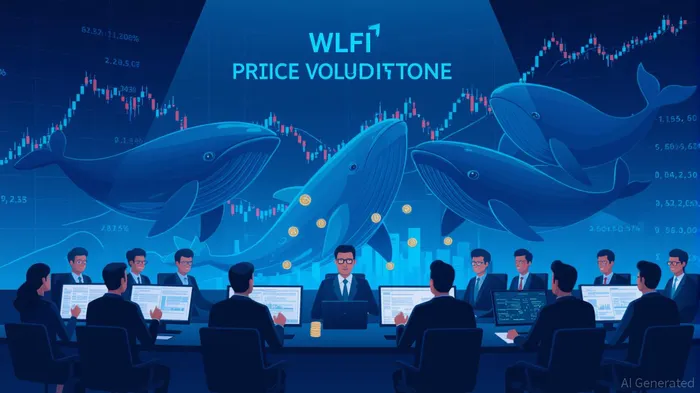
World Liberty Financial’s WLFI token has emerged as a polarizing force in the DeFi landscape, blending political influence, institutional backing, and speculative fervor. Launched with a $8.7 billion market cap and a total supply of 100 billion tokens, WLFI’s rapid ascent to the 27th-largest crypto asset underscores its disruptive potential. However, its trajectory is marred by extreme volatility, centralized governance, and regulatory uncertainty, raising critical questions about its role in shaping the future of DeFi governance tokens [6].
Volatility: A Double-Edged Sword
WLFI’s 30-day price swings exceeding 150% in 2025 highlight its volatility as both an opportunity and a risk [1]. This turbulence is amplified by the token’s structured unlock mechanism: 27 billion tokens (27% of the max supply) were in circulation at launch, with 80% locked in a governance-controlled “Lockbox” to prevent dumping [5]. While this aims to stabilize liquidity, it introduces uncertainty as tokens gradually become tradable. Whale activity further destabilizes the market, with outflows of $20 million and $7 million in July and August 2025, respectively, triggering sharp price corrections [1]. Derivatives markets reflect this chaos, with open interest peaking at $950 million before retreating to $887 million, signaling leveraged positions amplifying losses [5].
Liquidity Dynamics: Thin Order Books and Strategic Buybacks
WLFI’s liquidity profile is a mixed bag. While its listing on Binance, Kraken, and HTX provides broad access, thin order books make it susceptible to large trades disrupting price equilibrium [4]. To counter this, World Liberty Finance’s multisig executed a $2 million USD1 buyback of 6.498 million tokens, averaging $0.308 per token. Such on-chain buybacks signal strategic value retention but may not offset broader liquidity risks [6]. The token’s integration with USD1—a stablecoin backed by U.S. Treasuries—adds a layer of stability, yet a brief de-peg event in 2025 exposed fragility in this model [6].
Governance: Centralization and Regulatory Scrutiny
WLFI’s governance model is a focal point of controversy. The TrumpTRUMP-- family holds a 37.5% stake, while institutional investors like Alt5 SigmaALTS-- own 8%, creating a centralized power structure [4]. Community governance votes exist, but token concentration raises concerns about decision-making bias. Regulatory bodies are also scrutinizing WLFI: the SEC is evaluating its compliance with the Howey Test, while the EU’s MiCA framework demands transparency in tokenomics [3]. These pressures could lead to delistings or legal challenges if WLFI is classified as a security [1].
Strategic Implications for DeFi Governance Tokens
WLFI’s case offers lessons for the broader DeFi ecosystem. Its volatility and governance flaws exemplify the risks of blending political influence with decentralized finance. For investors, the token represents a high-velocity opportunity, with derivatives volume surging 400% to $3.13 billion [1]. However, position sizing and leverage management are critical—experts recommend capping leverage at 2x to mitigate losses [1]. On-chain metrics like NVT ratios and whale activity should be monitored to anticipate liquidity-driven movements [4].
Conclusion: A Paradox of Hype and Risk
WLFI embodies the paradox of modern crypto investing: institutional backing and ambitious use cases coexist with volatility, centralization, and regulatory uncertainty. Its success will hinge on the stability of USD1, the effectiveness of its DeFi platform, and the resolution of regulatory inquiries. For risk-tolerant investors, WLFI is a speculative bet on Trump’s political influence and institutional confidence. For others, it serves as a cautionary tale of how governance flaws and hype can amplify crypto’s inherent risks.
Source:
[1] World Liberty Financial's WLFI Open Interest Tops $800 [https://www.mitrade.com/insights/news/live-news/article-3-1082960-20250831]
[2] WLFI: A High-Velocity Launch in DeFi Backed by Trump ... [https://www.ainvest.com/news/wlfi-high-velocity-launch-defi-backed-trump-institutional-capital-2509/]
[3] Trump family's World Liberty Financial token starts trading on exchanges with 30 billion plus valuation [https://www.theblock.co/post/368920/trump-familys-world-liberty-financial-token-starts-trading-on-exchanges-with-30-billion-plus-valuation]
[4] The Volatility Trap: How Whale Activity and Thin Order ... [https://www.ainvest.com/news/volatility-trap-whale-activity-thin-order-books-redefining-crypto-risk-management-2508/]
[5] World Liberty Financial (WLFI) Token Launching on Bitrue September 1st [https://www.theblock.co/post/368938/world-liberty-financial-wlfi-token-launching-on-bitrue-september-1st]
[6] $WLFI On-Chain Buyback: World Liberty Finance Multisig Purchases 6.498M Tokens for $2M USD1 at $0.308 Average in 1 Hour [https://blockchain.news/flashnews/wlfi-on-chain-buyback-world-liberty-finance-multisig-purchases-6-498m-tokens-for-2m-usd1-at-0-308-average-in-1-hour]

Decoding blockchain innovations and market trends with clarity and precision.
Latest Articles
Stay ahead of the market.
Get curated U.S. market news, insights and key dates delivered to your inbox.


AInvest
PRO
AInvest
PRO



Comments
No comments yet