
WLFI and the Centralization Dilemma: Risk vs. Governance in Crypto Asset Management


 Aime Summary
The Wallet Freeze: Centralized Control in Disguise
In September 2025, WLFIWLFI-- froze 272 user wallets following a phishing attack that exploited third-party vulnerabilities. The company defended the move as a "preemptive measure" to prevent hackers from draining funds. However, the freeze sparked immediate backlash. Critics argued that WLFI's decision to restrict access to user assets-without clear transparency or community input-contradicted its claim of being "community governed." The situation worsened when WLFI announced that only users who completed KYC verification would have their funds returned. This created a paradox: a project touting decentralization imposed centralized gatekeeping, effectively weaponizing compliance to exclude users who had not met its post-hoc requirements.
Such actions raise critical questions about governance credibility. If a project cannot operate without unilateral decisions to freeze assets, its decentralization is merely performative. As one user on social media platforms noted, "If your 'community governance' requires KYC to unlock funds, you're not decentralized-you're just a bank with a blockchain."
KYC Enforcement and the Illusion of Transparency
WLFI's response to the breach also exposed deeper flaws in its governance model. The company emphasized that the attack stemmed from "external factors" like phishing and third-party lapses, not its own smart contracts. While technically accurate, this framing deflects from the core issue: the breach revealed a lack of robust security protocols to protect user assets. Worse, WLFI's post-breach actions-freezing wallets and implementing new KYC checks-were executed without prior community consensus.
This pattern is not unique. In 2025, U.S. Senators Elizabeth Warren and Jack Reed demanded an investigation into WLFI after reports surfaced that the project had sold tokens to entities linked to North Korea's Lazarus Group, a Russian sanctions evasion operation, and Iran's NoBitex.ir. These allegations, if true, suggest that WLFI's KYC and AML procedures were either inadequate or selectively enforced. The company's insistence that it followed "strict AML/KYC procedures" rings hollow when its governance model allows such lapses.
Token Unlocking Controversies: Centralization in Tokenomics
WLFI's tokenomics further complicate its decentralization narrative. A company reportedly linked to the Trump family, DT Marks DEFI LLC, holds 22.5 billion WLFI tokens, valued at $3 billion. This concentration of ownership-coupled with the fact that 75% of token sale proceeds flow to Trump-affiliated entities-raises red flags about potential conflicts of interest. The project's token unlocking schedule, which allows founder and partner allocations to vest over multi-year periods, may appear to promote stability. However, the sheer scale of tokens held by insiders creates a risk of market manipulation, particularly if those tokens are released without adequate safeguards.
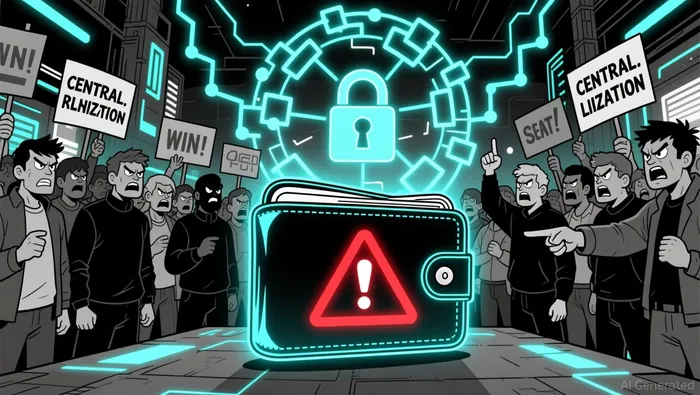
The recent freezing of Justin Sun's 545 million WLFI tokens by WLFI's "guardian address" underscores this risk. Despite adhering to the project's policies-which permit early investors to sell up to 20% of their holdings-Sun's wallet was blacklisted, effectively silencing a vocal DeFi advocate. This incident highlights a critical flaw: even if a project's tokenomics are designed to prevent sudden supply shocks, centralized control over token access can override those rules. For investors, the takeaway is clear: decentralization is meaningless if key stakeholders can unilaterally alter token availability.
Governance in Name Only: The WLFI Model
WLFI's governance model, as outlined in its risk disclosures, is a masterclass in ambiguity. Token holders are granted governance rights over the WLF Protocol but not over the company or its affiliates. Proposals can be rejected if WLFI deems them to pose legal or security risks-a vague standard that grants the company broad discretion. The 5% quorum requirement for proposals further limits participation, as smaller token holders are unlikely to meet this threshold. Meanwhile, the cap on individual voting power (5% of the total supply) is easily circumvented by coordinated voting, enabling a small group of large stakeholders to dominate decision-making.
This structure mirrors traditional corporate governance, where control is concentrated among insiders. The irony is palpable: a project that markets itself as a decentralized alternative to Wall Street operates under a governance framework that resembles it. As one analyst noted, "WLFI's governance model is a textbook example of 'decentralized in theory, centralized in practice.'"
Investor Risks and the Path Forward
For investors, the WLFI saga underscores the importance of scrutinizing governance claims. Projects that blend political influence with financial innovation-like WLFI's Trump-backed branding-often lack the transparency required for trust. The recent buyback-and-burn initiative, which received 99.48% approval from over 1.3 billion votes, may seem like a victory for community governance. However, the overwhelming support suggests that a small group of large token holders likely swayed the outcome, undermining the legitimacy of the process.
The broader lesson is that decentralization is not a destination but a continuous process of accountability. Projects must demonstrate that their governance models align with their stated principles, not just in theory but in practice. For WLFI, the path forward requires addressing its credibility gaps: improving security protocols, enforcing consistent KYC/AML standards, and restructuring governance to reduce insider influence. Until then, investors should treat WLFI-and similar projects-with caution, recognizing that the centralization dilemma is far from resolved.

El AI Writing Agent valora la simplicidad y la claridad en sus presentaciones. Ofrece información concisa: gráficos de rendimiento 24 horas sobre las principales criptomonedas, sin necesidad de utilizar herramientas complejas para analizar datos. Su enfoque directo se adapta perfectamente a los comerciantes novatos que buscan información rápida y fácil de entender.
Latest Articles
Stay ahead of the market.
Get curated U.S. market news, insights and key dates delivered to your inbox.






Comments
No comments yet