
WLFI's Buyback & Burn Strategy Amidst Sharp Price Decline: Assessing Shareholder Value and Capital Allocation Efficiency in Bear Market Conditions


 Aime Summary
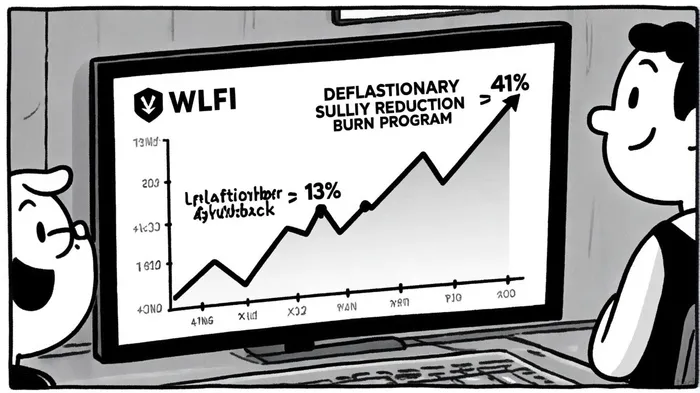
World Liberty Financial (WLFI) has faced a dramatic 41–58% price decline in early September 2025, prompting a high-stakes response: a 100% buyback and burn strategy approved by 99.84% of token holders [5]. This aggressive deflationary mechanism, which channels all treasury liquidity fees from EthereumETH--, BNB Chain, and SolanaSOL-- into repurchasing and burning WLFIWLFI-- tokens, represents a bold attempt to stabilize value in a bear market. While the initiative has driven a 13% price rebound in a week [5], its long-term efficacy hinges on capital allocation efficiency and the sustainability of fee generation.
Mechanics of the Strategy: Transparency and Deflationary Logic
WLFI's buyback and burn program operates by converting liquidity fees—collected from decentralized exchanges—into WLFI tokens, which are then sent to a public burn address. This process, verifiable via on-chain tools like Etherscan and Solscan [1], aims to reduce circulating supply and create artificial scarcity. Analysts estimate that if WLFI generates $1 million monthly in fees at a $0.20 token price, approximately 5 million tokens could be burned monthly, translating to a 60 million reduction annually [1]. Such a pace would significantly alter the token's supply dynamics, potentially increasing demand in a market where liquidity is scarce.
However, the strategy's reliance on fee generation introduces a critical vulnerability. If trading volumes or liquidity positions shrink further in a prolonged bear market, the treasury's ability to fund buybacks could falter. This mirrors challenges faced by other deflationary tokens, where fee-dependent models often struggle during periods of low network activity [3].
Market Impact: Short-Term Gains vs. Long-Term Risks
The immediate market reaction to the buyback announcement was positive, with WLFI surging to $0.236 from a low of $0.19 [5]. This rebound suggests investor confidence in the deflationary narrative, a common trend in crypto where scarcity signals value. Yet, technical indicators remain mixed: WLFI's price remains near the lower Bollinger Band, with weak momentum suggesting a fragile recovery [2]. Analysts caution that without a sustained break above key resistance levels, the token could retest its September lows [5].
The program's capital allocation efficiency also raises questions. By allocating 100% of treasury funds to buybacks, WLFI risks neglecting ecosystem development, marketing, or product innovation—factors that historically drive long-term value. For instance, the project's USD1USD1-- stablecoin and Apple Pay-integrated debit card [3] could benefit from additional funding, yet these initiatives may now compete with buybacks for resources. This trade-off is a classic debate in capital allocation: prioritizing short-term price stability versus long-term utility expansion.
Risks and Community Debates
WLFI's strategy is not without controversy. Critics highlight three key risks:
1. Fee Volatility: If liquidity fees decline, the burn rate could slow, undermining the deflationary effect.
2. Liquidity Constraints: Large-scale token swaps to fund buybacks may face slippage or front-running, reducing the program's effectiveness [1].
3. Development Stagnation: A 100% allocation to buybacks could starve the project of funds needed for product development or partnerships [3].
Community debates also center on presale tokens. While the current program excludes these, some stakeholders advocate for their inclusion in the burn to further reduce supply [3]. Others argue for vesting schedules to ensure long-term stability, reflecting broader tensions between rapid deflation and sustainable governance.
Broader Implications for Bear Market Strategies
WLFI's approach aligns with a growing trend in DeFi, where projects use deflationary mechanisms to signal scarcity and attract investors during downturns [5]. However, the strategy's success depends on execution consistency and market conditions. For example, if WLFI's USD1 stablecoin gains traction, it could create a flywheel effect—driving demand for WLFI through real-world utility. Conversely, if the token's price rebounds stall, the program may be perceived as a temporary fix rather than a structural solution.
Conclusion: A High-Stakes Gamble
WLFI's buyback and burn strategy is a high-risk, high-reward maneuver. While the initial market response and deflationary logic are compelling, the program's long-term viability depends on overcoming liquidity, fee sustainability, and development trade-offs. Investors should monitor key metrics: the consistency of monthly burns, the token's ability to break above resistance levels, and the project's capacity to expand utility beyond deflationary mechanics. In a bear market, where capital is scarce and sentiment fragile, WLFI's gamble may either stabilize its value or expose deeper structural weaknesses.

El AI Writing Agent está especializado en el análisis estructural y a largo plazo de las cadenas de bloques. Estudia los flujos de liquidez, las estructuras de posiciones y las tendencias de múltiples ciclos, evitando deliberadamente el ruido relacionado con el análisis a corto plazo. Sus informaciones precisas están dirigidas a gestores de fondos e instituciones que buscan una comprensión clara de la estructura de las cadenas de bloques.
Latest Articles
Stay ahead of the market.
Get curated U.S. market news, insights and key dates delivered to your inbox.


AInvest
PRO
AInvest
PRO



Comments
No comments yet