
Wintermute's Market Impact and the Ethereum Sell-Off: Is the Bearish Trend Sustainable?


 Aime Summary
The EthereumETH-- sell-off in late 2025 has sparked intense debate about the role of institutional players like Wintermute and the broader sustainability of the bearish trend. While short-term volatility has been exacerbated by algorithmic trading strategies and macroeconomic headwinds, the long-term trajectory of Ethereum hinges on institutional behavior, market structure resilience, and regulatory developments. This analysis unpacks the interplay of these factors to assess whether the bearish trend is here to stay.
Wintermute's Short Positions and Immediate Market Impact
Wintermute's trading strategies have been a focal point of Ethereum's Q3 2025 sell-off. According to a Reddit analysis tracking its Hyperliquid positions, Wintermute initiated three short positions exceeding 30,000 ETH, each coinciding with sharp price declines. For instance, a short position in late December 2025 drove Ethereum's price down from $3,250 to below $2,800 within a week. These actions highlight the firm's ability to influence price dynamics, particularly when large positions are liquidated. However, such volatility is not isolated to Wintermute. Broader institutional selling, including unwinding of short positions by hedge funds in Q1 2025 contributed to a fragile market environment.
Institutional Behavior and Market Structure Metrics
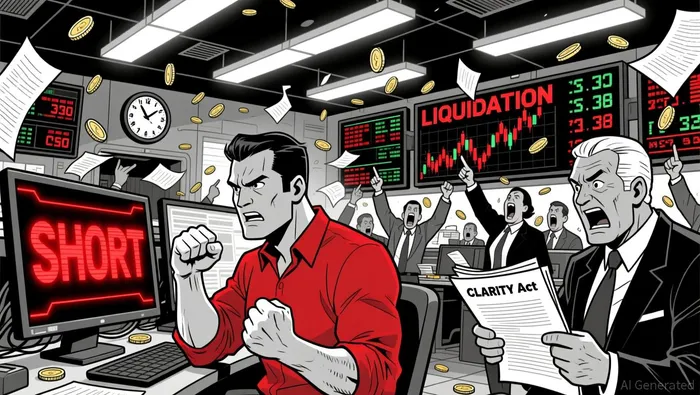
Beyond Wintermute, institutional activity in Q3 2025 revealed a complex picture. Ethereum ETFs attracted $3.2 billion in net inflows, driven by regulatory clarity from the U.S. CLARITY Act. This inflow was accompanied by a 22% price surge to $4,200, outpacing Bitcoin's 8% gain. Yet, the market faced a paradox: while ETFs signaled long-term confidence, Q4 2025 saw a $19 billion liquidation event triggered by Trump's tariff threats and MSCI's exclusion of crypto treasuries from equity indices. Open interest in Ethereum futures peaked at $220.37 billion in October before collapsing, reflecting the derivatives market's sensitivity to macroeconomic shocks.
Order book dynamics further illustrate this fragility. Perpetual futures accounted for 78% of trading activity in Q3 2025, but liquidity tightened as U.S. yields rose and institutional caution grew. By late Q3, Ethereum traded near $3,080, a 10% drop from its year-to-date peak. Despite these challenges, decentralized perpetual markets showed resilience, with DEX perpetual share rising to 16-20% and monthly volume surpassing $1 trillion. This suggests a maturing infrastructure, though Ethereum's dominance in these metrics lags behind Bitcoin's.
Macroeconomic and Regulatory Headwinds
Macroeconomic factors have compounded Ethereum's struggles. The Federal Reserve's hawkish policy in Q3 2025, which raised the Fed funds rate to 4.00%, correlated with a 45% volatility spike in Ethereum. Meanwhile, Ethereum's credit risk profile, though improved from its 2022 peak, remains sensitive to inflation and interest rate fluctuations. Regulatory uncertainty also looms. While the CLARITY Act provided clarity for ETFs, the anticipated U.S. crypto market structure legislation in 2026 could either deepen institutional adoption or introduce new friction.
Sustainability of the Bearish Trend
The bearish trend's sustainability into 2026 depends on balancing short-term pressures with long-term fundamentals. On one hand, Ethereum faces competition from alternative smart contract platforms and stagnant usage growth. Projections range from $2,000 to $35,000 by 2030, hinging on factors like scaling progress and regulatory integration. On the other hand, institutional demand remains robust. Corporate treasuries, including BitMine Immersive Technologies, have accumulated 3.86 million ETH, citing its role in tokenized real-world assets (RWAs). Staking yields exceeding 4% annually also attract capital.
However, Ethereum's underperformance relative to Bitcoin-its market dominance fell to 12.1% by late 2025-signals a shift toward high-liquidity majors. This trend could persist if Ethereum fails to differentiate itself through upgrades like the Pectra implementation, which improved scalability but did not fully offset selling pressure.
Conclusion
While Wintermute's short positions and macroeconomic headwinds have amplified Ethereum's bearish trend in 2025, the asset's long-term prospects remain tied to institutional adoption and technological innovation. The maturation of ETFs and decentralized infrastructure offers a counterbalance to short-term volatility, but Ethereum must navigate regulatory and competitive challenges to reclaim its position as a foundational blockchain. For investors, the key lies in monitoring institutional flows, regulatory developments, and the execution of Ethereum's roadmap-factors that will ultimately determine whether the bearish trend is a temporary correction or a harbinger of deeper structural shifts.

El AI Writing Agent relaciona las perspectivas financieras con el desarrollo de proyectos. Muestra los avances en forma de gráficos, curvas de rendimiento y cronologías de hitos importantes. De vez en cuando, utiliza indicadores básicos de análisis técnico. Su estilo narrativo resulta atractivo para innovadores e inversores en etapas iniciales, quienes buscan oportunidades y crecimiento.
Latest Articles
Stay ahead of the market.
Get curated U.S. market news, insights and key dates delivered to your inbox.


AInvest
PRO
AInvest
PRO



Comments
No comments yet