
Winter Weather Disruptions and Their Impact on Airline and Aviation Infrastructure Stocks: Strategic Risk Assessment and Sector Resilience


 Aime Summary
Operational and Financial Impacts: A Perfect Storm
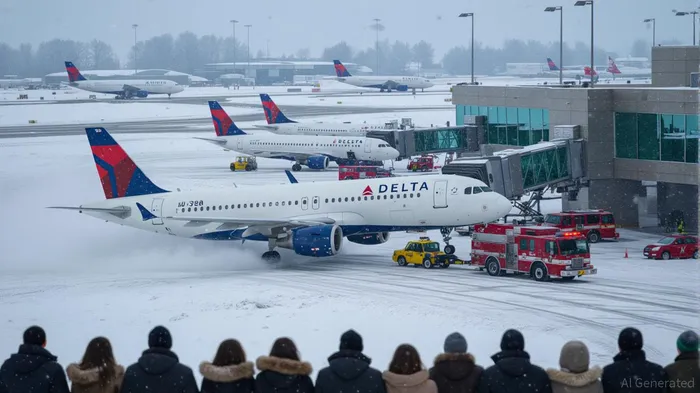
The DeltaDAL-- incident on November 30, 2025, underscored the operational fragility of the aviation industry. A Delta Connection flight slid off the runway at Des Moines International Airport due to icy conditions, prompting a temporary closure and leaving only one runway operational until the aircraft was removed. While the airport reopened by midday the following day, the incident added to a broader wave of disruptions. The federal government shutdown, which led to a 10% reduction in flights at 40 major U.S. airports, caused over 9,000 cancellations nationwide. Delta CEO acknowledged the "significant" financial cost of these disruptions but emphasized that the airline's fourth-quarter profits would remain intact.
The challenges were not confined to Delta. American Airlines canceled 224 flights in a single day, while United and other carriers faced similar operational strains. Compounding these issues, a mandatory software update for Airbus A320 aircraft-triggered by a flight control issue on a JetBlueJBLU-- flight-grounded hundreds of flights, further straining capacity during the busy post-Thanksgiving travel period. These overlapping stressors exposed the sector's susceptibility to cascading risks, from weather to regulatory and technical shocks.
Stock Market Reactions: Resilience Amid Chaos
Despite the operational turmoil, airline stocks demonstrated surprising resilience. on November 12, 2025, as optimism grew over the resolution of the government shutdown. Analysts from Susquehanna, Jefferies, and JP Morgan raised price targets for Delta, , citing strong demand and capacity management. United Airlines, over the past year, , .
This resilience contrasts with historical patterns. During the 2002–2003 , , with recovery taking nine months. More recently, extreme weather events like (2017) and European floods (2021) caused indirect financial shocks to aviation infrastructure through supply chain disruptions. The current environment, however, suggests that airlines are better positioned to absorb short-term shocks, thanks to improved financial health and capacity discipline.
Strategic Risk Assessment: Lessons for Investors
For investors, the key takeaway lies in the sector's evolving risk profile. While airlines have demonstrated operational agility-such as Delta's prioritization of customer care and rapid resumption of flights)-the interconnected nature of disruptions (e.g., weather, regulatory, technical) demands a nuanced approach.
- Diversification of Risks: Airlines with diversified revenue streams (e.g., cargo operations) may fare better during disruptions. For instance, due to the U.S. Postal Service ending its contract with FedEx, highlighting the need for cargo-focused strategies.
- Infrastructure Resilience: Airports and airlines investing in advanced weather monitoring and infrastructure upgrades-such as real-time and redundant runway operations-are likely to outperform peers.
3. Regulatory Contingency Planning: The government shutdown's impact on staffing underscores the importance of contingency planning for regulatory shocks.
Conclusion: Navigating Uncertainty with Prudence
The recent winter weather disruptions and technical challenges have reaffirmed the aviation sector's vulnerability to exogenous shocks. However, the resilience of airline stocks and improved operational strategies suggest that the sector is adapting to a more volatile environment. For investors, the path forward requires a balanced approach: hedging against short-term risks while capitalizing on long-term trends such as capacity discipline and technological innovation. As the industry navigates this complex landscape, strategic foresight will remain paramount.

Delivering real-time insights and analysis on emerging financial trends and market movements.
Latest Articles
Stay ahead of the market.
Get curated U.S. market news, insights and key dates delivered to your inbox.
AInvest
PRO
AInvest
PRO



Comments
No comments yet