
Winmark's Dividend Signal and Investment Implications: Evaluating Dividend Sustainability and Long-Term Shareholder Value Creation
 Aime Summary
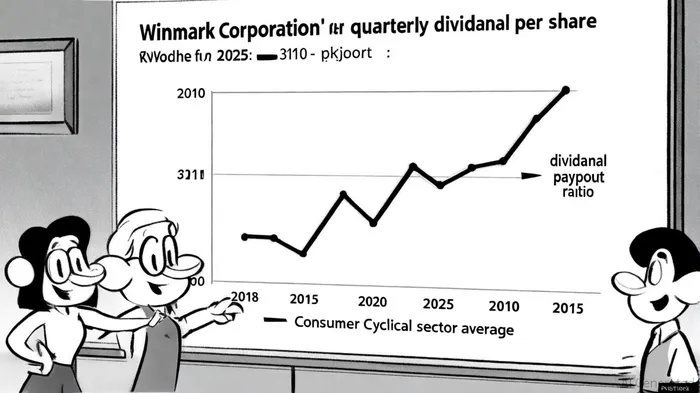
Winmark Corporation (WINA) has long been a focal point for income-oriented investors, thanks to its consistent dividend growth and resilient franchise model. However, as of 2025, the company's dividend payout ratio of 96.1%-significantly higher than the Consumer Cyclical sector average of 39.8%-raises critical questions about sustainability and long-term value creation, according to FullRatio's dividend history. This analysis evaluates Winmark's dividend strategy through the lens of financial health, operational performance, and market positioning, offering insights for investors weighing the risks and rewards of its dividend-driven approach.
Dividend Growth and Operational Resilience
Winmark's recent dividend hike to $0.96 per share (annualized $3.84) reflects a 230% increase since 2024, underscoring its commitment to rewarding shareholders, per FullRatio. This growth is supported by robust earnings: Q2 2025 net income rose to $10.6 million, or $2.89 per diluted share, compared to $10.4 million in the prior year, according to FullRatio data. The company's franchise model, spanning 1,371 stores across five brands, has demonstrated resilience, with strong sales performance and strategic investments in technology and marketing, as shown in FullRatio's historical figures.
A key strength lies in Winmark's capital-light business model, which generates consistent cash flow. For the first six months of 2025, operating cash flow reached $24.1 million, up 11.8% year-over-year, while liquidity remains strong with $28.8 million in cash and $20 million in undrawn credit, according to a Panabee analysis. This financial flexibility allows WinmarkWINA-- to balance reinvestment in its franchise network with shareholder returns.
Risks to Dividend Sustainability
Despite these positives, Winmark's high payout ratio poses a significant risk. A 96.1% payout ratio means the company is distributing nearly all of its earnings as dividends, leaving minimal room for operational reinvestment or navigating economic downturns, per FullRatio. Projections suggest this ratio could rise to 116% in 12 months if dividend growth continues at its current pace, a level that would render the payout unsustainable, according to Yahoo Finance projections.
The recent special dividend of $10 per share, payable in December 2025, further complicates the picture. While such one-time payments can reward loyal shareholders, they also strain liquidity and may signal a prioritization of short-term returns over long-term stability, as noted in a Business Wire release. For context, the company's operating free cash flow payout ratio stands at 28.2%, indicating cash flow is sufficient to support the dividend-but only if earnings and cash flow remain stable, according to Panabee.
Comparative Analysis and Sector Positioning
Winmark's dividend yield of 2.5% slightly outperforms the sector average of 2.45%, per FullRatio, making it attractive for income seekers. However, its payout ratio dwarfs peers, creating a mismatch between yield and financial prudence. For example, a 96.1% payout ratio implies Winmark is distributing dividends at a rate that could erode earnings growth if revenue or profit margins decline, as FullRatio's figures suggest. In contrast, companies with lower payout ratios (e.g., 30–50%) typically retain more earnings to fuel innovation or weather volatility.
Investment Implications and Strategic Outlook
For investors, Winmark's dividend strategy presents a dual-edged sword. On one hand, its franchise model and operational efficiency provide a stable foundation for consistent payouts. On the other, the high payout ratio and aggressive dividend growth create vulnerability to macroeconomic shifts or sector-specific risks (e.g., retail downturns).
A prudent approach would involve monitoring earnings consistency and cash flow generation. If Winmark maintains its 11.8% operating cash flow growth and avoids overextending its payout ratio, the dividend could remain secure. However, a slowdown in earnings or a rise in the payout ratio above 100% would likely force a dividend cut-a scenario that could erode investor confidence.
Conclusion
Winmark's dividend signal is a testament to its operational success and shareholder-centric ethos. Yet, the sustainability of its payout hinges on balancing growth with prudence. While the current yield and historical dividend increases are appealing, investors must weigh these against the risks of an overextended payout ratio. For those prioritizing long-term value creation, Winmark's stock may offer compelling returns-but only if the company navigates its financial levers with discipline.

Tianhao Xu is currently a financial content editor, focusing on fintech and market analysis. Previously, he worked as a full-time forex trader for several years, specializing in global currency trading and risk management. He holds a master’s degree in Financial Analysis.
Latest Articles
Stay ahead of the market.
Get curated U.S. market news, insights and key dates delivered to your inbox.
AInvest
PRO
AInvest
PRO



Comments
No comments yet