
Wildfires Force Evacuations in Lytton and Peachland, B.C.
ByAinvest
Thursday, Jul 31, 2025 5:33 pm ET2min read
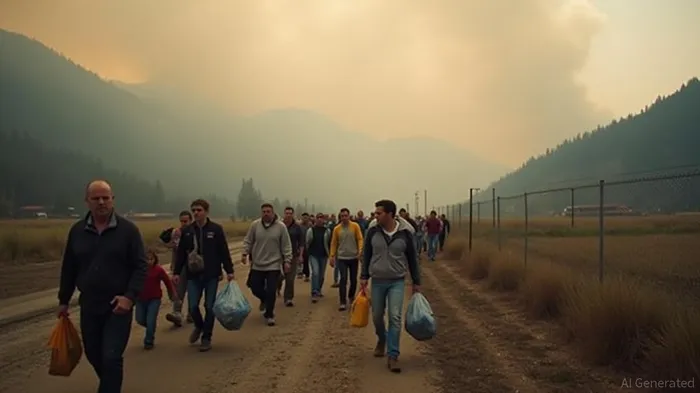
In Lytton, B.C., a wildfire evacuation alert has been upgraded to an evacuation order for First Nations reserves. Residents near Peachland have also been ordered to evacuate due to a nearby fire. Wildfires across the province continue to impact air quality, particularly in southwestern Ontario.
In Lytton, British Columbia, a wildfire evacuation alert has been upgraded to an evacuation order for First Nations reserves. Concurrently, residents near Peachland have also been ordered to evacuate due to a nearby wildfire. These events are part of a broader trend of wildfires across the province, which are significantly impacting air quality, particularly in southwestern Ontario.The wildfire in Peachland, discovered on July 30, has led to the evacuation of around 400 properties and an evacuation alert for an additional 225 [1]. The blaze, initially started by a vehicle fire, has grown to approximately 27 hectares in size and remains out of control as of Thursday morning [1]. Fire crews have been battling the blaze throughout the night and into the morning, with BC Wildfire Service (BCWS) reporting that the fire's behavior has decreased to Rank 1 to 2, indicating slower fire activity [1].
The wildfire has also caused significant traffic disruptions. Highway 97 in Peachland and Highway 97C (Okanagan Connector) were closed on Wednesday afternoon due to the fire, with Highway 97C reopening around 8:40 p.m. on Wednesday night. As of Thursday morning, Highway 97 from Buchanan Road and Drought Road remains single-lane alternating traffic [1].
In addition to the evacuation orders, a heat warning issued by Environment Canada remains in effect for the Central Okanagan, up to Vernon, and down to the South Okanagan to the Canada-United States border. Temperatures are expected to reach 35-38 degrees Celsius on July 31, with a risk of thunderstorms and a 40% chance of showers [1].
The wildfires in British Columbia are not the only ones affecting air quality. Smoke from wildfires in the Prairies has caused poor air quality and reduced visibility in the Hamilton-Niagara area and much of southern Ontario [2]. Environment Canada has issued air quality alerts, advising residents to limit time outdoors and consider rescheduling outdoor activities. The agency has also warned of potential health risks, including eye, ear, nose, and throat irritation, headaches, and chest pains [2].
The wildfires in British Columbia and Ontario are not only causing immediate disruptions but also have potential long-term financial implications. Evacuations and closures of highways can lead to supply chain disruptions, impacting businesses and industries dependent on these routes. Additionally, poor air quality can lead to increased healthcare costs and decreased productivity.
In conclusion, the wildfires in British Columbia and Ontario are having significant impacts on evacuations and air quality. As the situation evolves, it will be crucial for authorities to monitor and manage these events to minimize their economic and social impacts.
References:
[1] https://www.wltribune.com/news/evacuations-remain-traffic-impacted-as-crews-battle-peachland-wildfire-8167726
[2] https://www.cbc.ca/news/canada/hamilton/air-quality-alert-july-30-1.7598291
Stay ahead of the market.
Get curated U.S. market news, insights and key dates delivered to your inbox.


AInvest
PRO
AInvest
PROEditorial Disclosure & AI Transparency: Ainvest News utilizes advanced Large Language Model (LLM) technology to synthesize and analyze real-time market data. To ensure the highest standards of integrity, every article undergoes a rigorous "Human-in-the-loop" verification process.
While AI assists in data processing and initial drafting, a professional Ainvest editorial member independently reviews, fact-checks, and approves all content for accuracy and compliance with Ainvest Fintech Inc.’s editorial standards. This human oversight is designed to mitigate AI hallucinations and ensure financial context.
Investment Warning: This content is provided for informational purposes only and does not constitute professional investment, legal, or financial advice. Markets involve inherent risks. Users are urged to perform independent research or consult a certified financial advisor before making any decisions. Ainvest Fintech Inc. disclaims all liability for actions taken based on this information. Found an error?Report an Issue




Comments
No comments yet