
The Widening Equity-Bond Valuation Gap: A Strategic Rebalancing Opportunity in 2025
 Aime Summary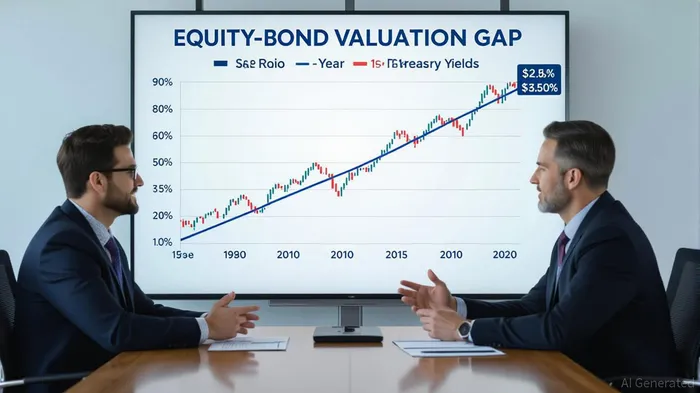
The global financial landscape in 2025 is marked by a striking divergence between equity and bond valuations. The S&P 500, a barometer of U.S. corporate health, trades at a price-to-earnings (P/E) ratio of 25.67, a level that appears undervalued over the past year but sits firmly in overvaluation territory when viewed through the lens of 5, 10, or 20-year historical averages. Meanwhile, the 10-year U.S. Treasury yield has climbed to 4.38%, a level above its long-term average of 4.25%. This widening gap—a product of divergent economic narratives and investor behavior—demands a critical reassessment of portfolio allocations.
The Equity Premium Puzzle
The equity risk premium (ERP), a measure of the excess return investors demand for holding equities over bonds, has turned negative in 2025. The S&P 500's earnings yield (3.88%) now trails the 10-year Treasury yield (4.09%), an inversion not seen since the dot-com bubble. Historically, equities have commanded a premium of around 485 basis points over Treasuries, but this buffer has evaporated. The implications are profound: investors are no longer being compensated for the heightened risk of equity ownership.
This inversion reflects a combination of factors. For equities, the S&P 500's P/E ratio of 25.67 is 1.47σ above its five-year average and 3.82σ above its 20-year average, signaling overvaluation. For bonds, the 10-year yield has climbed on expectations of moderate inflation and the Federal Reserve's tightening cycle. Yet, the yield remains below the peak of 15.84% seen in 1981, suggesting it is not yet in a “bubble” territory. The dislocation is not a sign of systemic risk but of a recalibration of risk-reward dynamics.
Strategic Rebalancing: The Case for Fixed-Income
The current environment presents a unique opportunity to rebalance portfolios toward fixed-income assets. Treasuries, with their current yield of 4.38%, offer a compelling income stream and a defensive hedge against equity volatility. For income-seeking investors, the 4.25% coupon rate on the 10-year note maturing in 2035 provides a stable return, particularly in a world where corporate bond yields remain compressed.
The case for fixed-income is further strengthened by the structural end of the 40-year bond bull market. With yields normalizing, the risk of further erosion in bond prices has diminished, making them less volatile than equities. For instance, the S&P 500's 200-day moving average suggests a bullish trend, but its 3.82σ deviation from the 20-year P/E average implies a high probability of mean reversion. Investors who overweight equities in this environment risk locking in gains at the peak of a cycle.
Diversification and the Role of Alternatives
While fixed-income serves as a defensive pillar, diversification into alternative assets—such as private real estate, infrastructure, and high-quality corporate bonds—can enhance risk-adjusted returns. These assets offer income streams less correlated with public equity markets and can act as a buffer during periods of economic deceleration. For example, private real estate has historically delivered returns of 6–8% annually, with cash flows that provide resilience in high-interest-rate environments.
The Path Forward
The widening equity-bond gapGAP-- is not a crisis but a call to action. Investors should consider the following strategies:
1. Increase Fixed-Income Exposure: Allocate a larger portion of portfolios to long-duration Treasuries and high-grade corporate bonds to capture income and reduce equity risk.
2. Rebalance Toward Alternatives: Diversify into private real estate, infrastructure, and credit strategies to access yield and mitigate correlation with equities.
3. Adopt a Dynamic Approach: Use forward-looking metrics like the earnings yield gap and valuation multiples to adjust allocations as market conditions evolve.
In a world where equities trade at historically elevated levels and bonds offer a rare combination of income and safety, the imperative for strategic rebalancing is clear. The next decade may not deliver the same returns as the past 40 years, but a disciplined, diversified approach can navigate the uncertainties ahead.
The equity-bond valuation gap is not a warning sign—it is an invitation to rethink the foundations of long-term investing. By prioritizing income, diversification, and defensive positioning, investors can transform a period of uncertainty into a foundation for resilience.

Stay ahead of the market.
Get curated U.S. market news, insights and key dates delivered to your inbox.


AInvest
PRO
AInvest
PRO



Comments
No comments yet