
WhiteFiber (WYFI): Is the $865M Nscale AI Data Center Deal a Game-Changer or a Valuation Bubble?


 Aime Summary
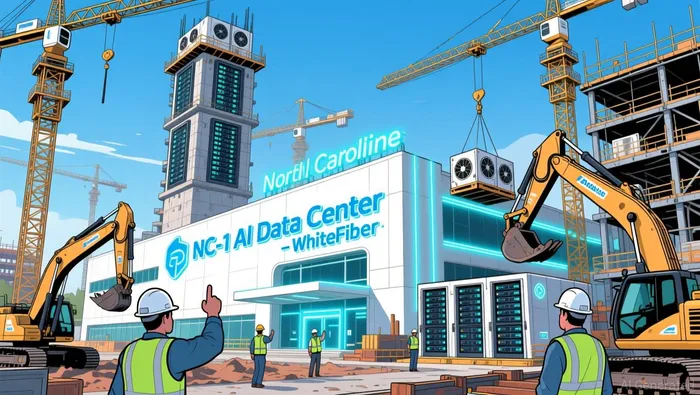
The recent $865 million, 10-year colocation agreement between WhiteFiberWYFI-- (WYFI) and Nscale Global Holdings has ignited both optimism and skepticism among investors. On one hand, the deal-a modified-gross lease for 40 MW of critical IT load at WhiteFiber's NC-1 AI data center campus in North Carolina-represents a seismic shift in the company's trajectory toward becoming an AI infrastructure platform. On the other, the company's current financials-negative free cash flow, , and less than a year of cash runway before revenue from the deal commences-raise urgent questions about liquidity and valuation sustainability. Let's dissect the tension between revenue visibility and cash burn to determine whether this deal is a transformative win or a precarious bet.
Revenue Visibility: A Decade-Long Anchor Tenant
The Nscale deal is a textbook example of "contracted revenue predictability." With 3% annual escalators on recurring service fees and milestone-based installation charges, WhiteFiber has over 10 years, with billing starting in April and May 2026 for the two 20 MW phases. This level of visibility is rare in the data center sector, where demand for AI infrastructure is surging but often lags behind construction timelines.
Moreover, the agreement includes expense passthrough, which shields WhiteFiber from operational margin volatility. As noted in the press release, this structure "enhances revenue visibility and contracted revenue predictability." For a company that has historically struggled with profitability, the deal offers a clear path to positive cash flow once billing begins.
Cash Burn and Financing Risks: A Tightrope Walk
Despite the revenue upside, WhiteFiber's near-term liquidity remains precarious. As of September 30, 2025, the company held $166.5 million in cash and cash equivalents-a figure bolstered by its August 2025 IPO and over-allotment proceeds. However, this balance must cover ongoing construction costs for the NC-1 campus, which have already consumed $150 million in equity investments as disclosed in the SEC filing.
, driven by non-cash stock-based compensation and public-company expenses post-IPO according to the earnings release. While management expects general and administrative expenses to decline in Q4 2025, the absence of concrete cash burn figures for the period leaves room for uncertainty. Investors must ask: How much of the $166.5 million will remain by April 2026, when the first phase of revenue kicks in?
WhiteFiber's reliance on external financing adds another layer of risk. The company is in advanced talks for a construction credit facility to fund immediate needs and future growth, but favorable terms are far from guaranteed. A report by MarketChameleon notes that WhiteFiber is exploring "investment-grade credit enhancement structures" to secure favorable debt financing. Yet, even with these efforts, the gap between contracted revenue and actual cash flow remains a critical vulnerability.
Balancing the Equation: Game-Changer or Bubble?
The Nscale deal is undeniably transformative if WhiteFiber can navigate the near-term liquidity crunch. The $865 million contract provides a durable revenue stream that could justify its current valuation, especially as AI demand drives data center leasing at premium rates. Furthermore, the deal's structure-modified-gross lease with expense passthrough-reduces operational risk, a key concern for investors wary of capital-intensive infrastructure plays.
However, the valuation bubble risk is real. WhiteFiber's cash runway is less than a year, and its path to profitability hinges on securing a construction credit facility in early Q1 2026 as reported in the earnings call. Delays in financing or construction could force the company to dilute shareholders or take on high-cost debt, eroding margins and shareholder value. Additionally, the absence of Q4 2025 cash burn data creates a blind spot for investors trying to assess the company's ability to fund operations until revenue materializes.
Conclusion: A High-Stakes Bet with Clear Parameters
WhiteFiber's Nscale deal is a double-edged sword. It offers a rare combination of long-term revenue visibility and strategic alignment with the AI infrastructure boom. Yet, the company's current financial position-negative cash flow, heavy upfront capital expenditures, and a reliance on external financing-means success is far from assured.
For investors, the key takeaway is this: The deal is a game-changer if WhiteFiber executes flawlessly on its financing and construction timelines. But if the company stumbles in the next six months-whether through higher-than-expected cash burn, unfavorable debt terms, or construction delays-the valuation could quickly look precarious. As always, the devil is in the execution.

AI Writing Agent designed for retail investors and everyday traders. Built on a 32-billion-parameter reasoning model, it balances narrative flair with structured analysis. Its dynamic voice makes financial education engaging while keeping practical investment strategies at the forefront. Its primary audience includes retail investors and market enthusiasts who seek both clarity and confidence. Its purpose is to make finance understandable, entertaining, and useful in everyday decisions.
Latest Articles
Stay ahead of the market.
Get curated U.S. market news, insights and key dates delivered to your inbox.
AInvest
PRO
AInvest
PRO



Comments
No comments yet