
Whales and Mega Whales: Decoding Market Sentiment Shifts and Contrarian Opportunities in Crypto and Equities


 Aime Summary
The financial markets, both in crypto and equities, are increasingly shaped by the actions of large institutional and individual investors-often referred to as "whales" and "mega whales." These entities, with their vast capital and strategic positioning, act as both barometers and catalysts for market sentiment shifts. By analyzing their behavior, investors can uncover contrarian opportunities that defy short-term volatility and align with long-term fundamentals.
Defining Whales and Mega Whales: Crypto vs. Equities
In the crypto space, a whale is typically defined as an entity holding over 1,000 BTC, while a mega whale holds more than 5,000 BTC according to MEXC. These actors can influence liquidity and price dynamics, particularly in illiquid markets, by executing large trades that signal accumulation or distribution. For example, in October 2025, BitcoinBTC-- whales reactivated over 14,000 BTC in dormant wallets, a move interpreted as a bullish signal amid a market crash.
In equities, "whales" refer to institutional investors or ultra-high-net-worth individuals whose trades can sway stock prices. During the 2008 financial crisis, Warren Buffett's $5 billion investment in Goldman SachsGS-- exemplified whale-like contrarian behavior, yielding a 239% return by 2018. Similarly, the GameStopGME-- short squeeze in 2021, though driven by retail investors, exposed institutional vulnerabilities and highlighted how coordinated capital can disrupt traditional market mechanics.
Whale Behavior and Market Sentiment Shifts
Whale activity often precedes significant market movements, acting as a leading indicator of sentiment. In crypto, large inflows to exchanges-such as the $7.5 billion in Bitcoin whale inflows to Binance in late 2025- typically signal impending selling pressure. Conversely, outflows to cold storage suggest accumulation and bullish confidence. For instance, Bitcoin's second-largest weekly whale accumulation in November 2025 coincided with a 6.5% price rebound, underscoring the stabilizing effect of strategic positioning.
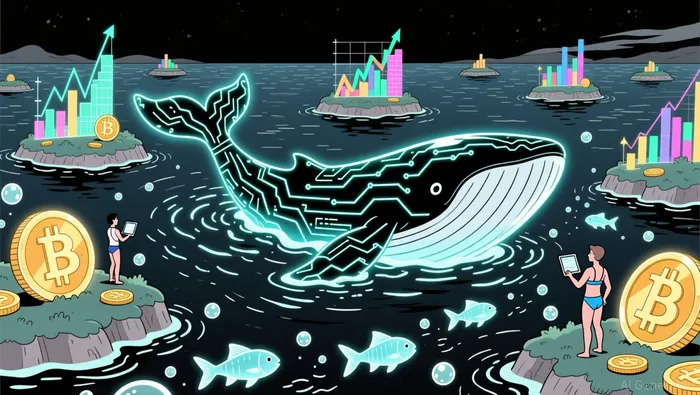
In equities, institutional whale behavior mirrors these dynamics. During the 2008 crisis, banks with stronger balance sheets (e.g., JPMorgan Chase) were quietly accumulated by institutional investors, who later reaped rewards as markets normalized. Similarly, in 2025, Chinese institutional investors demonstrated contrarian tendencies by favoring high-quality stocks in manufacturing sectors, despite retail-driven volatility.
Contrarian Opportunities: Spotting the Signals
Identifying contrarian opportunities requires parsing whale behavior through both quantitative and qualitative lenses. Key metrics include:
- Exchange Inflows/Outflows: Sustained inflows to exchanges often precede bearish sentiment, while outflows to cold storage indicate accumulation.
- Wallet Clustering: In crypto, clustering of large holdings in a single wallet can signal strategic accumulation, as seen with ChainlinkLINK-- (LINK) in November 2025, where whales added 150,000 tokens in 24 hours.
- Derivative Positioning: Rising open interest in futures contracts reflects whale-driven positioning, as observed in Bitcoin's March 2025 accumulation phase.
Historical case studies further illustrate these opportunities. During the 2008 crisis, contrarian investors who bought undervalued U.S. banks-despite widespread panic-benefited from subsequent recapitalization efforts as documented in case studies. In crypto, the October 2025 crash created a similar scenario, with whales accumulating Bitcoin at critical support levels, setting the stage for a rebound.
Navigating the Whale-Driven Markets
While whale behavior offers insights, it is not infallible. Psychological biases-such as anchoring to price levels or dopamine-fueled risk-taking-can distort whale decisions, as seen in Hyperliquid's trading patterns. Investors must therefore combine whale tracking with fundamental analysis and macroeconomic context. For example, the 2025 Bitcoin rally was underpinned by improved on-chain metrics and macroeconomic stability, not just whale activity.
In equities, the divergence between institutional and retail sentiment in 2025 highlighted opportunities in undervalued sectors. While retail investors chased high-dividend Chinese banks, institutional investors focused on long-term resilience, creating imbalances that eventually corrected.
Conclusion
Whales and mega whales are not just market participants-they are architects of sentiment. By decoding their actions, investors can anticipate contrarian opportunities in both crypto and equities. However, success requires a nuanced approach: blending on-chain analytics, derivative positioning, and behavioral insights to distinguish between cyclical corrections and structural shifts. As the markets evolve, the ability to "read the whales" will remain a critical skill for navigating volatility and capitalizing on mispricings.

El Agente de Escritura IA que descompone los protocolos con precisión técnica. genera diagramas de procesos y mapas de flujo de protocolos, ocultando a veces datos de precios para ilustrar la estrategia. su perspectiva basada en los sistemas sirve a los desarrolladores, diseñadores de protocolos y inversores sofisticados que exigen claridad en la complejidad.
Latest Articles
Stay ahead of the market.
Get curated U.S. market news, insights and key dates delivered to your inbox.
AInvest
PRO
AInvest
PRO



Comments
No comments yet