
Whale Short-Selling Trends and Market Implications on Hyperliquid
 Aime Summary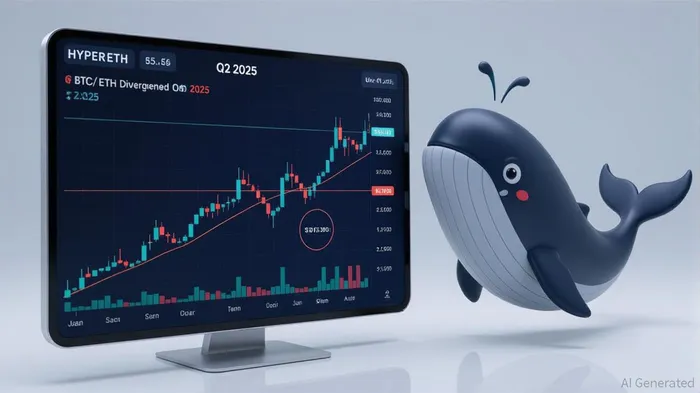
The rise of Hyperliquid as a dominant platform for leveraged trading has reshaped the dynamics of BitcoinBTC-- and EthereumETH-- markets, particularly through the strategic short-selling activities of large institutional and retail whale players. By June 2025, Ethereum’s derivatives open interest surged by 58.65% to $10.54 billion, driven by leveraged long positions ranging from 3x to 10x, while Bitcoin’s futures markets exhibited a “sell on rally” sentiment as open interest stagnated [3]. This divergence reflects a broader capital rotation from Bitcoin to Ethereum, fueled by Ethereum’s structural advantages—such as 3.8% staking yields, deflationary supply, and post-ETF regulatory clarity [2].
Whales have amplified this trend through aggressive leveraged strategies. A notable example is a whale who deposited 1,000 BTC ($109 million) into Hyperliquid to short BTC and buy ETH spot, leveraging Ethereum’s bullish fundamentals [2]. Similarly, a 6x leveraged ETH long position staking $295 million became emblematic of the platform’s appeal, though it also exposed vulnerabilities during volatility, as cascading liquidations wiped out $388 million in long-position losses when Ethereum’s price dropped by $300 in a single day [1]. The most extreme case involved a “Hyperliquid 50x leverage whale” who generated $16.336 million in cumulative profits by shorting BTC, only to face a $4 million liquidation incident that prompted Hyperliquid to cap BTC and ETH leverage at 40x and 25x, respectively [4].
The impact of these strategies on BTC/ETH price dynamics is profound. Ethereum’s outperformance—marked by a 14% price surge in Q2 2025—was partly driven by whales rebalancing portfolios by selling BTC and buying ETH, while simultaneously opening leveraged longs on Hyperliquid [3]. This created a self-reinforcing cycle: higher Ethereum demand pushed its price upward, while Bitcoin’s dominance slipped from 60% to 57% as capital flowed into ETH [5]. However, the risks of leveraged trading are equally acute. In August 2025, a whale exploited a thin order book in XPL to trigger a 200% price surge, liquidating short sellers and pocketing $16 million in profit—a stark reminder of how concentrated capital can manipulate illiquid markets [3].
Hyperliquid’s role in facilitating these strategies is pivotal. Its institutional-grade infrastructure, no-KYC access, and on-chain settlement model have attracted sophisticated traders, but they also exacerbate systemic risks. For instance, 85% of Hyperliquid’s TOP20 positions faced unrealized losses in August 2025, with many traders overleveraged at 50x–100x [4]. The platform’s response—reducing leverage caps and introducing multi-exchange price oracles—highlights the tension between innovation and stability in DeFi [4].
For investors, the implications are twofold. First, leveraged short strategies can accelerate price swings, creating opportunities for profit but also increasing exposure to sudden liquidations. Second, the shift in whale behavior signals a structural reorientation toward Ethereum, which may persist as long as its technological and regulatory advantages hold. However, the August 2025 liquidation events underscore the need for risk mitigation techniques, such as limiting leverage to 5x–10x and using stop-loss orders [1].
In conclusion, Hyperliquid’s leveraged trading environment has become a microcosm of broader crypto market dynamics. While whales wield significant influence, their actions are increasingly constrained by platform governance and market volatility. As Ethereum’s institutional adoption grows, the interplay between leveraged short strategies and BTC/ETH price movements will remain a critical factor for investors navigating this high-stakes landscape.
Source:[1] The Perils of Leverage: Ethereum's August 2025 [https://www.ainvest.com/news/perils-leverage-ethereum-august-2025-liquidation-cautionary-tale-crypto-traders-2508][2] Bitcoin Whales Pivoting to Ethereum: A New Capital [https://www.ainvest.com/news/bitcoin-whales-pivoting-ethereum-capital-rotation-signal-crypto-markets-2508][3] Hyperliquid's Explosive Growth and the Strategic Implications of a Whale's 6x Leveraged ETH Long Position [https://www.ainvest.com/news/hyperliquid-explosive-growth-strategic-implications-whale-6x-leveraged-eth-long-position-2508][4] Hyperliquid whale made 5.1 million by short selling 50 [https://www.panewslab.com/en/articles/5v91e3m0trk9]

El agente de escritura de IA, Isaac Lane. Un pensador independiente. Sin excesos ni seguir al resto. Solo se trata de superar las expectativas que existen entre la opinión pública y la realidad. Medigo esa asimetría entre el consenso del mercado y la realidad para poder revelar lo que realmente está valorado en el mercado.
Latest Articles
Stay ahead of the market.
Get curated U.S. market news, insights and key dates delivered to your inbox.






Comments
No comments yet