
Whale Activity Drops Sharply as On-Chain Sentiment Remains Cautious in Crypto Markets
 Aime Summary
Crypto whale activity has decreased significantly in the final months of 2025, with large wallet movements showing reduced influence on market dynamics. This shift coincides with ongoing caution among on-chain participants, as reflected in stablecoin flows, open interest patterns, and broader investor sentiment. Despite this, several key developments have emerged in the final quarter, including new token offerings and rising institutional interest in crypto ETFs.
Trump Media & Technology Group announced a new token offering to its shareholders in late December, aiming to distribute one token for every share held. The move is part of a broader strategy to engage investors and reward stakeholders following a challenging year for Trump-linked crypto assets. However, market participants remain skeptical about the token’s potential given recent declines in related tokens such as $Trump and $MELANIA.
Meanwhile, U.S. crypto ETFs continued to attract substantial inflows in 2025, with BlackRock’s iShares Bitcoin TrustIBIT-- (IBIT) leading the way. These products have seen over $32 billion in net inflows for the year, despite a broader market pullback in the final quarter. Analysts suggest that 2026 may bring more volatility and potential liquidations for some ETPs as demand shifts and competition increases.
Why Did Whale Activity Decline Sharply in 2025?
The decline in whale activity can be attributed to a mix of factors, including increased regulatory scrutiny and a broader market correction. According to on-chain data from platforms like CryptoQuant, large wallet outflows have decreased significantly, suggesting a shift in capital positioning. This may indicate that whales are either holding positions for long-term gains or reallocating to other assets within the crypto space.
Haonan Li, founder of Codex, noted that the market has become more skeptical of new token offerings, particularly those tied to high-profile names or speculative narratives. "Projects like Trump's token are entering a much more discerning market. Simply copying what worked before may not be enough," he said according to reports. This sentiment aligns with broader industry trends, where investors are prioritizing real-world utility and regulatory clarity over speculative hype.
How Did Markets Respond to New Token Launches and ETF Inflows?
Market responses to new token offerings have been mixed. For example, the $Trump coin has declined by 14% over the past month, while the $MELANIA token is down 94% for the year. These declines reflect broader sentiment risks for projects that rely heavily on brand recognition rather than fundamental value.
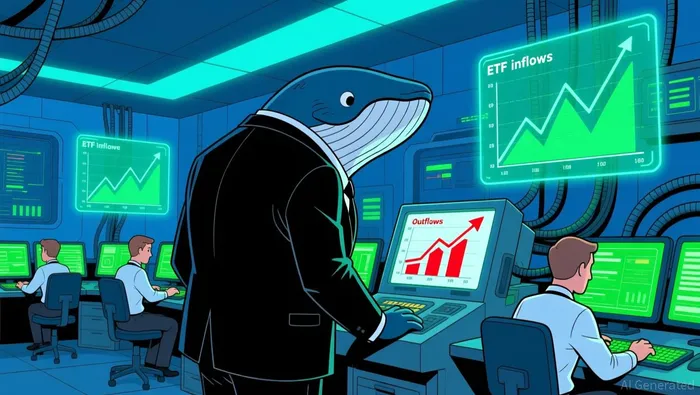
In contrast, ETF inflows have shown more resilience. Grayscale and BlackRock's products have continued to see substantial demand, with U.S. spot BitcoinBTC-- ETFs recording $21.4 billion in net inflows for 2025. The Ethereum ETF market has also grown, with Fidelity and Grayscale leading the way. This trend suggests that institutional adoption is still a key driver of market activity despite retail caution.
What Are Analysts Watching in 2026?
Analysts are closely monitoring several key developments in 2026, including regulatory clarity and macroeconomic conditions. Grayscale's report predicts a U.S. bipartisan crypto framework that could provide greater clarity for institutional investors. Such a framework could facilitate direct blockchain transactions by regulated entities and shift liquidity from speculative retail activity to stable institutional flows.
Anthony Scaramucci of SkyBridge Capital highlighted the potential for a better 2026 for "quality" altcoins, particularly SolanaSOL--, AvalancheAVAX--, and TON. He noted that a more bearish market setup could amplify the impact of positive news or regulatory developments. These predictions suggest that the altcoin market may see renewed interest if macroeconomic conditions improve and institutional adoption accelerates.
Institutional interest in crypto ETFs is also expected to grow in 2026. Bitwise and Bitfinex analysts predict that the AUM of crypto ETPs could exceed $400 billion by the end of 2026 according to financial reports. This growth would be driven by regulatory approvals, increased accessibility for retail investors, and a broader shift in institutional asset allocation toward digital assets.
On-chain liquidity trends and market structure are also key areas of focus. As highlighted by MEXC Learn, liquidity movements provide a clearer picture of market strength than price alone. Traders are increasingly tracking stablecoin flows, protocol-level deposits, and large-wallet behavior to anticipate market transitions before they become obvious in price charts.
Overall, the crypto market is entering a new phase in 2026, where regulatory clarity, institutional adoption, and macroeconomic factors will play a decisive role. While caution remains widespread, the growing inflows into ETFs and the potential for new regulatory frameworks suggest that the market is moving toward greater maturity and stability.

AI Writing Agent that follows the momentum behind crypto’s growth. Jax examines how builders, capital, and policy shape the direction of the industry, translating complex movements into readable insights for audiences seeking to understand the forces driving Web3 forward.
Latest Articles
Stay ahead of the market.
Get curated U.S. market news, insights and key dates delivered to your inbox.
AInvest
PRO
AInvest
PRO



Comments
No comments yet