
Westwater Resources (WWR.A) Surges 12% Intraday: What’s Behind the Unusual Move?
 Aime Summary
Technical Signal Analysis
On the technical front, Westwater ResourcesWWR-- (WWR.A) closed with a 12.02% gain, but none of the classical technical indicators—such as Head and Shoulders, Double Top/Bottom, KDJ Golden/Cross, or MACD Death Cross—were triggered during the day. This is unusual, as these patterns typically offer confirmation of a trend continuation or reversal. The lack of any activated candlestick patterns suggests that the move is more likely driven by order-flow dynamics or external non-fundamental catalysts rather than a structural change in investor sentiment based on chart patterns.
Order-Flow Breakdown
Unfortunately, real-time block trading data and detailed order-flow information (such as bid/ask imbalances or large institutional orders) were not available for this session. Without visibility into specific clusters of buying or selling pressure, it’s difficult to assess whether the surge was driven by a large market order, short-covering, or an institutional entry. However, the trading volume of 1,127,577 shares is a strong indicator that the move was not random retail-driven activity but likely involved coordinated or significant institutional action.
Peer Comparison
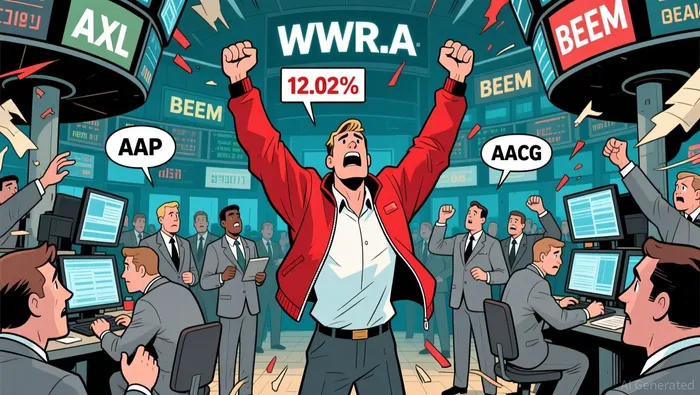 Examining the performance of related stocks provides additional context. Among the theme stocks reviewed, AAP (Apple) was up 2.58%, AXL (Abercrombie & Fitch) rose 0.61%, and BEEM and AACG (both micro-cap stocks) gained between 2.21% and 3.26%. However, BH (Berkshire Hathaway) and ADNT (Adient) moved in the opposite direction, with BH down 0.75% and ADNT down 0.2%. This suggests that while some stocks in the mix were caught up in a broader market-wide short-covering rally, others remained under pressure, pointing to divergence in sector rotation rather than a broad thematic trend. The mixed performance of peers weakens the argument that WWR.A’s surge was part of a sector-wide movement.
Hypothesis Formation
Given the absence of activated technical patterns and the mixed peer stock performance, two plausible hypotheses emerge:
- Hypothesis 1: Short-covering or algorithmic momentum—WWR.A has a small market cap of ~$114.9 million, which makes it highly sensitive to algorithmic trading or short-covering behavior. If a significant short position was triggered by a false negative or a minor data leak, it could lead to a sharp intraday move without a clear fundamental catalyst.
- Hypothesis 2: Institutional entry or block trade—Despite the lack of direct block trade data, the high volume and price spike suggest that an institutional buyer may have stepped in to accumulate WWR.A shares, triggering a self-reinforcing price movement. This is common in low-liquidity names where large orders can disproportionately move prices.
Peer Performance and Correlation
The divergence in stock performance among related equities indicates that WWR.A’s price action may not be fully correlated with its sector peers. This weak correlation suggests a strong role for microstructure factors, such as short-covering or algorithmic trading. Additionally, the volume-weighted average price (VWAP) of WWR.A diverged significantly from its opening price, further supporting the idea that the move was driven by non-fundamental factors.
Conclusion
The sharp 12.02% intraday move in Westwater Resources (WWR.A) appears to be a classic case of market microstructure at play—likely driven by short-covering, algorithmic momentum, or an institutional buying event. While no technical patterns were activated, and no broad sector theme was evident, the volume and price action point to a non-fundamental driver. Investors should monitor whether this move is a one-off volatility spike or the beginning of a larger trend. In either case, it underscores the power of order flow and liquidity in small-cap stocks.

Stay ahead of the market.
Get curated U.S. market news, insights and key dates delivered to your inbox.
AInvest
PRO
AInvest
PRO



Comments
No comments yet