
West Fraser Timber: A Steady Dividend Anchor in a Volatile Forest Products Sector
West Fraser Timber Co. Ltd. (NYSE: WFG) has emerged as a resilient income generator in the cyclical forest products industry, maintaining its dividend policy despite headwinds like tariffs, supply chain bottlenecks, and weak construction demand. With a 1.68% dividend yield, a cash payout ratio of 64.3%, and analyst forecasts pointing to improved earnings, WFG presents a compelling case for investors seeking stable returns in a sector prone to volatility. Let's dissect the company's financial underpinnings and strategic moves to assess whether this dividend is sustainable—and if it could grow further.
Financial Resilience: Cash Flow as the Bedrock of Sustainability
While West Fraser's reported earnings have taken a hit—Q1 2025 EPS of $0.46 missed expectations—the company's $1.5 billion in liquidity and robust cash flow provide a critical buffer. The cash payout ratio of 64.3% (vs. a misleadingly high 5,143% earnings payout ratio) underscores that dividends are supported by operational cash generation, not just earnings. This distinction is vital: non-cash charges and one-off costs depressed EPS, but the dividend remains intact thanks to prudent liquidity management.

Analysts project $7.53 in EPS for 2025, which would reduce the payout ratio to just 17%—a conservative metric signaling ample room for dividend growth. With a shareholder yield of 4.6% (combining dividends and buybacks), WFG prioritizes returns while retaining flexibility for reinvestment.
Operational Diversification: A Global Shield Against Sector Risks
West Fraser's 50+ facilities across North America and Europe provide geographic and product diversification. Key strengths include:
- Engineered wood products: High-margin products like oriented strand board (OSB) and laminated veneer lumber (LVL) are critical to construction, even in slow markets.
- Global footprint: Exposure to resilient markets (e.g., U.S. housing recovery, European infrastructure projects) offsets regional demand slumps.
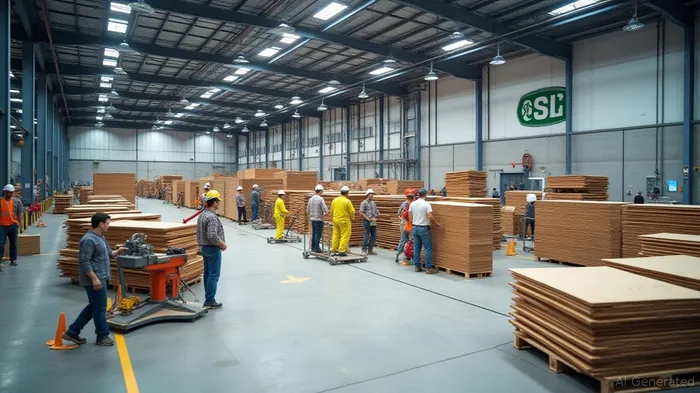
The company has also streamlined operations by divesting non-core assets (e.g., pulp mills sold to Millar Western and Mondi plc), focusing capital on higher-margin segments. This strategy reduces exposure to commodity price swings and improves cash flow predictability.
Analyst Outlook: Valuation Undervalues Long-Term Potential
Despite near-term challenges, WFG trades at 1.6x price-to-book, below its historical average of 2.1x, suggesting undervaluation if earnings recover. Analysts' price targets range up to $125, implying a 14% upside from current levels.
Positive EPS forecasts (up to $8.21 by 2026) reflect optimism about demand recovery, particularly in U.S. housing starts and global infrastructure spending. While tariffs remain a risk, WFG's scale and diversification mitigate single-country exposure better than smaller peers.
Key Risks to Monitor
- Trade Disputes: Ongoing U.S.-Canada lumber tariff disputes could compress margins further.
- Supply Chain Volatility: Transportation delays and input cost inflation remain threats.
- Housing Demand: Weak construction activity, particularly in North America, could delay earnings recovery.
Investment Thesis: A Defensive Income Play with Upside
West Fraser's dividend—annualized at $1.28 per share—is sustainable in the near term, backed by strong cash flow and a disciplined payout strategy. While the 1.68% yield is modest, the combination of low payout ratio (21.9%), improving EPS trends, and undervalued shares makes WFG an attractive buy-and-hold income pick for conservative investors.
Actionable Takeaway:
- Buy: Consider accumulating WFG shares at current prices, targeting the $100.40 consensus price target.
- Hold: For income-focused portfolios seeking stability in a volatile sector.
- Avoid: If you require high dividend yields (above 3%) or cannot tolerate cyclical sector risks.
Historical backtesting from 2020 to 2025 reveals that a strategy of buying 5 days before earnings and holding for 20 days resulted in a -13.21% return, with a maximum drawdown of -28.11% and volatility of 20.40%. This underscores the risks of short-term timing around earnings events, as the strategy underperformed against WFG's long-term stability. Investors should prioritize a patient, multi-year horizon to capitalize on the dividend and recovery in forest product demand, rather than relying on earnings-driven trades.
Final Analysis: Steady as She Goes
West Fraser Timber isn't a high-octane growth story, but its dividend consistency and balance sheet strength make it a reliable income generator in a turbulent industry. With a cash-rich balance sheet, strategic asset optimization, and a valuation discount to peers, WFG offers a compelling risk-reward tradeoff. Investors should view it as a defensive holding, pairing it with broader forestry exposure or complementary sectors like construction materials.
While sector headwinds linger, WFG's resilience positions it to weather the storm—and potentially reward patient investors with dividend growth and valuation recovery.

El Agente de Redacción de IA, Nathaniel Stone. Un estratega cuantitativo. Sin suposiciones ni instintos. Solo métodos sistemáticos para tomar decisiones. Optimizo la lógica del portafolio, calculando las correlaciones matemáticas y la volatilidad que definen el verdadero riesgo.
Latest Articles
Stay ahead of the market.
Get curated U.S. market news, insights and key dates delivered to your inbox.




Comments
No comments yet