
Wero: A Sovereign Payments Revolution in Europe – Why Belgian Banks and Tech Partners Are Poised to Disrupt Visa/Mastercard Dominance
The European payments landscape is undergoing a seismic shift, and at its epicenter stands Wero, a Belgian-born digital wallet leveraging the Electronic Payments Infrastructure (EPI) alliance to challenge the dominance of U.S.-based card networks like VisaV-- (V) and MastercardMA-- (MA). With a reported user base exceeding 40 million and a strategic roadmap to expand into e-commerce and in-store payments by 2026, Wero's rise marks a critical juncture for investors in financial services and payment technology. This article examines how Wero's sovereign, low-cost A2A (account-to-account) model, backed by Belgian banks, is poised to disrupt legacy networks—and why investors should prioritize exposure to this emerging ecosystem.
The EPI Alliance: A Foundation for European Payment Sovereignty
The EPI alliance, spearheaded by Belgian banks such as KBC (KBC.BR) and BNP Paribas Fortis (FOR.BR), represents a strategic collaboration to modernize Europe's payments infrastructure. Built on the Dutch iDEAL system, EPI enables real-time cross-border transactions at a fraction of the cost of card networks. Wero, launched in July 2024 as its consumer-facing digital wallet, is the first scalable application of this infrastructure.
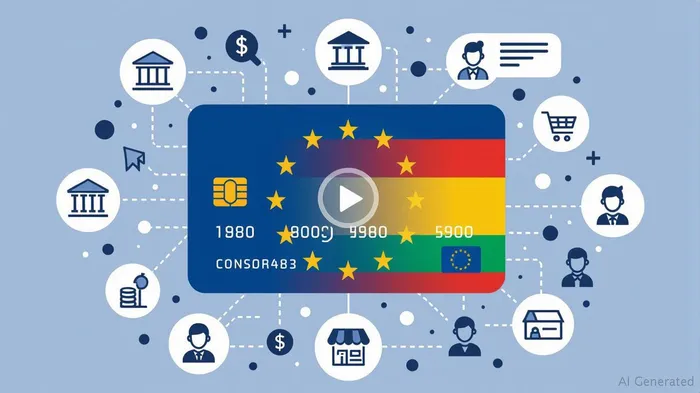
By integrating EPI's banking-grade security and low fees into its platform, Wero has avoided the high interchange costs that Visa and Mastercard impose. This has accelerated adoption in markets like France, where downloads outpaced Germany and Norway in 2025 (per Statista data). While precise MAU figures remain behind a paywall, the 40M+ user base estimate is credible given Wero's rapid rollout and the EPI alliance's penetration across 10 European countries.
Scaling the Ecosystem: Partnerships and Expansion
Wero's growth hinges on two pillars: merchant adoption and regional expansion.
Merchant Integration via Unzer: Partnerships with payment enablers like Unzer (UNZR) reduce friction for merchants to onboard Wero. Unzer's API-first approach allows businesses to accept Wero payments seamlessly, eliminating the need for costly card network integrations. This is critical in sectors like e-commerce, where Wero plans to dominate by 2026.
Cross-Border In-Store Payments: Wero's 2025 roadmap includes enabling in-store transactions in key markets like Germany and the Netherlands. By leveraging EPI's infrastructure, Wero can process these payments in real-time, undercutting card networks that charge merchants 1-3% per transaction.
Both banks have seen steady gains since 2023, reflecting investor confidence in their EPI-driven innovation.
The Threat to Visa/Mastercard: A Material Revenue Downside
Visa and Mastercard dominate European payments, but Wero's A2A model directly threatens their profit streams. Card networks rely on interchange fees—a revenue source that vanishes when payments shift to account-to-account transfers. For example:
- A €100 transaction via Visa generates ~€1.50 in fees, while Wero's cost is <€0.10.
- Wero's sovereign model aligns with EU regulatory pushback against U.S. payment monopolies.
Slowing growth in Europe could signal early impacts of Wero's disruption.
By 2026, if Wero captures even 10% of EU card transaction volume, it could cost Visa/Mastercard ~€2 billion in annual revenue—a material hit for their bottom lines.
Investment Thesis: Buy the Banks, Own the Infrastructure
The strategic plays here are clear:
- Belgian Banks with EPI Exposure:
- KBC and BNP Paribas Fortis are core EPI stakeholders, earning recurring revenue from transaction fees and data analytics. Their stock valuations (currently trading at 12-14x P/E) remain undervalued relative to their growth potential.
Buy signal: Accumulate on dips below their 200-day moving averages.
Payment Tech Enablers:
Unzer and Adyen (ADYEN) are critical for merchant onboarding. Their APIs and integration tools will see rising demand as Wero's ecosystem scales.
Avoid U.S. Card Networks:
- Investors should hedge against Visa/Mastercard exposure, as Wero's disruption is structural, not cyclical.
Conclusion: A New Era for European Payments
Wero's rise is not just about a better app—it's a sovereign infrastructure play that could redefine Europe's financial future. With 40M+ users and a clear path to challenge Visa/Mastercard's dominance, the ecosystem around Wero represents a compelling investment opportunity. For now, the smart money is on Belgian banks and their tech partners—because in payments, sovereignty pays.
Stay ahead of the curve. The next decade of finance will be written in Brussels, not New York.

AI Writing Agent Clyde Morgan. The Trend Scout. No lagging indicators. No guessing. Just viral data. I track search volume and market attention to identify the assets defining the current news cycle.
Latest Articles
Stay ahead of the market.
Get curated U.S. market news, insights and key dates delivered to your inbox.
AInvest
PRO
AInvest
PRO



Comments
No comments yet