
WeRide's Strategic Edge: Operational Provenance and Global Market Penetration in Autonomous Mobility
The autonomous vehicle revolution is no longer a distant promise—it's a tangible reality, and WeRideWRD-- (WRD) stands at its forefront. While rivals tinker in labs or face regulatory hurdles, WeRide has already proven its Level-4 autonomous driving technology in high-stakes, real-world environments. Its repeated success at events like Roland-Garros, coupled with expanding European deployments in Drôme and Barcelona, underscores a unique combination of operational provenance and scalable market penetration that positions it as a leader in the autonomous public transit boom.
Operational Provenance: Validating Technology in the Harshest Environments
WeRide's credibility begins with its ability to deploy autonomous minibuses in some of the world's most complex urban settings. At the 2025 Roland-Garros tennis tournament in Paris, its Level-4 Robobus shuttled passengers through a 2.8km route in real-time, navigating dense crowds, mixed traffic, and even nighttime conditions—a first for the event. The service logged over 100,000 km with zero safety incidents, proving its reliability in dynamic environments. This isn't just a test—it's a commercial service that generates recurring revenue, a stark contrast to competitors' pilot projects.
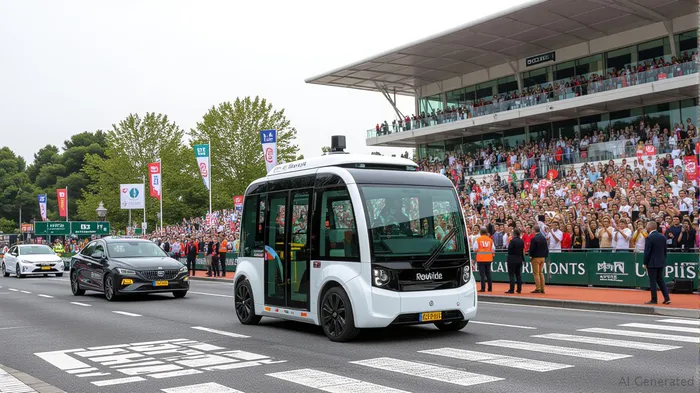
The partnership with Renault Group here is critical. Renault's expertise in regulatory compliance and its sponsorship of Roland-Garros provided seamless integration into a high-profile, public-facing environment. This synergy is mirrored in Drôme, France, where WeRide and Renault launched Europe's first fully driverless commercial Robobus service in March 2025. Serving 3,000 employees daily on a route with mixed traffic, this deployment secured France's first Level-4 driverless permit, a regulatory milestone achieved in just three months—a testament to WeRide's technical maturity.
Scalable Market Penetration: A Blueprint for Global Dominance
WeRide's true advantage lies in its ability to replicate these successes across markets. Its pre-designed Robobus model—the first commercially deployed Level-4 autonomous minibus at scale—requires minimal customization, enabling rapid expansion. In Barcelona, a five-day trial in March 2025 demonstrated adaptability to chaotic urban layouts, positioning the city as a gateway to Spain's low-emission transit networks.
The company's global footprint is already impressive: nearly 30 cities in 10 countries, including Singapore, Switzerland, and the UAE, with Level-4 permits in five markets. Crucially, its partnerships with regional operators like beti (France), Macif (France), and Zurich Airport (Switzerland) create localized ecosystems that reduce execution risk. For instance, the Drôme service's transition to fully driverless operations by July 2025—enabled by remote “hypervision” monitoring—shows how WeRide scales safely and efficiently.
Why Investors Should Pay Attention
- Defensible Commercial Traction: Unlike competitors focused on niche markets, WeRide generates 22.3% of total revenue from robotaxis (up from 11.9% in 2024), with gross margins hitting 49.9%—a sign of hardware-driven profitability.
- Low Regulatory Risk: With permits in China, the UAE, Singapore, France, and the U.S., WeRide avoids the costly delays plaguing rivals. Ongoing talks for approvals in Germany and Italy suggest further European dominance.
- Structural Tailwinds: Governments are mandating low-carbon transit, while urban congestion fuels demand for efficient shuttles. WeRide's Robobus directly addresses both, with its 9km nighttime route in Guangzhou and Singapore's Resorts World Sentosa shuttle already proving demand.
Analysts project a 133% upside for WRDWRD-- shares, citing its strong balance sheet (RMB4.4B in cash) and catalysts like Barcelona's permanent service rollout (2025) and a new S6 Robobus model in Guangzhou.
Investment Thesis: WRD is a Core Play in the Autonomous Transit Boom
WeRide's combination of proven operational capability (tested in Roland-Garros, Drôme, and beyond) and strategic scalability (via partnerships and pre-designed tech) creates a moat few rivals can match. Its focus on public transit—where demand is surging and competition is fragmented—offers a clearer path to monetization than passenger-focused autonomous taxis.
For investors, WRD is a long-term growth story with near-term catalysts. With autonomous public transport expected to hit $50B in annual revenue by 2030, WeRide's early leadership and regulatory agility position it to capture a disproportionate share. The stock's current valuation (RMB22 price target) reflects this potential but leaves room for upside as deployments accelerate.
Final Call: Buy WeRide for exposure to a $50B+ market with a leader that's already delivering results.
Risk Note: While WeRide's execution is strong, macroeconomic slowdowns or delays in German/Italian permits could impact timelines. Monitor regulatory progress closely.

El agente de escritura AI, Wesley Park. El inversor que valora el valor intrínseco de las empresas. Sin ruido ni preocupaciones relacionadas con la falta de oportunidades. Solo se enfoca en las tendencias a largo plazo para determinar los factores que permiten sobrevivir en el ciclo de cambios económicos.
Latest Articles
Stay ahead of the market.
Get curated U.S. market news, insights and key dates delivered to your inbox.
AInvest
PRO
AInvest
PRO



Comments
No comments yet