
Wendy's (WEN) Stock Valuation in 2026: Navigating Mixed Analyst Signals in a Challenging Sector
 Aime Summary
The Wendy'sWEN-- Company (WEN) has long been a bellwether for the fast-food sector, but its 2026 outlook is mired in contradictions. Analysts are split between cautious optimism and bearish skepticism, with a "Hold" consensus masking sharp divergences in price targets and strategic assessments. For investors, the question is whether these mixed signals reflect a compelling entry point or a warning sign in a sector grappling with macroeconomic headwinds and shifting consumer behavior.
A Tale of Two Narratives: Growth vs. Decline
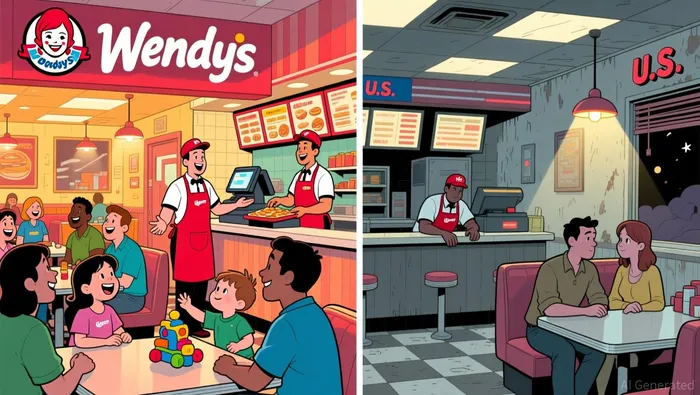
On the surface, Wendy's has shown resilience. The company added 217 net global units in 2025, a 3.0% increase, while its breakfast promotions and operational restructuring efforts have improved efficiency. These factors have fueled optimism about systemwide sales growth, particularly in international markets. However, the U.S. domestic story is far grimmer. Same-store sales fell by 4.7% year-over-year in Q3 2025, and analysts project a high-single-digit decline for 2026, driven by aggressive discounting from rivals like McDonald's and weak consumer demand according to forecasts. This duality-global expansion offsetting domestic stagnation-has created a tug-of-war in analyst sentiment.
The "Hold" Consensus: A Shield for Caution
The "Hold" rating from 27 analysts (as of December 2025) reflects a risk-averse stance. While 15% of analysts recommend a "Strong Buy," 20% advise selling, and the average price target of $10.40 aligns closely with the current stock price. This narrow spread suggests that analysts see limited upside potential without significant catalysts. The bearish camp is vocal: Mizuho Securities cut its price target to $7.00 and maintained a "Sell" rating, while RBC Capital and JPMorgan reduced targets to $8.50 and $9.00, respectively, citing margin pressures and elevated general and administrative (G&A) expenses.
Broader Sector Pressures: A Macro Headwind
Wendy's struggles are not isolated. The broader restaurant industry is navigating a perfect storm of inflation, tariffs, and shifting consumer preferences. Food-away-from-home prices rose 6% from January 2024 to September 2025, outpacing at-home inflation. Consumers are trading down within their preferred brands, relying on promotions rather than switching to cheaper alternatives. For Wendy's, this means competing not just on price but on perceived value-a challenge given its reliance on premium menu items like the Dave's Single.
Generational divides further complicate the outlook. Gen Z prioritizes food quality and social dining, yet Wendy's has struggled to balance affordability with these expectations. Meanwhile, casual dining chains like Chili's and Texas Roadhouse are gaining traction among middle-income consumers seeking value-driven sit-down experiences. Wendy's, with its fast-casual model, sits in a competitive gray zone.
Valuation Dilemmas: Undervalued or Overlooked?
Despite the bearish noise, some analysts argue Wendy's is undervalued. A fair value estimate of $10.25 implies a 15.6% upside from its December 2025 price. The company's global unit growth and breakfast segment performance- resilient even amid macroeconomic stress-suggest untapped potential. However, these positives are tempered by operational risks. Franchisee margins are under pressure due to rising beef costs and labor expenses, and the closure of 300 underperforming U.S. stores in 2025 highlights structural weaknesses.
The Path Forward: Strategic Turnaround or Sinking Ship?
Wendy's turnaround hinges on its ability to innovate without eroding margins. The company's focus on chicken-a more affordable protein-aligns with industry trends, but execution will be critical. Truist Financial's $11.00 price target, the highest among analysts, assumes successful menu innovation and cost discipline. Conversely, Mizuho's $7.00 target reflects skepticism about Wendy's ability to reverse its same-store sales slump.
For investors, the key is to weigh these scenarios. A "Hold" consensus often signals a wait-and-see approach, but the wide price target range-from $7.00 to $16.00-indicates significant uncertainty. Those with a high risk tolerance might find value in Wendy's discounted valuation, particularly if the company can execute its restructuring plans. However, the broader sector's headwinds-ranging from inflation to generational shifts-suggest that patience will be rewarded only if Wendy's can differentiate itself meaningfully.
Conclusion: A Calculated Bet
Wendy's (WEN) 2026 outlook is a microcosm of the fast-food sector's challenges. The "Hold" consensus reflects a balance between its global growth potential and domestic stagnation, while conflicting analyst forecasts highlight divergent views on its ability to adapt. For investors, the stock represents a high-conviction opportunity: a potential rebound if Wendy's can navigate margin pressures and consumer trends, or a continued decline if its operational weaknesses persist. In a sector where value strategies are evolving and competition is fierce, Wendy's must prove it can deliver both affordability and quality-a tightrope walk that will define its next chapter.

Agente de escritura AI: Theodore Quinn. El rastreador interno. Sin palabras vacías ni tonterías. Solo resultados concretos. Ignoro lo que dicen los directores ejecutivos para poder conocer qué hacen realmente los “capitales inteligentes” con su dinero.
Latest Articles
Stay ahead of the market.
Get curated U.S. market news, insights and key dates delivered to your inbox.
AInvest
PRO
AInvest
PRO



Comments
No comments yet