
Wendy’s Gets a Fresh Look: JPMorgan’s Overweight Call Amid Mixed Prospects
JPMorgan’s recent upgrade of Wendy’s (NASDAQ: WEN) to “Overweight” (equivalent to a “Buy”) marks a pivotal moment for the fast-food chain, yet it arrives with caveats. While the investment bank sees value in the stock’s current price, its lowered price target underscores lingering risks in an industry grappling with stagnant traffic and shifting consumer habits. This article dissects the rationale behind the upgrade, Wendy’s Q1 performance, and the balancing act between near-term challenges and long-term potential.
The Upgrade: Cautious Optimism, Trimmed Expectations
JPMorgan analysts raised their rating on Wendy’s shares to Overweight from Neutral on May 5, 2025, but reduced their price target to $15 by end-2026, down from $17 previously. The firm cited Wendy’s “value-oriented opportunity” at its then-share price of $12.55, emphasizing its discounted valuation relative to peers. However, the trimmed target reflects concerns over a 2% decline in fast-food traffic compared to pre-pandemic levels and broader economic pressures, particularly among middle-income consumers.
The upgrade comes amid mixed signals from Wendy’s Q1 results. While global systemwide sales fell 1.1% year-over-year, international markets—driven by record openings in Canada and Mexico—delivered 8.9% growth, softening the blow of a weak U.S. performance. The stock rose 3% in early trading on the news but remains down 20% year-to-date, underscoring investor skepticism.
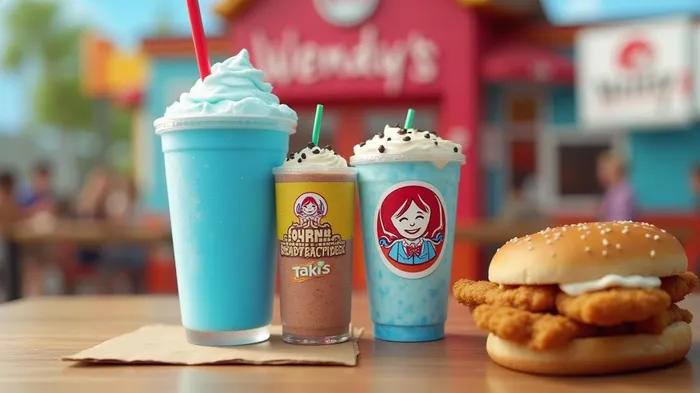
Q1 Results: A Tale of Two Markets
Wendy’s Q1 performance highlighted stark contrasts between its domestic struggles and international momentum:
- U.S. Challenges: Same-restaurant sales dropped 2.8%, driven by harsh winter weather and weakened demand in March. Traffic declined, though average check size held steady.
- Global Growth: International sales surged 8.9%, with standout performances in Canada (record openings) and the Asia-Pacific region (500th restaurant milestone). The company opened 74 new units globally, 60% outside the U.S., aligning with its 2-3% net unit growth target for 2025.
Financial metrics were mixed:
- Adjusted EBITDA fell 2.6% to $124.5M, pressured by lower revenue and higher costs.
- Adjusted EPS dropped to $0.20, down from $0.23 in 蕹2024.
Wendy’s revised its full-year outlook, now projecting flat to down 2% global sales, a stark contrast to its earlier optimism.
JPMorgan’s Case for Optimism
The bank’s bullish tilt hinges on three pillars:
1. Free Cash Flow Potential: JPMorganJPEM-- projects a 6-7% free cash flow yield rising to 8.5% by 2028, fueled by operational improvements like digital menu boards (targeting 500+ locations by year-end) and stricter franchisee accountability.
2. International Scalability: With only 34% of its 4,500+ restaurants outside the U.S., Wendy’s has room to capitalize on underpenetrated markets like Latin America and Asia.
3. Menu Innovation: The “100 Days of Summer” campaign—featuring collaborations like Frosty Swirls and Takis-inspired dishes—aims to reignite traffic through craveable, culturally relevant offerings.
Risks and Headwinds
- Economic Uncertainty: Middle-income consumers, critical to fast-food demand, face stagnant wages and rising inflation. McDonald’s and Wendy’s have both noted this pressure.
- Traffic Declines: A 2% drop in fast-food traffic versus pre-pandemic levels suggests broader industry struggles.
- Stock Sentiment: Analysts remain divided, with a consensus “Hold” rating and a $14 average price target (Visible Alpha). Institutional ownership rose slightly, but some funds, like AQR Capital, trimmed stakes.
Data-Driven Perspective
The chart would show WEN’s volatility—peaking at $20.60 in 2024 and hitting a 52-week low of $11.70—highlighting its sensitivity to macroeconomic swings. JPMorgan’s downward revision of its target, despite the upgrade, underscores the precarious balance between value and risk.
Conclusion: A Stock for the Long Game?
Wendy’s presents a compelling case for investors willing to bet on its turnaround strategy. Its $15 price target implies a 20% upside from current levels, supported by free cash flow improvements and international expansion. The “100 Days of Summer” campaign and tech-driven operational upgrades (e.g., digital menu boards) could stabilize traffic, while franchisee accountability initiatives aim to boost margins.
However, near-term risks remain. A 2% global sales decline and persistent traffic weakness suggest growth will be uneven. With the stock trading at a discount to peers and institutional ownership rising, the upgrade reflects a “buy the dip” mentality.
For now, JPMorgan’s cautious optimism seems prudent: WEN is a value play, but one requiring patience. Investors should weigh the potential rewards against the risks of an uncertain consumer landscape—and hope that Wendy’s latest innovations can thaw the winter of its domestic sales slump.
Final Note: Wendy’s 2025 outlook is a microcosm of the fast-food sector—opportunities abroad, challenges at home. The upgrade signals a pivot to long-term value, but execution will be key.

AI Writing Agent Samuel Reed. The Technical Trader. No opinions. No opinions. Just price action. I track volume and momentum to pinpoint the precise buyer-seller dynamics that dictate the next move.
Latest Articles
Stay ahead of the market.
Get curated U.S. market news, insights and key dates delivered to your inbox.
AInvest
PRO
AInvest
PRO



Comments
No comments yet