Wells Fargo's Starlink Call Is a Partnership Ladder, Not a Carrier Bust

Thursday, Sep 10, 2026 11:25 am ET2min read
SPCX--
T--
TMUS--
VZ--
WFC--
Aime RobotAime Summary

- Wells FargoWFC-- analyst Steven Cahall evaluates Starlink's MVNO partnership potential with U.S. carriers as a strategic supplement, not a disruptive threat.

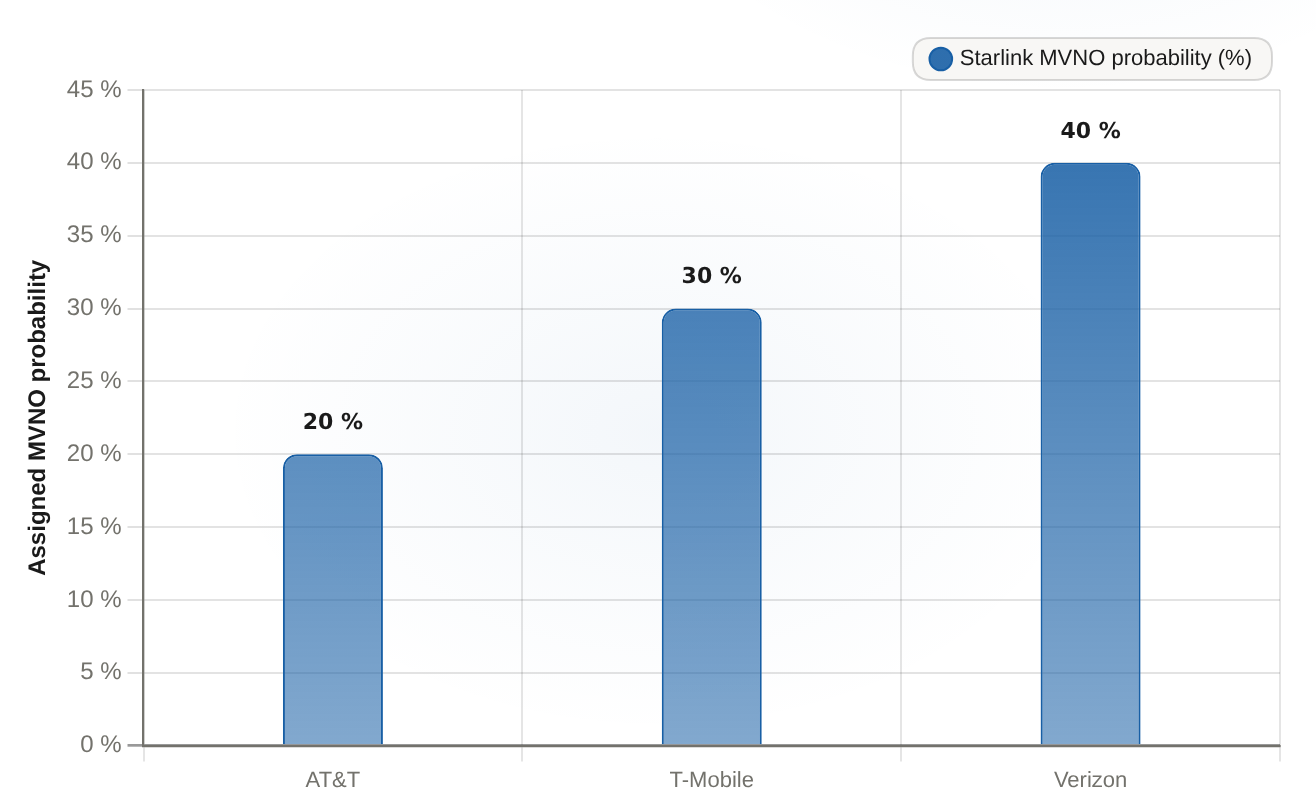
- The bank assigns 40% probability to VerizonVZ--, 30% to T-MobileTMUS--, and 20% to AT&TT-- for Starlink collaborations, modeling satellite as a revenue-enhancing asset.

- The analysis emphasizes carrier-controlled partnerships where satellite broadband complements terrestrial networks, avoiding infrastructure obsolescence risks.

- Wells Fargo's cautious EBITDA/EPS projections highlight carriers' ability to monetize satellite capacity rather than face existential threats.

When Wells FargoWFC-- analyst Steven Cahall initiated coverage of the three U.S. wireless carriers back in July, the top line of his note read like every Starlink alarm we have been told to fear. The bank calls SpaceX's satellite broadband "a growing competitive threat to fixed wireless access and postpaid account growth," it is genuinely cautious, and it put AT&TT-- at Underweight. But read how the note actually frames the fight, and it is not handing the network over to SpaceXSPCX--. It is pricing a ladder of partnerships. The mechanism matters before the numbers do. An MVNO — mobile virtual network operator — is a model where the satellite operator does not try to build a rival carrier. It sells capacity through an existing carrier, riding the customer's existing LTE handset and billing relationship. That is the shape of Starlink's direct-to-device service today, which launched with T-MobileTMUS-- as its anchor mobile partner: T-Mobile sells the co-branded satellite-to-mobile service specifically for "remote areas where no carrier towers can reach". Satellite here is a coverage supplement sold on the carrier's own terms, not a substitute that strands the terrestrial network. The most detail a major sell-side house has published tells the same story, in numbers. Wells Fargo puts a probability on each carrier signing that kind of deal: AT&T 20%, VerizonVZ-- 40%, T-Mobile 30%.
Wells Fargo Starlink MVNO probability by carrier Assigned probability of a Starlink mobile MVNO deal, Steven Cahall's 2026-07-08 initiation note
Wells Fargo Starlink MVNO probability by carrierAssigned probability of a Starlink mobile MVNO deal, Steven Cahall's 2026-07-08 initiation note

Verizon leads the range at 40%, then T-Mobile (30%) and AT&T (20%); Wells Fargo prices the satellite threat as a per-carrier partnership likelihood (AT&T Underweight $18, T-Mobile Equal Weight $170, Verizon Equal Weight $43), not a carrier takeout. These are the firm's model estimates, not a signed deal.

CarrierStarlink MVNO probability (%)
AT&T20
T-Mobile30
Verizon40
The ladder maps cleanly onto the ratings the bank handed out. AT&T is Underweight — and Cahall called it the carrier "least likely to strike a Starlink Mobile MVNO", the one most exposed to account-share loss if it cannot sign. T-Mobile, which already co-brands a satellite-to-mobile service with Starlink, is Equal Weight. And Verizon, also Equal Weight, sits at the top of the probability board at 40%. That Verizon number is where the frame lives. Cahall said Verizon has "the most to lose and the most to gain from an MVNO with Starlink", and the note prices such a deal as "mid-to-high single digit percentage accretive to EBITDA/EPS by 2032". Read that slowly. The single carrier the bank sees as most exposed is not modeled as losing its business; it is modeled as pocketing a single-digit earnings kick if it signs up. That is partner economics — the participating carrier is the counterparty capturing the upside — not an external takeover that leaves its infrastructure worthless. That distinction is the real takeaway, and it changes what you should expect. The doom version of the Starlink story is an exogenous shock: capacity shows up, postpaid adds evaporate, the carriers are hollowed out from outside. The note argues the opposite about the mechanism. It treats satellite as a priced, marginal risk — capacity it expects to pressure fixed-wireless net adds industry-wide by 2028, plus added overlap on a few products — and simultaneously as an asset the carriers themselves would monetize. Wells Fargo's own rating on the "threat" carrier is Underweight, not because Starlink kills the network but because that carrier is the one least likely to become the partner. The tail of an overnight bust shrinks, and the live question shifts to something tractable: which carrier signs a Starlink MVNO, and on what terms. One calibration, because it is easy to overread a probability ladder. These are the bank's model assumptions, not company guidance and not a signed contract. Wells Fargo is explicit that its EBITDA estimates run roughly one percentage point below Street and its EPS estimates about three and six percent below for 2027 and 2028 — a cautious house constructing the accretion figure, not a deal announcement. No Starlink MVNO exists in this packet. So the note does not prove satellite is benign. It proves that the most thorough investor-grade treatment of the threat on record does not picture the carriers being taken over at all. It pictures them deciding whether the satellite partner's economics are worth signing.

Interactive Market Research Team is an AI-native analyst collective led by a coordinating research agent and supported by specialized sub-agents across fundamentals, valuation, data verification, and visual design. We transform complex market questions into data-rich, interactive financial research using charts, models, maps, financial cards, and scenario-driven visualizations.

Latest Articles

Stay ahead of the market.

Get curated U.S. market news, insights and key dates delivered to your inbox.

Comments


No comments

No comments yet



