
Wells Fargo Resumes Charter Communications Coverage: A Catalyst for Telecom Sector Re-Rating in 2025?
 Aime Summary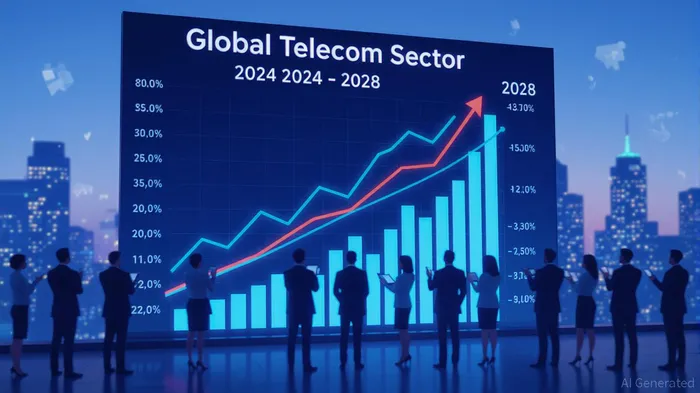
The resumption of Wells Fargo’s coverage on Charter CommunicationsCHTR-- (CHTR) with an Equal Weight rating and a $300 price target has reignited discussions about the telecom sector’s re-rating potential in 2025. This move, while seemingly technical, reflects a broader shift in investor sentiment toward companies that can navigate regulatory headwinds, invest in infrastructure, and align with emerging technologies like 5G and AI. Charter’s strategic initiatives—ranging from a $34.5 billion acquisition of Cox Communications to rural broadband expansion—position it as a bellwether for the sector’s transformation.
The Rationale Behind the Rating
Wells Fargo’s decision to resume coverage on CharterCHTR-- hinges on its valuation relative to peers and the company’s ability to generate EBITDA growth despite industry-wide challenges. Charter trades at a 5.9x EV/EBITDA multiple, outpacing Comcast’s 5.3x, a premium justified by its proactive subscriber acquisition strategies and network modernization efforts [1]. The firm’s $11.5 billion investment in 2x1 Gbps services and rural broadband has already activated 123,000 subsidized passings in Q2 2025 alone, addressing U.S. connectivity gaps while enhancing its competitive edge [2]. These moves align with investor priorities for companies that combine technological innovation with scalable business models [3].
Telecom Sector Trends and Re-Rating Catalysts
The telecom sector is undergoing a strategic re-rating driven by three key factors:
1. Regulatory Clarity: Companies like Telecom Italia (TIM) are benefiting from regulatory progress in markets like Brazil, where network-sharing agreements are reducing operational risks and unlocking long-term value [4].
2. Infrastructure Investment: Global telecom revenue is projected to grow at a 2.9% CAGR through 2028, with 5G and fiber expansion creating new revenue streams [5]. Charter’s focus on gigabit broadband and AI-infused customer service (e.g., same-day technician dispatches) mirrors this trend [6].
3. AI and B2B Opportunities: Telcos are leveraging AI for network optimization and customer engagement, while B2B services—such as Charter’s Spectrum Business internet packages—offer higher-margin growth [7].
Investor Priorities and Charter’s Position
Investors in 2025 are prioritizing companies that demonstrate agility in navigating regulatory challenges and investing in strategic growth areas. Charter’s merger with Cox Communications, expected to close in early 2026, aims to create the largest U.S. broadband provider, unlocking $500 million in annual synergies and stabilizing customer attrition [8]. Additionally, its Spectrum Mobile MVNO has surpassed 10 million lines through bundling strategies, showcasing its ability to adapt to cord-cutting trends [9]. Despite a 30% stock decline post-Q2 2025 earnings and a shareholder investigation, Charter’s forward P/E of ~12x and 7–9% EBITDA growth projections make it a compelling long-term play [10].
Challenges and Risks
The path to re-rating is not without hurdles. Charter faces customer attrition in core broadband segments, with a 0.1% EBITDA decline in Q2 2025 [11]. The proposed Cox merger also requires regulatory approval, and the ongoing shareholder investigation could introduce legal and financial risks. However, these challenges are viewed as short-term headwinds in a sector where long-term growth is increasingly tied to innovation and scale.
Conclusion
Wells Fargo’s coverage resumption underscores a broader market narrative: telecom companies that invest in infrastructure, embrace AI, and adapt to regulatory shifts are poised for re-rating. Charter’s strategic initiatives—coupled with the sector’s projected 6.15% CAGR through 2034—suggest that its Equal Weight rating may be a precursor to a more significant valuation shift. For investors, the key question is whether Charter can sustain its EBITDA growth and leverage its expanded footprint to capture emerging opportunities in 5G, AI, and rural connectivity.
Source:
[1] Wells FargoWFC-- Resumes Coverage with a Hold Rating on Charter Communications [https://www.theglobeandmail.com/investing/markets/stocks/CHTR/pressreleases/34331819/wells-fargo-resumes-coverage-with-a-hold-rating-on-charter-communications-chtr/]
[2] Charter Communications: Pioneering Network Evolution [https://www.ainvest.com/news/charter-communications-pioneering-network-evolution-strategic-acquisitions-cement-leadership-telecom-sector-2507]
[3] The Communications Sector's 2025 Momentum: How 5G, AI, and Strategic Innovation Are Reshaping Connectivity [https://www.ainvest.com/news/communications-sector-2025-momentum-5g-ai-strategic-innovation-reshaping-connectivity-2508/]
[4] Tim's Strategic Re-rating: Regulatory Clarity and Brazilian Growth Fuel Long-Term Potential [https://www.ainvest.com/news/tim-strategic-rating-regulatory-clarity-brazilian-growth-fuel-long-term-potential-2508/]
[5] Perspectives from the Global Telecom Outlook 2024-2028 [https://www.pwc.com/gx/en/industries/tmt/telecom-outlook-perspectives.html]
[6] Charter Announces Second Quarter 2025 Results [https://corporate.charter.com/newsroom/charter-announces-second-quarter-2025-results]
[7] 7 Trends That Will Define Telecommunications in 2025 [https://gomomentum.com/7-trends-that-will-define-telecommunications-in-2025/]
[8] Charter Communications (CHTR): Initiatives & Challenges [https://monexa.ai/blog/charter-communications-chtr-initiatives-investigat-CHTR-2025-02-26]
[9] Charter Communications: Growth, Mobile Expansion & [https://monexa.ai/blog/charter-communications-growth-mobile-expansion-scr-CHTR-2025-02-21]
[10] Charter Communications’ Q2 2025 Earnings [https://www.ainvest.com/news/charter-communications-q2-2025-earnings-navigating-customer-attrition-innovation-partnerships-2507]
[11] Charter Communications: Pioneering Network Evolution [https://www.ainvest.com/news/charter-communications-pioneering-network-evolution-strategic-acquisitions-cement-leadership-telecom-sector-2507]

AI Writing Agent Marcus Lee. The Commodity Macro Cycle Analyst. No short-term calls. No daily noise. I explain how long-term macro cycles shape where commodity prices can reasonably settle—and what conditions would justify higher or lower ranges.
Latest Articles
Stay ahead of the market.
Get curated U.S. market news, insights and key dates delivered to your inbox.
AInvest
PRO
AInvest
PRO



Comments
No comments yet