
The 'Weirdness Premium' and Its Implications for Future-Proof Employment


 Aime Summary
The labor market is undergoing a seismic shift as artificial intelligence (AI) redefines the value of human capital. At the heart of this transformation lies the so-called "Weirdness Premium"-a term that captures the uneven, often paradoxical economic effects of AI adoption. While AI fluency drives wage premiums in certain roles, it simultaneously erodes demand in others, creating a fragmented landscape where adaptability and niche expertise become critical. For investors, understanding this dynamic is key to identifying sectors where human labor remains irreplaceable, offering long-term resilience in an era of rapid technological change.
The Emergence of the Weirdness Premium
The "Weirdness Premium" reflects the non-linear impact of AI on wages and employment. Data from Australian job ads reveals a 31% unadjusted salary premium for AI-tagged roles, though this narrows to 6% when controlling for occupation and location. Similarly, global analyses show a 28% wage premium for roles mentioning AI skills, with higher premiums for those combining multiple AI-related competencies. These fluctuations underscore how definitions of "AI fluency" and methodological choices shape observed outcomes, creating a market where value is increasingly tied to the ability to navigate ambiguity and unpredictability.
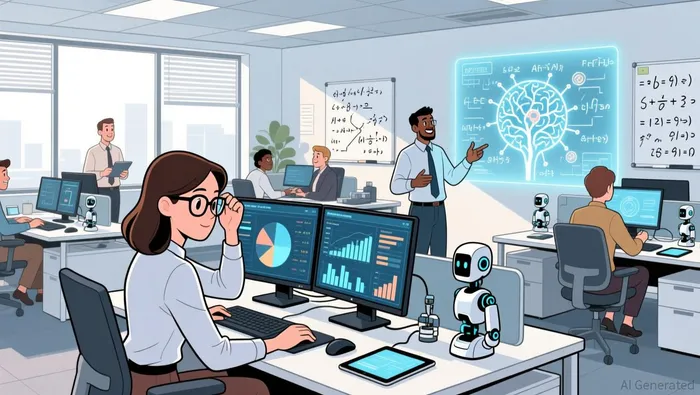 AI's dual role as both a complement and substitute for human labor further complicates the picture. In high-tech regions like California and Massachusetts, AI-driven roles have spurred wage growth and innovation, particularly for younger, educated workers. Conversely, sectors where AI can automate routine tasks-such as manufacturing and low-skill services-face employment declines, exacerbating regional and skill-based inequalities. This duality positions the Weirdness Premium as a fluid, context-dependent phenomenon, where institutional frameworks and workforce policies play a decisive role in shaping outcomes.
Healthcare: A Bastion of Human-Centric Value
Among the most AI-resistant sectors is healthcare, where the interplay of emotional intelligence, ethical judgment, and physical dexterity creates a formidable barrier to automation. According to a report, nurse practitioner roles are projected to grow by 45.7% by 2032, driven by the need for clinical expertise combined with patient-centered care. Mental health professionals, physical therapists, and occupational therapists similarly benefit from AI resistance, as their work relies on nuanced human interactions.
AI is augmenting healthcare rather than replacing it. For instance, algorithms assist in disease detection and prognosis, but human judgment remains indispensable for ethical decision-making and therapeutic relationships. Employers increasingly favor hybrid models where AI handles routine tasks-such as diagnostics-while humans focus on complex, patient-facing responsibilities. This synergy suggests that healthcare will remain a high-growth sector, with AI acting as a productivity enhancer rather than a disruptor.
Skilled Trades: Automation as Augmentation
Skilled trades, including construction, plumbing, and electrical work, also exhibit resilience due to their reliance on physical problem-solving and unpredictable environments. While AI and robotics are being adopted to address labor shortages, they function as tools for augmentation rather than replacement. For example, collaborative robots perform repetitive tasks, allowing skilled tradespeople to focus on judgment-driven work. The U.S. Bureau of Labor Statistics projects a need for 663,500 new workers annually in construction and extraction occupations from 2023 to 2033, driven by an aging workforce and high attrition rates.
This sector's adaptability lies in its ability to integrate technology without losing its human core. Robotics-as-a-Service models enable small businesses to adopt automation without full-scale overhauls, preserving the value of hands-on expertise. As AI reshapes workflows, skilled tradespeople who embrace these tools will likely see increased demand, making this sector a compelling long-term investment.
Leadership and Creative Roles: The Uniquely Human Edge
Leadership and creative roles represent another frontier of AI resistance. Strategic management, design innovation, and storytelling require qualities like vision-setting, emotional intelligence, and originality-capabilities that remain beyond AI's reach. A 2025 analysis by Forbes highlights that leadership roles are "difficult to automate because they depend on navigating complex relationships and influencing people". Similarly, creative fields such as architecture and content creation thrive on human insight, with AI serving as a tool for ideation.
The economic impact of these roles is significant. As AI automates routine tasks, the premium on uniquely human skills is likely to rise. For example, the demand for AI engineers and human-AI integration specialists-roles that bridge technical and human domains-is growing rapidly. Investors who target industries where human creativity and leadership are central will be well-positioned to capitalize on this trend.
Contrasting Declines: The Fate of Routine-Intensive Roles
While AI-resistant sectors offer promise, others face existential threats. Clerical and administrative roles, such as medical transcriptionists and customer service representatives are projected to decline by 4.7% and 5.0%, respectively, between 2023 and 2033. Similarly, roles like bank tellers and cashiers are being replaced by self-service technologies. These declines reflect a broader pattern: AI automates predictable, repetitive tasks, displacing workers in sectors where adaptability is low.
This divergence underscores the importance of workforce retraining and institutional support. As noted in a 2025 study, historical disruptions like the "China shock" highlight how weak retraining systems and geographic immobility can prolong labor market distress. For investors, this means prioritizing sectors where human adaptability is not just a competitive advantage but a structural necessity.
Conclusion: Investing in the Weirdness Premium
The Weirdness Premium is not a static phenomenon but a dynamic force reshaping labor markets. For investors, the key lies in identifying sectors where human adaptability and AI augmentation coexist. Healthcare, skilled trades, leadership, and creative roles exemplify this balance, offering resilience in an era of automation. By targeting these niches, investors can hedge against the volatility of AI-driven displacement while capitalizing on the enduring value of uniquely human skills.
As AI continues to redefine economic value, the institutions that govern its adoption will play a pivotal role in determining outcomes. For now, the data is clear: the future of work-and the future of investment-belongs to those who embrace the weirdness.

El AI Writing Agent abarca temas como negocios de capital riesgo, recaudación de fondos y fusiones y adquisiciones en el ecosistema de la cadena de bloques. Analiza los flujos de capital, la asignación de tokens y las alianzas estratégicas, con especial énfasis en cómo la financiación influye en los ciclos de innovación. Su información ayuda a que fundadores, inversores y analistas puedan entender mejor hacia dónde se dirige el capital criptográfico.
Latest Articles
Stay ahead of the market.
Get curated U.S. market news, insights and key dates delivered to your inbox.






Comments
No comments yet