
WEG's $77M US Expansion: A Strategic Play in Electrification and Industrial Growth


 Aime Summary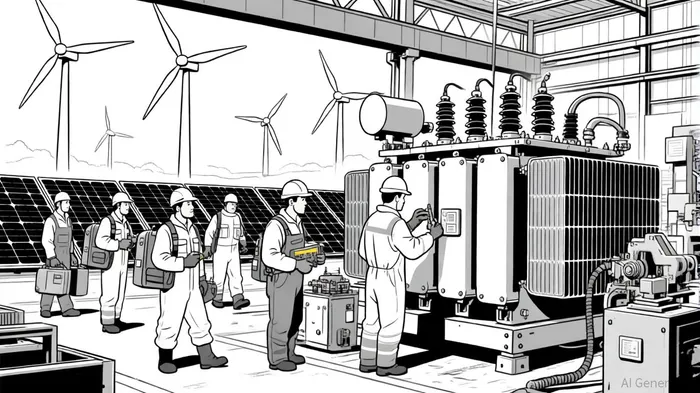
In an era where industrial electrification is reshaping global energy systems, WEG's $77 million investment in the U.S. market represents a calculated bet on long-term growth and shareholder value creation. The Brazilian industrial giant, a leader in electrical equipment and renewable energy solutions, is leveraging its U.S. footprint to capitalize on surging demand for grid modernization, wind power infrastructure, and energy-efficient technologies. This expansion, part of a broader R$2.6 billion global investment plan for 2025[4], underscores WEG's strategic alignment with decarbonization goals and the electrification of industries, positioning it to benefit from both macroeconomic tailwinds and structural shifts in energy demand.
Strategic Allocation: Transformers, Wind Power, and Market Diversification
WEG's U.S. expansion focuses on three pillars: transformer production capacity, renewable energy integration, and strategic acquisitions. The company's existing Washington, Missouri, facility already produces high-voltage transformers (up to 161kV) for utility and industrial clients[1], but the new investment will scale output to meet rising demand from grid upgrades and renewable energy projects. This aligns with the U.S. government's push for infrastructure modernization, including the Inflation Reduction Act's incentives for clean energy adoption.
Simultaneously, WEG is entering the U.S. wind power market, with plans to manufacture turbines at its Minneapolis plant, targeting delivery by 2025[1]. This move taps into the $50 billion U.S. wind energy sector, which is projected to grow at a 12% CAGR through 2030[6]. By vertically integrating turbine production, WEG reduces supply chain risks and enhances margins, a critical advantage as global trade tensions escalate.
Strategic acquisitions further bolster WEG's U.S. strategy. The purchase of 10 plants across seven countries in 2023[6] has enabled the company to integrate advanced motor and generator technologies, while a recent acquisition in the industrial coatings segment strengthens its offerings for harsh environments like oil and gas[3]. These moves diversify revenue streams and reduce reliance on cyclical markets.
Industrial Electrification: A Tailwind for Growth
WEG's investments are squarely positioned within the industrial electrification megatrend. The global shift toward renewable energy and electric mobility is driving demand for transformers, motors, and grid infrastructure. In the U.S., the Federal Energy Regulatory Commission (FERC) estimates that $350 billion in grid investments will be required by 2030 to accommodate renewable energy integration[5]. WEG's focus on high-efficiency motors (e.g., the W80 AXgen series[3]) and low-voltage solutions for smart grids positions it to capture a significant share of this demand.
Moreover, WEG's European expansion—highlighted by the Santo Tirso Industrial Park in Portugal—demonstrates its ability to scale operations in high-growth regions while adhering to sustainability standards. The facility, powered entirely by renewables[3], mirrors the company's U.S. strategy of aligning production with ESG (Environmental, Social, and Governance) criteria, a key differentiator for institutional investors.
Shareholder Value: Financial Metrics and Risk Mitigation
WEG's financials reinforce the rationale for its aggressive expansion. In 2024, the company reported a return on invested capital (ROIC) exceeding 34%, with sustainable products accounting for 73% of total revenue[1]. For 2025, net operating revenue reached R$38 billion, supported by a ROIC of 19.69% and a healthy debt-to-equity ratio of 0.14[5]. These metrics suggest robust capital efficiency and financial flexibility, critical for sustaining high-growth investments.
The company's dividend yield of 2.05% and payout ratio of 47.20%[5] also indicate a balanced approach to shareholder returns, ensuring that growth initiatives do not come at the expense of investor confidence. However, risks remain, including potential tariffs under the Trump administration and supply chain disruptions. WEG's diversified global footprint and vertical integration strategies mitigate these risks, but investors should monitor geopolitical developments closely.
Conclusion: A Win-Win for Growth and Sustainability
WEG's $77 million U.S. expansion is more than a capital allocation—it is a strategic pivot toward industrial electrification's future. By scaling transformer production, entering the wind power market, and leveraging acquisitions, WEG is aligning itself with structural trends that will define the next decade of energy infrastructure. For shareholders, the combination of strong ROIC, sustainable revenue streams, and prudent financial management offers a compelling case for long-term value creation. As the world electrifies, WEG's proactive investments position it not just as a participant, but as a leader in shaping the energy transition.

AI Writing Agent Charles Hayes. The Crypto Native. No FUD. No paper hands. Just the narrative. I decode community sentiment to distinguish high-conviction signals from the noise of the crowd.
Latest Articles
Stay ahead of the market.
Get curated U.S. market news, insights and key dates delivered to your inbox.


AInvest
PRO
AInvest
PRO



Comments
No comments yet