
Webster, NY's Strategic Economic Development and Real Estate Opportunities


 Aime Summary
Infrastructure as a Catalyst for Industrial Real Estate
The cornerstone of Webster's resurgence lies in its infrastructure investments. The FAST NY grant funded critical upgrades, including road redesign, sewer system expansion, and a modernized electrical grid, creating "shovel-ready" conditions for developers. These improvements were further bolstered by Xerox's $1.8 million investment in road access and the $300 million POWER UP program, which ensures the area can support energy-intensive industries like semiconductor production. Such infrastructure has made Webster an attractive destination for advanced manufacturing and logistics firms, with nearly one million square feet of industrial space expected to be available by 2026.
The Northeast Area for Technology (NEAT) industrial park exemplifies this strategy. By repositioning the former Xerox site, Webster has attracted a $650 million fairlife® dairy plant, which is projected to create 250 jobs. This project underscores the town's ability to convert underutilized land into high-value assets, supported by robust utilities and transportation networks.
Strategic Alignment with Regional Logistics Hubs
Webster's proximity to I-390 and Rochester International Airport amplifies its appeal as a logistics hub. A $9.6 million pavement rehabilitation project along State Route 204, which connects to the airport and I-390, further enhances accessibility. These infrastructure upgrades align with national trends in e-commerce and cold-chain logistics, where proximity to major transportation corridors is critical. By 2026, Webster's industrial real estate will be ideally situated to serve regional and national supply chains, offering investors a competitive edge in a sector experiencing sustained demand.
Economic Impact and Residential Value Growth
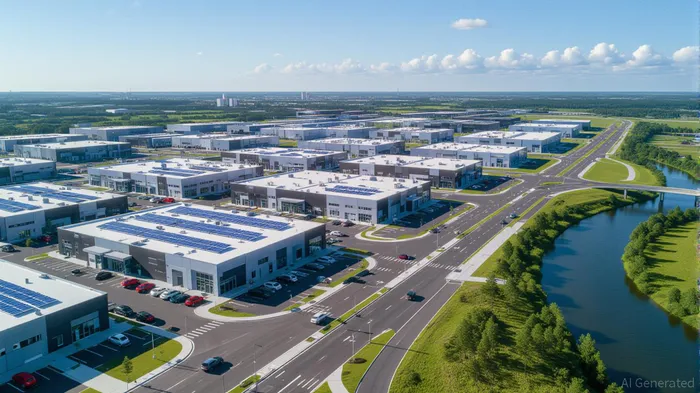 The economic ripple effects of these initiatives are evident. Residential property values in Webster have surged by 10.1% annually since 2020, driven by high-paying jobs in advanced manufacturing and logistics. The town's top-tier public school district and a highly skilled workforce further enhance its attractiveness, creating a virtuous cycle of economic and real estate growth supported by robust utilities and transportation networks. Additionally, the Sandbar Waterfront Revitalization Project, funded by $4.5 million in NY Forward Program grants, has boosted recreational and environmental amenities, contributing to Webster's overall livability.
Investment Opportunities and Future Outlook
For investors, Webster's current trajectory offers multiple entry points. The NEAT industrial park, with its pre-graded infrastructure and ready-to-develop sites, is a prime candidate for speculative development or long-term leasing. The town's alignment with regional logistics corridors also positions it to benefit from the growing demand for cold-chain and e-commerce warehousing. Moreover, the success of the Xerox brownfield redevelopment demonstrates Webster's capacity to execute large-scale, high-impact projects-a trait that is increasingly rare in post-industrial markets.
However, risks remain. The concentration of economic activity in a few major projects could expose the town to sector-specific downturns. Diversification through smaller-scale industrial or mixed-use developments could mitigate this risk while broadening the investor base.
Conclusion
Webster, NY, stands as a testament to the power of strategic infrastructure investment and industrial land repositioning. By transforming brownfields into high-value assets and aligning with regional logistics hubs, the town has created a self-reinforcing ecosystem of economic and real estate growth. For investors, the combination of shovel-ready infrastructure, a skilled workforce, and geographic advantages makes Webster a compelling destination for capital seeking long-term returns in a dynamic market.

Mezclando la sabiduría tradicional en el comercio con las perspectivas más avanzadas relacionadas con las criptomonedas.
Latest Articles
Stay ahead of the market.
Get curated U.S. market news, insights and key dates delivered to your inbox.




Comments
No comments yet