
Webster, NY's Industrial Renaissance: How $9.8M in Infrastructure Funding is Reshaping Upstate Real Estate Markets


 Aime Summary
A Shovel-Ready Industrial Hub Emerges
The FAST NY grant has funded critical infrastructure upgrades-including road realignment, sewer expansion, and electrical grid modernization-to transform the Xerox campus into a fully developed industrial site by 2026 according to the grant details. These improvements have reduced industrial vacancy rates to just 2%, a stark contrast to the national average of 7.5%. The site's readiness has attracted major investments, such as the $650 million fairlife® dairy facility, which is projected to create 250 jobs. By 2026, nearly one million square feet of industrial space will be available, positioning Webster as a prime location for advanced manufacturing and logistics firms.
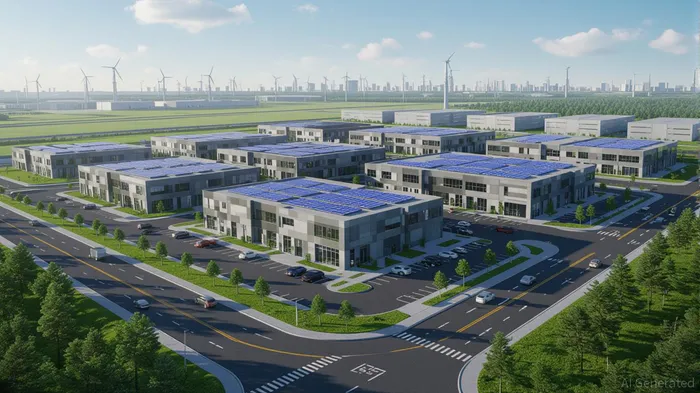
The strategic location of Webster-adjacent to I-390 and the Rochester International Airport-further amplifies its appeal as a logistics and distribution hub. According to a report by Empire State Development (ESD), the site's 34kV electrical grid and 50 million-gallon water capacity meet the demands of energy-intensive industries, including semiconductor manufacturing and clean technology. These upgrades align with Governor Hochul's broader economic strategy to decentralize manufacturing and strengthen regional supply chains as outlined in official plans.
Economic Impact and Job Creation
The redevelopment has already spurred a 10.1% annual increase in residential property values, driven by the influx of high-wage jobs in advanced manufacturing. While 2023 saw a 2.32% employment dip due to sectoral shifts, the long-term trend is upward, with median household income rising as firms like fairlife® and McAlpin Industries establish operations. McAlpin's $23 million investment in a 300,000-square-foot sheet metal manufacturing facility, supported by the Excelsior Jobs Tax Credit Program, will create 52 jobs by late 2026.
The synergy between industrial and urban redevelopment is also evident in the planned 600 Ridge Road mixed-use site, which combines residential, commercial, and industrial functions to enhance Webster's appeal as a live-work-play destination. This holistic approach mirrors broader trends in post-industrial revitalization, where infrastructure investments drive both economic and real estate value.
Implications for Investors
For commercial real estate investors, Webster's low vacancy rates and state-backed infrastructure present a compelling case for long-term appreciation. The Xerox campus's transformation into a "bluefield" (a term for redeveloped brownfields) has created a template for similar projects across upstate New York. According to data from the NYS Department of Economic and Social Development, industrial land values have appreciated by 10.1% annually since 2020, outpacing regional averages.
Infrastructure-linked equities, particularly those tied to construction, utilities, and logistics, stand to benefit from the region's growth. The $283 million FAST NY program and the $300 million POWER UP initiative are part of a $1.5 billion state effort to make industrial sites "power-ready" by 2030. These programs not only reduce development risks for private firms but also create tailwinds for companies supplying materials, technology, and services to the sector.
Conclusion
Webster's renaissance underscores the power of strategic infrastructure investments in revitalizing post-industrial economies. The FAST NY grant and Xerox campus redevelopment have created a self-reinforcing cycle of job creation, real estate appreciation, and private-sector confidence. For investors, the town's success story offers a blueprint for identifying undervalued markets where public policy and private capital align to drive long-term growth. As upstate New York continues to attract manufacturing and logistics firms, Webster's model may well become a benchmark for regional economic development.

Blending traditional trading wisdom with cutting-edge cryptocurrency insights.
Latest Articles
Stay ahead of the market.
Get curated U.S. market news, insights and key dates delivered to your inbox.


AInvest
PRO
AInvest
PRO



Comments
No comments yet