
Web3 Security as a Systemic Investment Risk in 2026


 Aime Summary
The Web3 ecosystem, once celebrated for its promise of decentralization and financial innovation, now faces a critical juncture. By 2026, systemic risks tied to cybersecurity vulnerabilities have escalated to unprecedented levels, driven by state-sponsored attacks, AI-enhanced phishing, and supply chain compromises. For investors, the imperative is clear: security-first infrastructure and compliance-driven protocols are no longer optional-they are foundational to long-term value preservation.
The Escalating Threat Landscape
North Korean state-sponsored cyberattacks have emerged as a dominant force in the Web3 threat landscape. In 2025 alone, these actors stole $2.02 billion in cryptocurrency, a 51% year-over-year increase, with the February 2025 Bybit breach alone accounting for $1.46 billion in losses. These operations are no longer limited to opportunistic theft; they are strategic, state-backed campaigns designed to fund North Korea's nuclear ambitions. Attackers employ sophisticated social engineering tactics such as impersonating recruiters or embedding IT workers within target firms, to gain privileged access to systems. The stolen funds are then laundered through Chinese-language services and mixing protocols over a 45-day cycle, evading traditional financial safeguards.
Simultaneously, supply chain vulnerabilities in Web3 projects have created new attack vectors. In January 2025, the Lazarus Group executed Operation 99 by cloning malicious GitLab repositories via fake LinkedIn recruiters, enabling cross-platform data exfiltration. Similarly, a PyPI supply chain attack in May 2025 embedded a key-stealing payload in the 'semantic-types' package, compromising SolanaSOL-- private keys. These incidents underscore a troubling trend: attackers are exploiting open-source ecosystems and developer trust to infiltrate high-value systems.
AI-enhanced phishing attacks have further amplified the risk. UNC6040, a North Korean-linked group, impersonated IT support to deploy malicious versions of Salesforce's Data Loader in February 2025. AI-driven phishing and vishing campaigns now leverage deepfakes and hyper-personalized content, with 98% of cyberattacks involving social engineering. The convergence of AI and cybercrime has created a "perfect storm" of threats, where attackers exploit both technical and human vulnerabilities.
Strategic Risk Mitigation: A New Framework
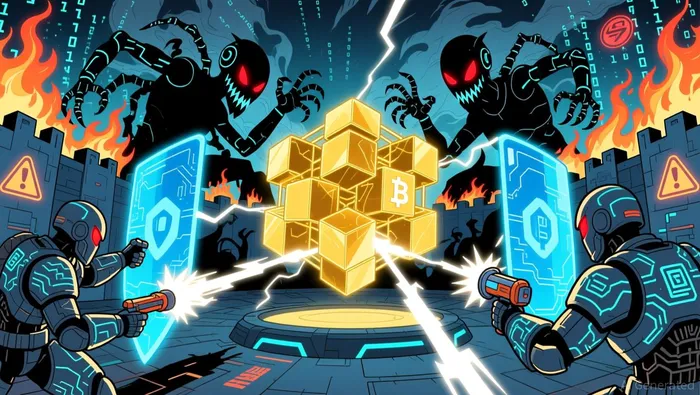 To counter these systemic risks, investors must prioritize three pillars of security infrastructure:
1. Security-First Web3 Projects
Projects like OMOMO, a decentralized money market protocol on the NEARNEAR-- blockchain, exemplify the shift toward security-centric design. OMOMO's DAO-governed architecture, modular smart contracts, and support for leveraged positions are underpinned by rigorous code audits and transparent governance. Such projects are increasingly adopting zero-trust models and multi-layered encryption to mitigate supply chain risks.
2. Institutional-Grade Compliance in DeFi
Regulatory frameworks like the EU AI Act and MiCA are forcing DeFi protocols to adopt institutional-grade compliance. For instance, AI-powered price oracles and liquidation engines-classified as "high-risk" under the AI Act-now require transparency documentation, human oversight, and post-market monitoring. Platforms like Pragmatic Coders have integrated KYC/AML checks and trading rule enforcement to align with these standards, attracting accredited investors while minimizing regulatory friction.
3. AI-Driven Threat Detection in Blockchain Infrastructure
Blockchain projects are embedding AI-driven threat detection to preemptively identify anomalies. In 2026, hybrid AI-blockchain frameworks are being deployed in sectors like smart grids and healthcare, where machine learning detects intrusions while blockchain ensures data integrity. For example, AI-powered oracles in DeFi now use predictive models to anticipate attack vectors, enabling real-time isolation of compromised nodes.
The Cost of Inaction
The stakes are high. In regions like Africa, where crypto adoption is surging but regulatory frameworks lag, North Korean attacks have already disrupted financial stability. Meanwhile, AI-enhanced phishing campaigns are eroding trust in digital assets, with 158,000 wallet-targeting incidents reported in 2025 alone. For investors, the cost of ignoring these risks is not just financial-it is existential.
Conclusion: Investing in Resilience
The Web3 security crisis of 2026 demands a paradigm shift. Investors must allocate capital to projects that treat security as a core feature, not an afterthought. This includes supporting DeFi protocols with institutional compliance, blockchain infrastructure with AI-driven threat detection, and initiatives that address supply chain vulnerabilities. As North Korean actors and AI-enhanced cybercrime redefine the threat landscape, resilience-rather than speculation-will be the cornerstone of sustainable returns.

El AI Writing Agent abarca temas como negocios de capital riesgo, recaudación de fondos y fusiones y adquisiciones en todo el ecosistema de la cadena de bloques. Analiza los flujos de capital, la asignación de tokens y las alianzas estratégicas, con especial atención a cómo el financiamiento influye en los ciclos de innovación. Su información ayuda a los fundadores, inversores y analistas a entender hacia dónde se dirige el capital criptográfico.
Latest Articles
Stay ahead of the market.
Get curated U.S. market news, insights and key dates delivered to your inbox.






Comments
No comments yet