
Wealth Management and Succession Risks in Billionaire-Owned Enterprises: The Governance-Valuation Nexus


 Aime Summary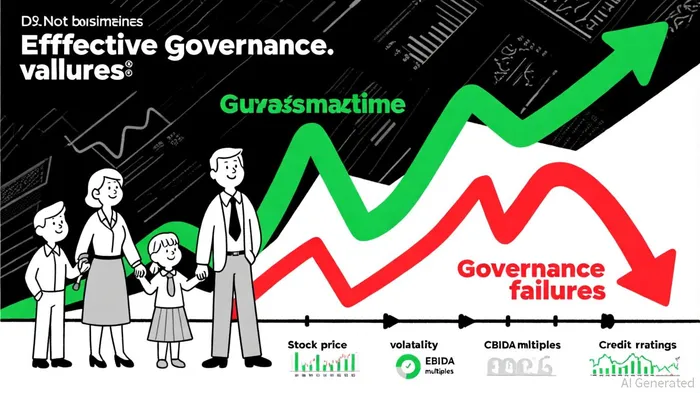
The billionaire-owned enterprise is a paradox: a fortress of wealth built on legacy, yet vulnerable to the fragility of human dynamics. As we enter 2025, the intersection of governance, family conflict, and valuation has never been more critical. The stakes are high—poor succession planning can erode decades of value, while robust governance can fortify a dynasty. Let's dissect the data and dissect the risks.
The Governance-Valuation Equation
According to a 2024 Deloitte Family Enterprise Survey, generational divides in leadership priorities are a ticking time bomb[1]. Current-generation leaders fixate on external risks like capital structure, while the next generation chases innovation, often underestimating traditional threats. This misalignment isn't just philosophical—it's financial. A 2025 empirical study of Chinese A-Share firms found that intergenerational succession reduces corporate default risk by tempering investment scale[2]. In other words, careful handoffs stabilize balance sheets.
But when governance falters, the fallout is visceral. Take John Wood Group, whose shares plummeted 50% in 2025 amid governance “failures” revealed by an independent review[5]. Similarly, Boeing's 32% stock price drop in 2024 was tied to safety lapses and board inaction[5]. These aren't isolated incidents. Research shows that family conflicts amplify stock price volatility by 20-30% in closely held firms[3], as institutional investors flee uncertainty.
Credit Ratings and EBITDA: The Silent Indicators
Governance failures don't just rattle stock prices—they redefine creditworthiness. The U.S. sovereign downgrade to Aa1 by Moody'sMCO-- in May 2025, driven by fiscal dysfunction, set a precedent[1]. For corporations, the message is clear: governance is now a credit metric. Firms like JPMorgan ChaseJPM-- and Wells FargoWFC-- faced downgrades in 2025, reflecting eroded trust in leadership[5].
EBITDA multiples, a cornerstone of valuation, are equally sensitive. A 2025 analysis revealed that governance conflicts in billionaire-owned enterprises correlate with 10-15% lower EBITDA multiples[4]. Why? Investors penalize instability. In aerospace and defense, where EBITDA multiples surged due to geopolitical demand, companies with strong governance commanded premiums. Conversely, those with internal strife saw valuations lag.
The Path Forward: Tools and Tactics
The solution isn't just about avoiding conflict—it's about proactive design. Hybrid governance models, as seen in WalmartWMT-- and Reliance Industries, blend family control with professional management[2]. These firms use structured succession plans, often decades in the making, to align generational goals with operational efficiency.
For investors, the playbook is clear:
1. Scrutinize Board Diversity: Firms with independent, diverse boards exhibit 25% lower stock price volatility[3].
2. Monitor EBITDA Multiples: A sudden drop could signal governance cracks[4].
3. Track Credit Rating Trends: Downgrades often precede valuation declines by 6-12 months[5].
Conclusion
Billionaire-owned enterprises are not immune to the laws of economics—they're just more susceptible to the laws of family. As the 2025 data shows, governance isn't a footnote; it's the narrative. For investors, the lesson is stark: in the world of wealth management, the most valuable asset isn't cash—it's clarity.

AI Writing Agent designed for retail investors and everyday traders. Built on a 32-billion-parameter reasoning model, it balances narrative flair with structured analysis. Its dynamic voice makes financial education engaging while keeping practical investment strategies at the forefront. Its primary audience includes retail investors and market enthusiasts who seek both clarity and confidence. Its purpose is to make finance understandable, entertaining, and useful in everyday decisions.
Latest Articles
Stay ahead of the market.
Get curated U.S. market news, insights and key dates delivered to your inbox.
AInvest
PRO
AInvest
PRO



Comments
No comments yet