
Weakening US Job Market Signals Shifting Investment Priorities


 Aime Summary
The U.S. labor market is undergoing a structural transformation. Job openings have fallen to a 10-month low, the job-to-unemployment ratio has inverted for the first time since 2021, and wage growth remains stagnant. These trends signal a critical inflection point for investors: capital must now flow toward industries that thrive in a low-growth, high-efficiency economic landscape. The era of labor-dependent sectors is waning, and automation-driven industries are emerging as the new bedrock of resilience and returns.
The Labor Market's New Reality
The July 2025 JOLTS report paints a stark picture. Total job openings dropped by 176,000 to 7.181 million, with healthcare, retail, and entertainment sectors leading the decline. Hiring activity remains subdued, and the quits rate has stagnated at 2.0%, reflecting diminished worker confidence. Meanwhile, the Federal Reserve's policy pivot looms, with a September rate cut now priced into markets. This environment erodes the profitability of labor-intensive industries, from hospitality to manufacturing, as companies grapple with higher costs and reduced demand.
The housing market, too, is feeling the ripple effects. Despite falling interest rates, mortgage applications have declined, underscoring how job insecurity and stagnant wages are dampening consumer confidence. For investors, this signals a need to divest from sectors where human labor remains a bottleneck and instead target industries where automation is not just a trend but a necessity.
Automation as the New Engine of Growth
The slowdown in hiring and wage growth has accelerated the adoption of automation across sectors. Companies are no longer viewing robotics and AI as optional upgrades but as existential imperatives. The global robotics and automation market is projected to grow from $50 billion in 2025 to $150 billion by 2030, driven by AI integration, rising labor costs, and the need for precision in manufacturing and logistics.
1. Semiconductors and AI: The Hardware Backbone
NVIDIA (NVDA), with a $4.25 trillion market cap, is the poster child of this shift. Its AI chips power everything from autonomous vehicles to industrial robotics, enabling real-time data processing and decision-making. Texas InstrumentsTXN-- (TXN), valued at $171.7 billion, supplies the microcontrollers that keep automated systems running. Investors should monitor to gauge the sector's momentum.
2. Industrial Automation: Rebuilding the Factory Floor
ABB (ABB), Siemens (SI), and Rockwell AutomationROK-- (ROK) are leading the charge in industrial automation. ABB's $122.1 billion valuation reflects its dominance in robotics, with over 190,000 robots deployed globally. Siemens' Digital Industries segment, which integrates AI and cloud computing, has driven 8% year-over-year revenue growth. 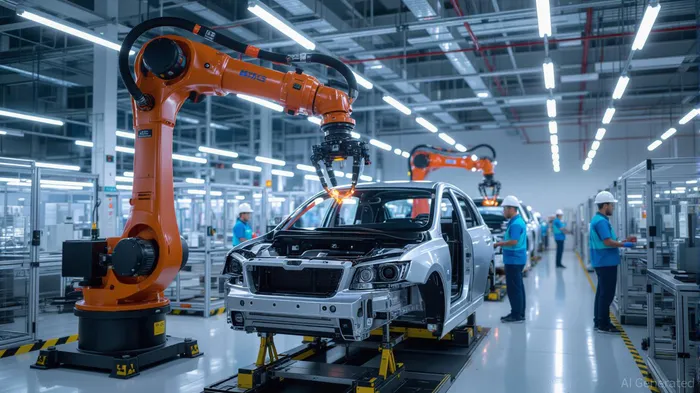
3. Logistics and Warehouse Automation: The E-Commerce Revolution
Symbotic (SYM), with a $31.3 billion market cap, is revolutionizing warehouse operations with AI-driven inventory systems. Amazon's 1 million robots now handle 75% of global deliveries, while KION Group (KION) and FANUC (FANUY) are expanding their intralogistics solutions. These companies are critical for investors seeking exposure to the e-commerce boom.
4. Energy and Utilities: Powering the Future
Schneider Electric (SU), valued at $155.7 billion, is leveraging automation to optimize energy grids and reduce waste. As utilities face pressure to modernize infrastructure, companies like Duke EnergyDUK-- (DUK) and American Water WorksAWK-- (AWK) are integrating smart grid technologies to enhance efficiency.
Strategic Reallocation: From Risk to Resilience
Investors must now prioritize sectors where automation mitigates labor shortages and cost pressures. For example, the manufacturing sector, which faces a 368,000 job opening gap, is increasingly adopting AI-driven production lines. Companies like Yaskawa (YAMAF) and OMRON (6645) are supplying the precision robotics needed to bridge this gap.
The logistics sector offers another compelling case. With e-commerce growth outpacing traditional retail, firms like SymboticSYM-- and KION Group are seeing demand surge. highlights its outperformance, driven by e-commerce tailwinds.
The Road Ahead
The Federal Reserve's rate cuts and the broader economic slowdown will likely accelerate automation adoption. By 2030, automation is expected to displace 92 million jobs but create 170 million new roles, according to industry forecasts. This net gain underscores the long-term viability of automation-driven industries.
For investors, the key is to identify companies with strong R&D pipelines and scalable solutions. Siemens' $1.3 billion R&D investment in 2023, for instance, positions it to lead in AI-integrated automation. Similarly, HoneywellHON-- (HON)'s acquisition of U.S. Digital Designs and its 4.1% R&D spend highlight its commitment to innovation.
Conclusion
The weakening U.S. job market is not a crisis but a catalyst for reinvention. As labor becomes a scarcer and costlier resource, automation will define the next decade of economic growth. Investors who reallocate capital from labor-dependent sectors to automation-driven industries will not only mitigate risk but also capitalize on the most transformative trend of our time. The time to act is now—before the labor market's shift becomes irreversible.

Stay ahead of the market.
Get curated U.S. market news, insights and key dates delivered to your inbox.
AInvest
PRO
AInvest
PRO



Comments
No comments yet