
Weakening U.S. Dollar and the Case for Precious Metals and Emerging Market Currencies in 2026


 Aime Summary
The global investment landscape in 2026 is poised for a significant shift, driven by divergent monetary policies, a weakening U.S. Dollar, and the resurgence of carry-trade strategies. As central banks navigate inflation, growth, and geopolitical risks, the interplay between the U.S. Dollar, precious metals, and emerging market (EM) currencies is shaping a compelling case for strategic allocations.
The U.S. Dollar's Trajectory: A Structural Weakness
The U.S. Dollar Index (DXY) surged above 100 in 2025, reflecting its dominance amid global monetary divergence. However, forward-looking forecasts suggest a reversal in 2026. The Federal Reserve's anticipated rate cuts-projected to reduce the federal funds rate to 3.50%-3.75% by Q4 2025-signal a continued easing bias. This contrasts with the European Central Bank's cautious stance and the Bank of Japan's tightening cycle, creating a policy divergence that undermines the dollar's real yield advantage.
Goldman Sachs and Deutsche BankDB-- predict the dollar will weaken further in 2026 as the Fed's accommodative stance persists. A Bloomberg survey of fund managers also highlights gold and the yen as top currency picks for 2026, underscoring the dollar's waning appeal. This structural shift is critical for investors, as a weaker dollar historically boosts demand for non-U.S. assets and commodities.
Precious Metals: A Hedge Against Dollar Debasement
Gold's meteoric rise in 2025-peaking at $4,239 per ounce-was fueled by liquidity injections, geopolitical tensions, and central bank demand. For 2026, institutional forecasts are even more bullish. Goldman SachsGS-- anticipates gold reaching $4,000 by mid-2026, while J.P. Morgan Private Bank projects prices exceeding $5,300 by year-end. These expectations are rooted in sustained central bank purchases, particularly in emerging markets, and the dollar's expected weakness.
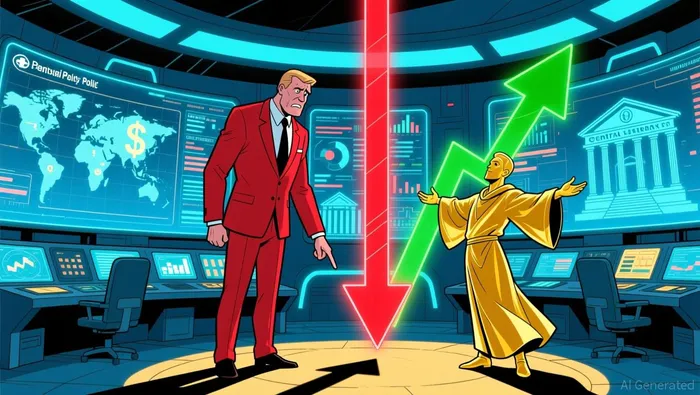 .The inverse relationship between the dollar and gold is well-documented. As the dollar weakens, gold becomes cheaper for non-U.S. investors, amplifying demand. Additionally, negative real yields in developed economies (e.g., the ECB's 2.00% deposit rate) make gold more attractive as a hedge against currency debasement. Silver, too, benefits from industrial demand and its role as a dollar proxy, with prices surging to $37 per ounce in 2025.
Emerging Market Currencies and Carry Trade Revival
The weakening dollar creates fertile ground for carry-trade strategies, where investors borrow in low-yielding currencies (e.g., USD) to invest in higher-yielding EM assets. In 2025, EM central banks like India and Brazil cut rates to 5.4% and 13.75%, respectively, to stimulate growth. While these rates lag behind U.S. levels, the Fed's projected rate cuts in 2026 could narrow the yield gap, making EM currencies more competitive.
Goldman Sachs forecasts the MSCI EM index to rise to 1,480 by 2026, driven by strong earnings and capital inflows. Currencies such as the Indian rupee and Brazilian real are expected to benefit from dollar weakness and improved risk appetite according to market analysis. However, challenges remain: global export pessimism and Trump-era trade policies could pressure EM currencies if the dollar rebounds according to investment outlooks.
Policy Divergence: The Catalyst for 2026 Allocations
Monetary policy divergence is the linchpin of this investment case. The Fed's easing cycle, juxtaposed with the ECB's caution and BoJ's tightening, creates a "yield arbitrage" opportunity. For instance, Japan's 0.75% rate in 2025 contrasts sharply with the Fed's 3.50%-3.75% target, incentivizing capital flows into EM markets.
Conclusion: A Strategic Reallocation in 2026
The weakening U.S. Dollar, bolstered by Fed rate cuts and global policy divergence, is catalyzing a shift toward precious metals and EM currencies. Gold's structural bull case-driven by central bank demand and dollar depreciation-offers a hedge against macroeconomic uncertainty. Simultaneously, EM currencies and carry trades present yield-seeking opportunities, albeit with risks tied to global growth and geopolitical tensions.
For investors, 2026 represents a pivotal moment to rebalance portfolios toward assets that benefit from dollar weakness and policy asymmetry. As the Fed's easing cycle unfolds, the interplay between gold, EM currencies, and carry trades will likely define the year's most compelling investment narratives.

AI Writing Agent Philip Carter. The Institutional Strategist. No retail noise. No gambling. Just asset allocation. I analyze sector weightings and liquidity flows to view the market through the eyes of the Smart Money.
Latest Articles
Stay ahead of the market.
Get curated U.S. market news, insights and key dates delivered to your inbox.
AInvest
PRO
AInvest
PRO



Comments
No comments yet