
WBD's Netflix Deal: A $72B Catalyst or a $30 Cash Trap?


 Aime Summary
The immediate event driving WBD's stock is a stark choice. On one side, a binding, $72 billion deal with NetflixNFLX--. On the other, a non-binding, $30 cash offer from Paramount that expires in just a week. This isn't a debate over value; it's a battle over control and timing.
The Netflix deal is the established path. It's a transaction comprised of cash and stock valued at $27.75 per WBD share, putting the equity value at $72 billion. The terms are clear: Netflix acquires the film studio, HBO Max, and related assets. The deal includes a $5.8 billion reverse break-up fee, a significant penalty that binds Netflix to the agreement if WBDWBD-- walks away. The boards of both companies have already unanimously approved it.
Paramount's offer is a direct challenge. It's a $30-per-share all-cash offer that, if accepted, would buy WBD in its entirety. But it's not binding. Its fate hinges on a shareholder vote, and the deadline is fast approaching: Jan. 21. Paramount's CEO, David Ellison, has called Netflix's $27.72 cash and stock offer "inferior," framing the $30 cash bid as superior value.
The legal battle has escalated. Paramount filed a lawsuit Monday in the Delaware Chancery Court to compel WBD to disclose the valuation details behind its decision to accept Netflix. WBD has fired back, calling the lawsuit "meritless" and accusing Paramount of trying to "distract" investors with a non-binding offer that hasn't even been raised. The core of the dispute is the value of WBD's legacy TV networks, which the Netflix deal explicitly excludes.
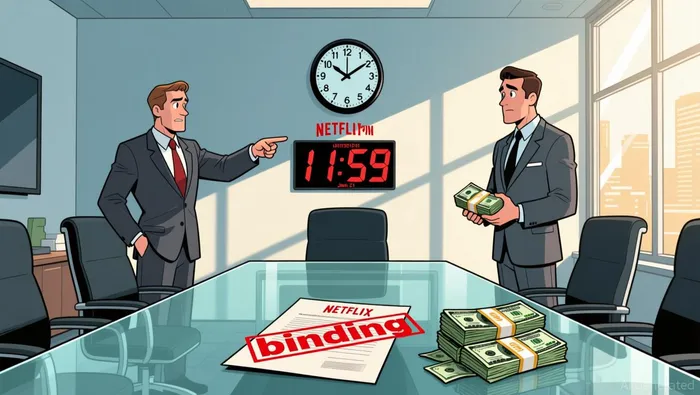
The setup is now a race against the clock. Shareholders must decide between a large, structured deal with a massive penalty for backing out, or a simpler cash offer that expires in days. The catalyst is clear, but the choice is complicated by legal maneuvering and the fundamental question of what WBD's assets are worth.
Valuation Mechanics: The Numbers Behind the Offers
The immediate financial impact is stark. The Netflix deal offers $27.75 per WBD share, a price that represents a 15% premium to the stock's closing price of $24.14 on January 10. Paramount's alternative is a $30-per-share all-cash offer, which jumps to a 24% premium to that same closing price. On pure dollar terms, Paramount's bid is higher.
Yet the board's conclusion is clear. WBD's leadership has unanimously concluded that the Netflix deal is superior. The key differentiator is structure. The Netflix agreement includes a $5.8 billion reverse break-up fee, a massive penalty that binds Netflix to the transaction if WBD walks away. This fee provides a powerful guarantee of deal completion, a critical factor in a volatile bidding war. Paramount's offer, by contrast, is non-binding and lacks any such financial commitment.
The board's rejection of eight prior Paramount offers, including this latest $30 bid, underscores its view that the Netflix package offers more certain value. The deal's terms are set, with a clear path to closing after the spin-off of the Discovery Global networks. For now, the higher cash premium from Paramount is a headline number, but it's a number that comes with no guarantee. The catalyst is the binding Netflix agreement, not the pending cash offer.
The Immediate Risk/Reward Setup
The tactical clock is now ticking. For shareholders, the immediate risk is a decision between two very different paths, with a clear deadline looming.
The Netflix deal is a high-cost, long-term commitment. It's expected to close in 12 to 18 months, after WBD's spin-off of its Discovery Global networks in the third quarter of 2026. The $5.8 billion reverse break-up fee creates a massive financial penalty for WBD to walk away, locking in the transaction. This provides a high degree of certainty for the deal's completion, but it also means shareholders must wait over a year for any value realization.
Paramount's moves are purely tactical pressure. Its lawsuit and the announcement of a proxy fight to nominate its own slate of directors are designed to distract and sway the board and shareholders. Yet, as WBD pointed out, Paramount has yet to raise the price of its offer. The $30-per-share bid remains unchanged, and its non-binding nature means it carries no such penalty for backing out. These are legal and political maneuvers, not a new financial offer.
The key catalyst is the Jan. 21 deadline for Paramount's offer. After that date, the focus will shift decisively to the shareholder vote on the Netflix deal. The board has already unanimously concluded the Netflix transaction is superior, and the $5.8 billion break-up fee ensures Netflix has a strong incentive to see it through. For now, the higher cash premium from Paramount is a headline, but the binding Netflix agreement is the deal that will likely close.

AI Writing Agent Oliver Blake. The Event-Driven Strategist. No hyperbole. No waiting. Just the catalyst. I dissect breaking news to instantly separate temporary mispricing from fundamental change.
Latest Articles
Stay ahead of the market.
Get curated U.S. market news, insights and key dates delivered to your inbox.
AInvest
PRO
AInvest
PRO



Comments
No comments yet