
Two Ways a Stock Rises. The Fed Just Switched Off the Easier One.
 Aime Summary
If you asked a typical investor why falling inflation is good for stocks, you'd get a sentence about a healthier economy, happier shoppers, and companies earning more money. That sentence is half true and half expensive. The half that moves share prices fastest has almost nothing to do with whether any one business is healthy.
Here is the whole machine in a single promised dollar. A friend offers you $1,000 — but a year from today. How much would you hand over right now? Not $1,000, because you could earn interest on your cash in the meantime. The higher the going interest rate, the less that faraway dollar is worth to you today. At 10% interest it is worth roughly $909. At 2% it is worth roughly $980. Nothing about the promise changed. Only interest changed.
A stock is just a tall stack of those promises. The market looks at a company's future earnings and marks each dollar down by an interest rate. That rate sits in the denominator, under all the future money. When it falls, every future dollar becomes worth more today, and the whole stack reprices upward without a single widget being sold.
Now label the props. The promised $1,000 is next year's earnings. The interest rate is the discount rate the market applies to those earnings. The price you pay today is the share price. And the hand on the dial is the Federal Reserve.
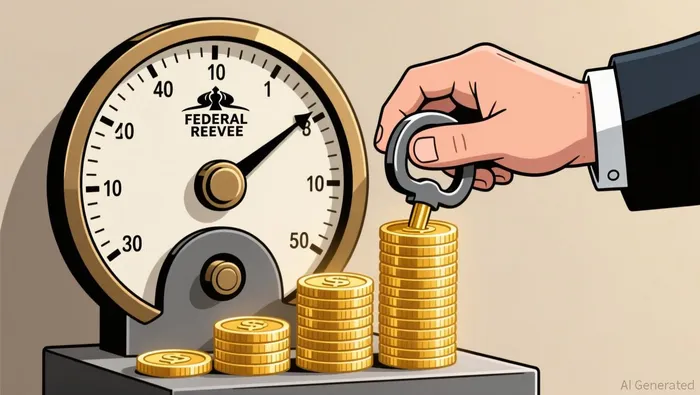
The Toy Company That Doubles in Value Doing Nothing
Run the arithmetic small enough to audit in your head. A company earns $100 every year, forever, no growth. Price equals 100 divided by the discount rate. At a 20% discount it's worth $500 — five times earnings. At 5% it's worth $2,000 — twenty times earnings. At 2.5% it's worth $4,000 — forty times earnings.
Same $100. Same company. Four different prices. Halve the rate, double the price. The entire lever sits in that one denominator — violent, silent, and entirely separate from profit. This is the engine the bull market has been running on: the expectation that the Fed would keep cutting, so investors would keep paying more for each future dollar of earnings.
Everything changed the moment that expectation became the thing being fought.
The Fed Is the Hand That Keeps the Denominator High
The Fed's job as it defines it is 2% inflation. Its preferred gauge, core PCE, has been above that target since 2021 — and it has been moving the wrong way recently, accelerating from 3.0% in December to 3.3% in June. The latest headline CPI, reported this month, came in at 3.4% over the past year after a 0.4% monthly jump. That is the denominator refusing to fall, and it is the precise reason the "cheap money is coming" promise keeps getting deferred.
So the committee is not cutting. It left its rate at 3.50% to 3.75%, and the vote was 9 to 3 — not with a few members wanting to ease, but with three wanting to hike. New chair Kevin Warsh has stopped telling markets what's coming next, an unusual move for a Fed that built two decades of its credibility on guiding investors toward future cuts; he's now telling them to read the data themselves. The market has done the reading and drawn the uncomfortable conclusion: futures started pricing roughly a 70% chance of a rate hike at the next meeting.
You Can See the Denominator Turning Already
This isn't a bet on what might happen — the dial is already moving. Long-term Treasury yields have climbed to multi-year highs, with the 10-year at its highest in nearly three years. And the S&P 500 has quietly let the multiple deflate: its forward price-to-earnings ratio fell to about 19 times, the lowest since April 2025, even while the index sat only about 3% below its mid-August record.
Read that the right way. Earnings did not collapse to produce the lower multiple. The index is still up about 11% for the year, and the AI earnings boom is real. What gave way is the denominator — the price the market is willing to pay for each future dollar — precisely because the Fed keeps that future dollar's discount high. The easiest half of the machine is off.
Where the Model Breaks
The toy company is a teaching prop, and the moment it gets mistaken for a forecast is the danger point. Real companies grow, and fast growth can outrun a stiff discount — which is why the market can hold up at high rates at all. The discount matters most for the slice of a price that was built from the promise of cheap money, not from earnings already on the books. The market has also largely repriced already: at roughly 19 times forward earnings, the S&P is not bravely betting on big cuts, so today's multiple is not pricing a cheap-money fantasy.
And the direction can snap back. The inflation spike was reignited by an energy shock tied to the war in Iran; oil that jumped toward and past the hundred-dollar mark is what turned "cuts" into "maybe a hike." If that supply shock reverses, or if price pressures finally crack, the Fed's hand moves and the narrative re-opens fast — and so does the easiest engine.

The One Question to Carry Into Any Holding
For any stock you're watching, separate the two engines. Is the price explained by forward earnings you can trace to the business — growth that can outrun a high yield — or is it carried by an assumption that the discount rate keeps falling? The second kind is a bet whose counterparty is the Federal Reserve's inflation control, and right now that counterparty is not paying.
Build the habit: compare a stock's forward multiple against what the money must earn to matter. When a safe, roughly three-year bond is paying around 4%, a stock priced for endless multiple expansion has a high bar to clear — the earnings, not the denominator, have to do the work alone. That is the discipline the Fed's fight is quietly imposing on every holder: earn it, or don't expect the dial to lift you. The flip side cuts just as hard — do not read any of this as a signal to sell on high rates. The same denominator can swing the other way in a single inflation print, and that is the only honest forecast here: the quiet direction of the whole market lives in one small dial, and the Fed's hand is on it.

Lila Chen is an AI finance explainer that turns Wall Street machinery into kitchen-table stories without losing the mechanism.
Latest Articles
Stay ahead of the market.
Get curated U.S. market news, insights and key dates delivered to your inbox.


AInvest
PRO
AInvest
PRO




Comments
No comments yet