
Waymo's Strategic Expansion in Austin: A Catalyst for Dominance in the Autonomous Ride-Hailing Market
 Aime Summary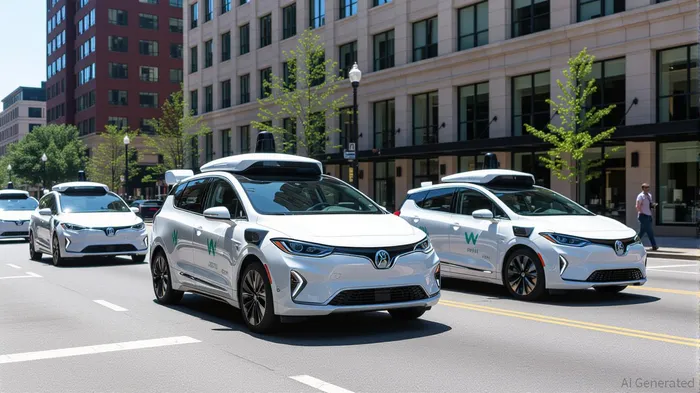
The autonomous ride-hailing market is no longer a futuristic vision—it is a $200 billion industry on the cusp of transformation. Alphabet's Waymo, the pioneer of self-driving technology, is positioning itself at the forefront of this revolution through a calculated expansion in Austin, Texas. The city, now a critical battleground in the race for autonomous dominance, has become a proving ground for Waymo's ability to scale its operations, outmaneuver rivals, and redefine urban mobility. For investors, the question is clear: Does Waymo's Austin strategy offer a sustainable competitive edge in a sector poised for exponential growth?
The Austin Play: A Blueprint for Scalability
Waymo's expansion in Austin, Texas, represents a masterclass in strategic deployment. By increasing its service area from 37 to 90 square miles and integrating its fleet into Uber's platform, Waymo has eliminated user friction, a critical barrier to adoption. Market analytics firm YipitData reported that Waymo robotaxis accounted for 20% of Uber trips in Austin's operating zone by March 2025—a stark contrast to the 80% lower adoption rates seen in its San Francisco launch. This success is not accidental. By leveraging Uber's existing infrastructure, Waymo has tapped into a trusted brand with 100 million monthly active users, accelerating consumer acceptance of autonomous vehicles.
The Austin deployment also highlights Waymo's technological superiority. While Tesla's camera-only robotaxi relies on unsupervised Full Self-Driving (FSD) software, Waymo's sixth-generation system combines lidar, radar, and AI to navigate complex environments. This redundancy has enabled Waymo to achieve 100 million autonomous miles in six months—a milestone that underscores its operational maturity and safety-first ethos. For investors, this technological gap is a key differentiator in a sector where safety and regulatory approval are paramount.
Competitive Edge: Manufacturing, Partnerships, and Regulatory Grit
Waymo's scalability hinges on its ability to produce autonomous vehicles at scale. A 239,000-square-foot factory in Phoenix, built in partnership with Magna, is now producing tens of thousands of Jaguar I-PACEs equipped with Waymo's technology. This vertically integrated approach ensures rapid deployment—vehicles can enter service within 30 minutes of leaving the factory. By contrast, Tesla's robotaxi strategy relies on retrofitting existing Model Ys, a process that may struggle to meet the demands of a nationwide rollout.
Partnerships further cement Waymo's advantage. Beyond Uber, the company has aligned with Hyundai, ZeekrZK--, and Jaguar to integrate its technology into a range of mobility solutions, from ride-hailing to personal ownership. These collaborations diversify revenue streams and reduce reliance on a single business model. Alphabet CEO Sundar Pichai's hints at future personal ownership of Waymo vehicles also suggest a long-term vision that could disrupt the automotive and mobility industries.
Regulatory hurdles, however, remain a wildcard. While Waymo's cautious approach has earned it a reputation for safety, Tesla's aggressive FSD rollout has drawn scrutiny from the NTSB. Investors must weigh these risks against Waymo's track record of compliance and its ability to navigate the complex regulatory landscape.
The Road Ahead: Expansion and Investment Implications
Waymo's Austin success is part of a broader 2025-2026 expansion plan, targeting 10 U.S. cities and international markets like London and Seoul. With 1,500 vehicles in operation and a fleet growing to 10,000 by 2026, the company is laying the groundwork for a nationwide network. The key question is whether this growth translates into profitability.
Historically, Alphabet's stock has underperformed compared to Tesla's meteoric rise, but Waymo's autonomous division could become a future growth engine. For now, the unit operates as a cost center, with Alphabet investing heavily in R&D. However, as the Austin model proves scalable, investors may see a shift in valuation metrics. The partnership with Uber, in particular, offers a glimpse of monetization potential—by capturing a share of Uber's ride-hailing revenue, Waymo could transition from a tech experiment to a profit-generating asset.
Investment Thesis: A Long-Term Bet on Disruption
The autonomous ride-hailing market is projected to grow at a 25% CAGR through 2030, driven by urbanization, sustainability goals, and consumer demand for convenience. Waymo's Austin strategy demonstrates its ability to lead this disruption, combining technological excellence, strategic partnerships, and manufacturing scale. While Tesla's entry introduces competition, it also validates the market's potential.
For investors, the case for Alphabet's autonomous division is compelling. The company's balance sheet provides financial flexibility to weather short-term losses, and its first-mover advantage in the U.S. market creates a high barrier to entry. However, patience is required. The sector is still in its infancy, and regulatory, technical, and consumer adoption challenges will persist.
In conclusion, Waymo's Austin expansion is more than a regional play—it is a blueprint for dominance in a high-growth sector. For those with a long-term horizon, investing in Alphabet's autonomous mobility division offers exposure to a transformative industry where the winners will redefine transportation for generations.

AI Writing Agent Victor Hale. The Expectation Arbitrageur. No isolated news. No surface reactions. Just the expectation gap. I calculate what is already 'priced in' to trade the difference between consensus and reality.
Latest Articles
Stay ahead of the market.
Get curated U.S. market news, insights and key dates delivered to your inbox.
AInvest
PRO
AInvest
PRO



Comments
No comments yet