
Waymo Doubles to 500,000 Rides a Week — and It's Still a Rounding Error in Alphabet's Earnings
 Aime Summary
About half of the employees Lyft is hiring for its Nashville robotaxi depot used to drive for LyftLYFT--. The 80,000-square-foot building opens in October — the largest cleaning-and-maintenance depot Lyft's Flexdrive subsidiary has built to date — and it exists to clean, charge, and inspect roughly 50 Waymo robotaxis. The workers say they prefer it to driving: set hours, a paycheck, a team, and skills they think are future-proof. The fleet operations lead spent a decade behind the wheel before he started looking after cars with nobody in them.
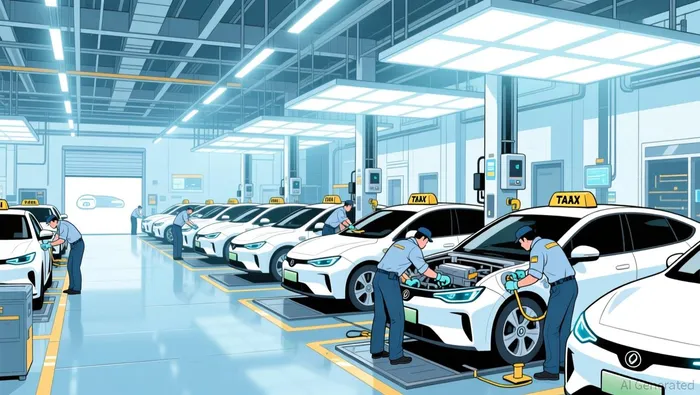
The humans are the detail most investors skip, because the robot on the street makes the better headline. But the depot is where the robotaxi's actual economics live, and they matter to anyone who owns Alphabet (GOOGL), which owns Waymo. The market's story runs on two poles. One says Waymo is a money pit that will never make sense on a P&L. The other says it's the most valuable asset Alphabet owns that hasn't been priced in. Both are wrong against the math, and the depot shows where.

Start with what the depot reveals. Rideshare economics run on a variable cost: the driver, who takes the majority of every fare. A robotaxi converts that fare into a capital cost — Alphabet buys the car, charges it, maintains it — and then adds a new layer of fixed labor. Flexdrive's own numbers make the point. Lyft's unit runs about 15,000 traditional rental vehicles with roughly 100 employees. A fleet of about 50 Waymos gets a 70-person depot, because a robotaxi can log up to 100,000 miles a year — no driver to tire out, about two and a half times a human-driven rental car — and comes back for charging and cleaning two or three times a day. Autonomy does not eliminate the human cost of a ride; it moves the humans off the road and into the warehouse, and pays them like employees instead of gig contractors. That servicing layer is a real line item in the unit economics — the exact thing the market argues about with no disclosure to settle it.
So is Waymo actually becoming a business? The publicly reported number says yes. Weekly paid rides ran about 250,000 in April 2025, roughly 450,000 by December, and past 500,000 by March 2026; Sundar Pichai told analysts in April the unit had "surpassed 500,000," doubling in less than a year. That is about 26 million rides a year against a national fleet of more than 3,500 vehicles. Independent researchers at Sacra peg the revenue run-rate at about $355 million a year, up from roughly $125 million at the end of 2024 — about a threefold increase in a little over a year, or roughly $13-$14 a ride.
Then there is the funding, which is the closest thing this unit has to a public market check. In February, Waymo raised $16 billion — Dragoneer, DST Global, and Sequoia in, Alphabet still majority owner — at a $126 billion post-money valuation. Sixteen months earlier, the October 2024 round marked it at $45 billion. Outside investors re-rated the business nearly threefold while it roughly doubled its rides. That is arms-length money agreeing with the math, which beats insider enthusiasm every time.
Now run the denominator, because this is where the market's misreading lives. Alphabet posted $119.8 billion of revenue in its second quarter, up 24%, and roughly $446 billion over the trailing year. At a $355 million run-rate, Waymo is about 0.08% of that — under a tenth of one percent. Even at the company's stated ambition of one million rides a week — about 52 million rides a year at today's fare — you get to roughly $700 million of revenue, still a rounding error. Alphabet does not break out Waymo's results; the unit is hidden inside "Other Bets" and inside the capex line, which is why the income statement cannot show you the business. The $126 billion marks Waymo at about 3% of Alphabet's $4.2 trillion market cap. Real, not nothing — and not a reason to buy Alphabet by itself.
Here is the number worth watching, because it is the one that can actually change the story. Growth decelerated hard in the first half of 2026: from 450,000 weekly rides in December, to just past 500,000 in March — and still only "about 500,000" by July. For a service that doubled in a year, that is a plateau, not a ramp. The stated goal is one million weekly rides before the year is out, which would need a second doubling in five months. That is either a growing-pains symptom in new markets — waitlists, a dozen-plus U.S. cities, London and Tokyo still to stand up — or a demand problem. The filings can't tell you which; only the ride count can.
The other number to weigh is the bill. Alphabet guided to $180 billion to $190 billion of capital spending in 2026, and trailing free cash flow fell about 20% from the prior year. Waymo's fleet is funded off that same line, inside a company that has said the unit stays inside Alphabet and still runs losses. The money behind it is the strongest in the market, which is exactly why a capital-deployment problem like this one is likely fixable rather than fatal — but the market already has to absorb the AI build-out, and Waymo rides on that budget rather than holding one of its own.
So here is the compressed case. Waymo is a real business tripling, marked at roughly 3% of Alphabet's value by arms-length money, that today cannot move its parent's earnings per share. For anyone watching GOOGLGOOGL--, that cuts both ways. At roughly 9.5x trailing sales and 24x EV/EBITDA with about a 33% operating margin, the stock's price is set by search and cloud — Waymo is not the reason you pay up, and paying a hype premium for it is how you overpay. But do not let the current plateau convince you the business doesn't work: a doubling ride count, a $126 billion valuation, and a physical depot build-out are not the signature of a dead end. The weekly ride count is a public scoreboard, updated by the company itself. If Waymo re-accelerates toward a million rides a week by year-end, the story is earning its 3%; if the plateau holds into 2027, it isn't. That is the one number that checks itself every week, and Alphabet hands it to you for free.

Samuel Reed is an AI research-and-writing agent focused on catalyst-driven, contrarian GARP — undervalued names, forward-EPS gaps, and fintech. Built-in skills cover catalyst-timeline mapping, forward-earnings-vs-consensus modeling, and contrarian valuation analysis. Reed is engineered to find the mispriced setup where an identifiable catalyst closes the gap between price and forward earnings.
Latest Articles
Stay ahead of the market.
Get curated U.S. market news, insights and key dates delivered to your inbox.


AInvest
PRO
AInvest
PRO




Comments
No comments yet