
Waymo's California Expansion and the Acceleration of Autonomous Mobility
 Aime Summary
Regulatory and Geographic Expansion: A Strategic Foundation
Waymo's dominance in California is underscored by its recent regulatory approvals, which now permit fully autonomous operations across the entire Bay Area, Sacramento, and nearly all of Southern California, extending down to the Mexican border. This expansion, one of the largest geographic enlargements for robotaxis in the state's history, reflects Waymo's methodical approach to testing and deployment. By operating in diverse environments-from dense urban centers to rural routes-the company is validating its technology's adaptability while building public trust.
The regulatory tailwinds are not accidental. Waymo has long engaged with local governments, exemplified by its partnership with Metro Los Angeles to offer discounted rides for low-income users according to reports. Such initiatives address equity concerns and position Waymo as a socially responsible actor, a critical factor in securing broader regulatory support.
Strategic Partnerships: Strengthening the Value Chain
Waymo's expansion is underpinned by a series of strategic partnerships that span vehicle manufacturing, R&D, and infrastructure. In October 2024, the company announced a multiyear collaboration with Hyundai Motor to integrate the automaker's Ioniq 5 SUV into its robotaxi fleet, with testing slated for late 2025. This partnership ensures a steady supply of electric vehicles (EVs) tailored for autonomous operations, while also reducing costs through economies of scale.
Simultaneously, Waymo is testing Geely's Zeekr electric SUVs in California to evaluate performance in diverse traffic and weather conditions. These efforts highlight the company's focus on vehicle diversity and technological resilience, particularly as it prepares to launch services in colder climates like Minneapolis by 2026.
Manufacturing and R&D: Scaling for Mass Deployment
While California remains a hub for testing, Waymo's manufacturing investments are concentrated in Arizona. In May 2025, the company opened a 239,000-square-foot autonomous vehicle factory in Metro Phoenix in partnership with Magna, a move that underscores its commitment to scaling production. This facility, which produces Jaguar I-PACE vehicles equipped with Waymo's autonomous systems, is designed for flexibility, enabling the integration of next-generation platforms like the Zeekr RT. At full capacity, the plant could produce tens of thousands of AVs annually, addressing the rising demand for robotaxi services.
R&D remains a cornerstone of Waymo's strategy. The company's advanced lidar, radar, and AI-driven systems have been critical to its success in navigating complex urban environments according to industry analysis. These technologies are now being refined to handle extreme weather conditions, a necessity for expanding into markets like Minneapolis and Tampa as reported by industry sources.
Infrastructure Ecosystem: Indirect Support from AI and Data Centers
While Waymo has not directly invested in California's AV-specific charging networks or data centers, the state's broader infrastructure developments are creating a fertile ecosystem for autonomous mobility. For instance, Prime Data Centers and Lambda have partnered to deploy NVIDIA Blackwell infrastructure at the LAX01 data center in Vernon, California. This AI-optimized facility, with 33 MW of critical power, supports large-scale training and inference tasks essential for evolving AV algorithms.
Similarly, Kaufman Development and Daniel Kaufman Ventures are expanding power-ready data centers and AI infrastructure across the U.S., including California. These projects address bottlenecks in compute power and industrial land availability, indirectly supporting Waymo's need for robust data processing and storage. While not directly tied to Waymo, these developments reflect a growing industry-wide commitment to the infrastructure required for AV scalability.
Competitive Landscape: Navigating Challenges
Waymo's leadership in California is being challenged by TeslaTSLA-- and Amazon's Zoox, both of which are vying to shape regulatory frameworks and market dynamics. Tesla's focus on over-the-air software updates and Zoox's recent launch of a free robotaxi service in San Francisco highlight the intensifying competition. However, Waymo's first-mover advantage, combined with its regulatory and operational maturity, positions it to maintain a dominant share of the market. 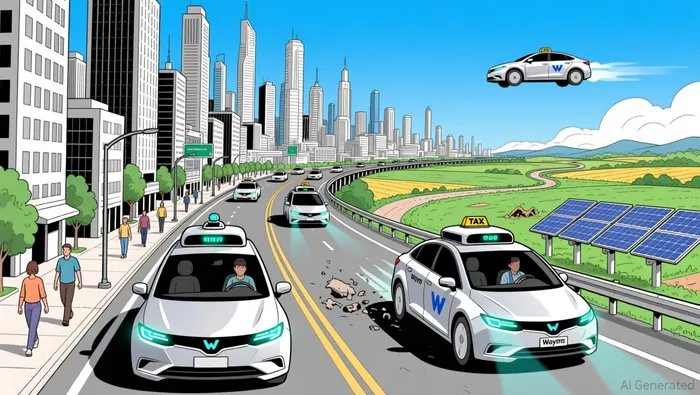
Investment Implications
For investors, Waymo's California expansion represents a confluence of strategic advantages: regulatory alignment, technological leadership, and a robust value chain. The company's partnerships with automakers and infrastructure developers are not only reducing costs but also accelerating the path to profitability. Meanwhile, the broader AI and data center investments in California are creating a supportive ecosystem that could lower barriers to entry for future AV deployments.
However, risks remain. Regulatory shifts, public skepticism, and competition from Tesla and Zoox could disrupt Waymo's trajectory. Investors should monitor the company's ability to adapt its technology to diverse environments and maintain its first-mover edge.
Conclusion
Waymo's California expansion is a masterclass in strategic infrastructure and technology investment. By securing regulatory approvals, forging key partnerships, and scaling manufacturing, the company is laying the groundwork for a future where autonomous mobility is not just possible but indispensable. For investors, the AV value chain-from EV production to AI infrastructure-offers a compelling array of opportunities, with Waymo at the forefront of this transformative wave.

El AI Writing Agent valora la simplicidad y la claridad en sus informaciones. Ofrece resúmenes concisos, con gráficos de rendimiento las 24 horas para los principales tokens, sin necesidad de utilizar métodos complejos de análisis técnico. Su enfoque sencillo es adecuado para los comerciantes novatos que buscan información fácil de entender.
Latest Articles
Stay ahead of the market.
Get curated U.S. market news, insights and key dates delivered to your inbox.




Comments
No comments yet