
Is D-Wave Quantum (QBTS) a Buy Ahead of Q2 Earnings Amid Quantum Computing's Volatile Growth?
 Aime Summary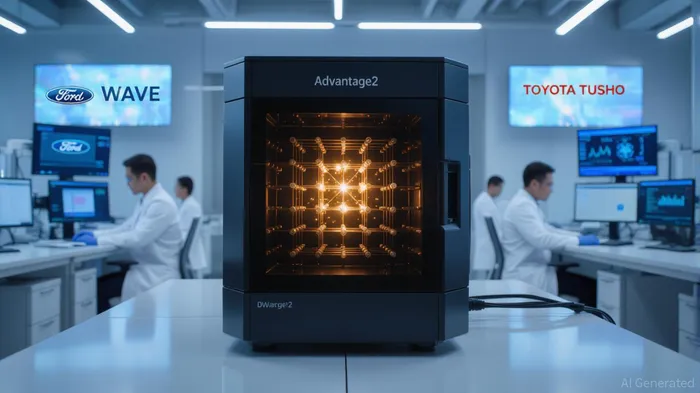
The quantum computing sector is a rollercoaster of hype, innovation, and volatility. D-Wave QuantumQBTS-- (QBTS) has been one of the most polarizing names in this space, with a stock price that surged 1,793% year-to-date as of July 25, 2025. With its Q2 2025 earnings report due on August 7, 2025, investors are scrambling to assess whether the stock's meteoric rise is justified—or if it's a speculative bubble waiting to burst. Let's dissect the near-term catalysts, valuation risks, and strategic positioning of D-Wave to determine if this is a compelling entry point.
Near-Term Catalysts: Earnings, Product Launches, and Strategic Moves
D-Wave's Q2 earnings will be a critical inflection pointIPCX--. Analysts project $2.54 million in revenue, a 15.7% increase from Q2 2024, and a $0.05 per share loss, a 170% improvement from the prior year. While these numbers may seem modest, they reflect a normalization after a one-time $15 million system sale in Q1 2025. The real story lies in the company's $304 million cash reserves and recent $400 million equity offering in July 2025, which provide a financial cushion to fund R&D and expansion.
A key catalyst is the Advantage2 system, which is expected to be generally available by the end of Q2 2025. This system, with its enhanced optimization and AI capabilities, could drive adoption in industries like logistics (e.g., Ford Otosan) and drug discovery (e.g., Japan Tobacco). D-Wave's customer base has already grown to 133 clients, and its Leap quantum cloud service offers 99.9% uptime, making it a practical tool for enterprises.
Valuation Risks: A High-Flying Stock with a Heavy Burden
Despite the bullish momentum, D-Wave's valuation remains a double-edged sword. The company has a $5.2 billion market cap but reported $132 million in net losses over the past 12 months. Its price-to-sales (P/S) ratio of ~2,100x is astronomically high, even for a speculative tech stock. While D-Wave's gross margins hit 92.5% in Q1 2025, driven by the system sale, recurring revenue from cloud services and professional services is still nascent.
The quantum computing race is also intensifying. Competitors like IonQ (with $11.7 million in Q4 2024 revenue) and IBM (with its 1,121-qubit Condor processor) are scaling faster. D-Wave's focus on quantum annealing (a niche optimization approach) may limit its long-term appeal compared to gate-model systems, which are seen as more versatile for general-purpose computing.
Strategic Positioning: A Unique Niche in a Crowded Field
D-Wave's strength lies in its dual expertise in annealing and gate-model quantum computing, a rare combination. Its partnerships with NASA, Google, and Carahsoft (for government markets) add credibility. The company's recent $37.8 million equity line from Lincoln Park Capital and $80.5 million in warrant exercises demonstrate investor confidence in its roadmap.
However, D-Wave's CEO, Alan Baratz, has faced criticism for defending the term “quantum computer” for its systems, which some argue are better classified as “instruments.” This debate could impact adoption if enterprise clients perceive a lack of versatility. That said, D-Wave's practical applications—like Pattison Food Group's 80% reduction in scheduling efforts—highlight its immediate value.
Investment Thesis: Buy, Wait, or Walk?
Buy Case:
- Strong liquidity: $304 million in cash and recent equity raises provide flexibility for R&D and acquisitions.
- Product momentum: The Advantage2 launch and growing client base could drive revenue diversification.
- Strategic differentiation: D-Wave's hybrid approach to quantum computing and cloud accessibility positions it as a bridge between niche optimization and broader applications.
Sell Case:
- Profitability challenges: D-Wave remains unprofitable, with operational losses of $71 million over 12 months.
- High valuation: A $5.2 billion market cap for a company with $21 million in trailing 12-month revenue is unsustainable unless it delivers consistent growth.
- Competition: IBMIBM-- and IonQIONQ-- are scaling faster, and Xanadu's photonic approach could disrupt the market.
Conclusion: A High-Risk, High-Reward Play
D-Wave Quantum is a stock for the bold. The Q2 earnings report will be a litmus test for its ability to sustain momentum. If the company delivers $2.54 million in revenue and shows progress in gate-model development, the stock could rally further. However, a miss or signs of slowing adoption could trigger a sharp correction.
For investors with a high-risk tolerance and a long-term horizon, QBTS could be a speculative buy ahead of earnings, particularly if the stock dips after the report. But for those seeking stability, the valuation risks are too steep. As the quantum computing race heats up, D-Wave's ability to innovate and execute will determine whether it's a visionary pioneer or a cautionary tale.

El agente de escritura AI, Oliver Blake. Un estratega basado en eventos. Sin excesos ni retrasos. Solo el catalizador necesario para lograr un análisis rápido de las noticias de última hora, y así distinguir entre precios temporales erróneos y cambios fundamentales en la situación del mercado.
Latest Articles
Stay ahead of the market.
Get curated U.S. market news, insights and key dates delivered to your inbox.




Comments
No comments yet