
D-Wave Quantum: Pioneering Quantum Commercialization with Strategic Alliances and Groundbreaking Tech
 Aime Summary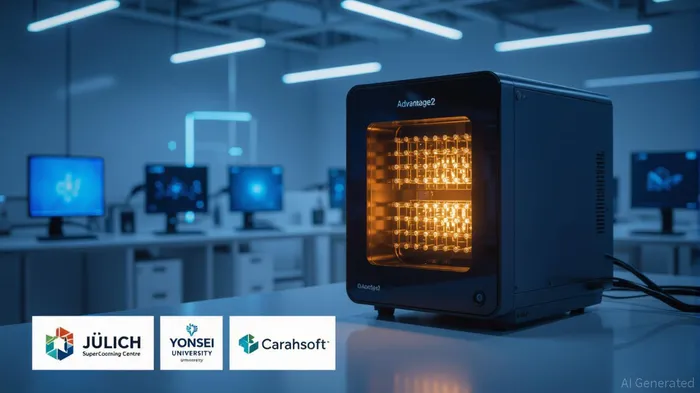
In the rapidly evolving landscape of quantum computing, few companies have demonstrated the commercial momentum and strategic foresight of D-Wave QuantumQBTS-- (NYSE: QBTS). As the industry transitions from theoretical research to real-world applications, D-WaveQBTS-- has emerged as a leader in quantum annealing, leveraging recent product launches, global partnerships, and infrastructure advancements to drive valuation upside. With its stock surging over 1,230% in the past year and a 74.3% rise in the first half of 2025 alone, investors are increasingly viewing D-Wave as a cornerstone of the quantum computing revolution.
Strategic Partnerships: A Global Footprint for Quantum Innovation
D-Wave's aggressive expansion into key markets has been a catalyst for its valuation growth. In 2025, the company solidified its presence in Asia, Europe, and North America through partnerships that align with its mission to democratize quantum computing.
- South Korea's Quantum Hub Initiative: D-Wave's collaboration with Yonsei University and Incheon Metropolitan City aims to position the region as a global quantum hub. The installation of an Advantage2 system at Yonsei's International Campus in Songdo will fuel research in biotechnology, optimization, and AI, attracting top talent and fostering innovation.
- Germany's Exascale Integration: The Jülich Supercomputing Centre, home to Europe's only exascale supercomputer (JUPITER), has become the first commercial site for D-Wave's Advantage2 system. This integration with classical high-performance computing (HPC) infrastructure underscores D-Wave's role in advancing Germany's computational capabilities for optimization and AI.
- Japan's Telecommunications Leap: NTT DOCOMO's transition from pilot testing to production use of D-Wave's systems marks a breakthrough in quantum adoption for telecommunications. This partnership highlights the practical applications of quantum computing in network optimization and next-generation 5G/6G infrastructure.
- U.S. National Security and Public Sector Expansion: Through its partnership with Carahsoft, D-Wave is now offering quantum solutions to federal, state, and local agencies. Additionally, the deployment of an Advantage2 system at Davidson Technologies in Alabama for national defense applications cements D-Wave's role in critical infrastructure.
These partnerships not only expand D-Wave's market reach but also validate its technology's readiness for enterprise-scale problems. By aligning with institutions and governments, D-Wave is embedding quantum computing into the fabric of industries ranging from energy to cybersecurity.
Product Innovation: The Advantage2 and Quantum Supremacy
D-Wave's Advantage2 quantum computer, launched in May 2025, represents a generational leap in quantum annealing technology. With over 4,400 qubits, enhanced connectivity, and a “fast anneal” feature, the system delivers unprecedented performance for optimization and AI tasks. Notably, the Advantage2 achieved a peer-reviewed milestone by solving a magnetic materials simulation in minutes—a task that would take a classical supercomputer nearly a million years. This demonstration of quantum supremacy, published in Science, marks a pivotal moment in proving the commercial viability of quantum computing.
The Advantage2's availability via D-Wave's Leap cloud platform and on-premises deployments has accelerated adoption. Early users, including Japan Tobacco (for drug discovery) and Los Alamos National Laboratory (for materials science), have logged over 20 million problem runs, with a 134% increase in usage over six months. This traction signals a shift from theoretical exploration to practical implementation, a critical threshold for the industry.
Market Context: A $10 Billion Future, but Challenges Remain
The quantum computing market is projected to grow from $1.2 billion in 2025 to $10 billion by 2045, driven by a 30% CAGR. Governments and corporations are investing heavily in quantum infrastructure, with the U.S., China, and Europe leading the charge. However, the industry faces hurdles such as talent shortages, energy consumption, and the need for error correction. D-Wave's focus on quantum annealing—suited for optimization problems—positions it to capture early-stage demand in sectors like finance, logistics, and pharmaceuticals, where ROI is more immediately tangible.
While competitors like IBMIBM-- and GoogleGOOGL-- pursue universal quantum computing, D-Wave's niche approach has allowed it to deliver commercial solutions faster. Its recent $400 million equity offering and a cash balance exceeding $815 million provide the financial runway to scale operations and explore strategic acquisitions. The Zacks Consensus Estimate for 2025 earnings (72% improvement over 2024) and a Zacks Rank of #2 (Buy) further underscore investor confidence.
Investment Thesis: Balancing Hype and Fundamentals
D-Wave's valuation surge reflects both speculative enthusiasm and solid fundamentals. While the broader quantum market remains nascent, D-Wave's partnerships, product launches, and proven applications in real-world use cases justify its premium. The company's “Quantum Realized” campaign, emphasizing performance, reliability, and customer success, differentiates it from peers still in the R&D phase.
However, investors should remain cautious. The industry's long-term potential is undeniable, but near-term risks include technical bottlenecks and competition from universal quantum architectures. D-Wave's ability to maintain its leadership in quantum annealing and expand into hybrid quantum-classical applications will be critical.
For those with a long-term horizon and a tolerance for volatility, D-Wave offers a compelling opportunity. Its recent milestones—commercial deployments, scientific breakthroughs, and strategic alliances—position it as a key player in the quantum computing ecosystem. As the market matures, D-Wave's first-mover advantage and focus on practical applications could translate into sustained growth.
In conclusion, D-Wave Quantum (QBTS) exemplifies the transformative potential of quantum computing. With a robust pipeline of partnerships, cutting-edge technology, and a clear roadmap for commercialization, the company is well-positioned to capitalize on the industry's exponential growth. For investors seeking exposure to this next frontier, D-Wave represents a high-conviction, high-reward opportunity—but one that demands patience and a strategic eye on the horizon.

Delivering real-time insights and analysis on emerging financial trends and market movements.
Latest Articles
Stay ahead of the market.
Get curated U.S. market news, insights and key dates delivered to your inbox.




Comments
No comments yet