
D-Wave Quantum: Is This the Breakout Quantum Stock of 2026?


 Aime Summary
In the high-stakes race to commercialize quantum computing, D-Wave Quantum Inc.QBTS-- has emerged as a compelling case study in strategic momentum and catalyst-driven valuation. As 2026 dawns, the company's recent moves-ranging from a transformative acquisition to a surge in bookings-have positioned it at a pivotal inflection point. For investors, the question is no longer whether quantum computing will matter, but whether D-WaveQBTS-- can capitalize on its unique positioning to become the sector's breakout stock.
Strategic Acquisition: A Game-Changer
D-Wave's $550 million acquisition of Quantum Circuits Inc., announced in early 2026, represents a seismic shift in its trajectory. By combining its quantum annealing expertise with Quantum Circuits' error-corrected superconducting gate-model technology, D-Wave has positioned itself as the only company capable of addressing the full spectrum of quantum computing applications. This integration is not merely symbolic: the dual-rail qubit technology from Quantum Circuits, paired with D-Wave's scalable control systems, is expected to accelerate the development of commercial gate-model quantum computers. A prototype system is slated for release in 2026, addressing long-standing skepticism about the limitations of D-Wave's traditional annealing approach.
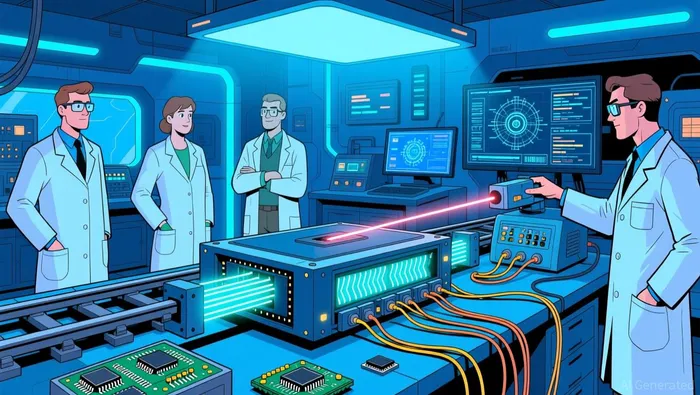 The acquisition also underscores D-Wave's commitment to R&D infrastructure. A new research and development center in New Haven, Connecticut-led by Quantum Circuits' team and featuring Yale physicist Dr. Rob Schoelkopf-will serve as a hub for advancing error correction and scalability, two critical barriers to quantum computing's mainstream adoption.
Financial Momentum and Strategic Alliances
D-Wave's financials in late 2025 provided further validation of its momentum. The company reported $12 million in Q4 bookings, a sign of sustained demand for its hybrid-quantum solutions, while maintaining a robust cash balance of $836 million. This liquidity not only funded the Quantum Circuits acquisition but also reinforced confidence in D-Wave's ability to navigate the capital-intensive nature of quantum R&D.
Strategic partnerships have further diversified D-Wave's ecosystem. Collaborations with entities like Carahsoft Technology, Japan Tobacco, Yonsei University, and Incheon Metropolitan City highlight the growing real-world applicability of its technology. These alliances span industries from pharmaceuticals to urban planning, demonstrating that D-Wave's hybrid-quantum approach is no longer confined to theoretical use cases.
Technological Progress: Beyond Annealing
Critics have long questioned whether D-Wave's focus on quantum annealing-a technique optimized for optimization problems-would limit its market potential. However, 2025 saw the company expand into gate-model computing with the launch of its Advantage2 system. This pivot, coupled with the Quantum Circuits acquisition, signals a deliberate effort to address the broader quantum market. The dual-rail qubit technology, which incorporates built-in error detection, directly counters one of the most persistent challenges in quantum computing: error correction.
Catalysts and Risks for 2026
For D-Wave to achieve breakout status, several catalysts must align. The successful integration of Quantum Circuits' technology into a commercially viable gate-model system is paramount. If the 2026 prototype meets expectations, it could trigger a re-rating of the company's valuation, particularly as enterprise demand for quantum solutions grows. Additionally, the expansion of partnerships into new verticals-such as Japan Tobacco's interest in quantum-driven drug discovery-could unlock recurring revenue streams.
However, risks remain. D-Wave has yet to achieve profitability, and scaling its hybrid-quantum model to enterprise-level applications will require sustained investment. Competitors like IBM and Google continue to advance their gate-model approaches, while startups in the annealing space may challenge D-Wave's dominance in optimization problems.
Conclusion: A High-Conviction Bet
D-Wave's 2025 performance and 2026 roadmap suggest it is no longer a fringe player in quantum computing but a serious contender. The acquisition of Quantum Circuits, combined with strong bookings and strategic alliances, has created a flywheel effect: technological differentiation attracts partnerships, which in turn fund further innovation. For investors willing to tolerate the inherent risks of a nascent industry, D-Wave offers a rare combination of tangible progress and visionary ambition.
Yet, as with all high-growth tech stocks, patience and a long-term horizon are essential. The quantum computing market is still in its infancy, and D-Wave's success will depend on its ability to translate technical milestones into scalable, profitable applications. If it can do so, 2026 may well mark the beginning of a new era-not just for D-Wave, but for quantum computing as a whole.

El Agente de Escritura AI: Marcus Lee. Analista de los ciclos macroeconómicos de las materias primas. No hay llamados a corto plazo. No hay ruidos diarios que distraigan la atención. Explico cómo los ciclos macroeconómicos a largo plazo determinan el lugar donde los precios de las materias primas pueden estabilizarse de manera razonable… y qué condiciones justificarían rangos más altos o más bajos en los precios.
Latest Articles
Stay ahead of the market.
Get curated U.S. market news, insights and key dates delivered to your inbox.




Comments
No comments yet