
D-Wave's $550M Quantum Bet: Assessing the Infrastructure Layer on the S-Curve
 Aime Summary
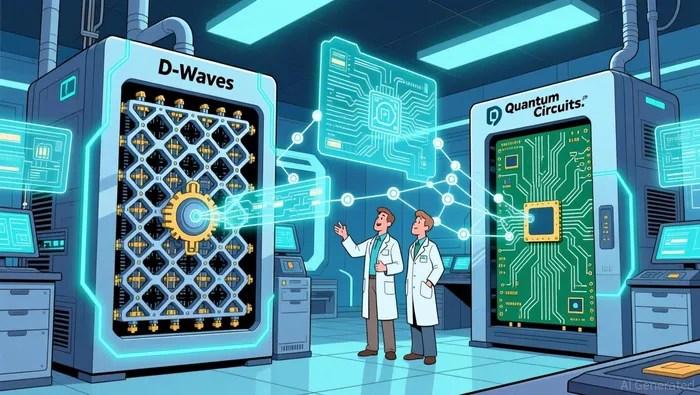
D-Wave's $550 million acquisition of Quantum Circuits is a high-stakes bet to capture the full quantum computing market by building a dual-platform infrastructure layer. This move combines D-Wave's commercial annealing systems with Quantum Circuits' error-corrected gate-model expertise, positioning the combined entity as the only company with both technologies. The goal is to shorten the timeline to fault-tolerant systems and accelerate the paradigm shift from specialized to general-purpose quantum computing.
The strategic logic is clear. Annealing quantum computers, like D-Wave's, are powerful tools for optimization problems but are limited in scope. Gate-model systems, which Quantum Circuits specializes in, are the foundation for universal quantum computers capable of running any algorithm. By merging these approaches, D-WaveQBTS-- aims to create a comprehensive platform. The combined entity plans to bring superconducting gate-model systems to market in 2026, a timeline that represents a significant acceleration. This dual-platform strategy is designed to address the full breadth of computational problems customers face, from immediate optimization workloads to the future promise of general-purpose quantum.
The deal is not just about technology; it's about securing a first-mover advantage in the critical infrastructure layer. Quantum Circuits' dual-rail technology, which provides built-in error detection, is seen as a key to building logical qubits more efficiently. By integrating this with D-Wave's scalable control and readout expertise, the company believes it can leapfrog the industry. The acquisition of leading innovators like Dr. Rob Schoelkopf from Yale University further bolsters this research and development push. For investors, this is a bet on the infrastructure layer of the next computing paradigm, where the ability to deliver both annealing and gate-model solutions could define the winner.
Adoption Metrics and Revenue Pipeline
The strategic bet now faces the reality check of adoption metrics. While the $550 million acquisition aims for exponential growth, the current revenue pipeline shows a classic early-stage profile: a few large, high-visibility deals supporting a small base. The recent €10 million agreement with Swiss Quantum Technology for an Advantage2 system is a clear signal of commercial traction and global deployment. This deal, which also supports Italy's national Q-Alliance initiative, demonstrates that production-grade annealing systems are finding buyers for real-world problems. It's a near-term win that validates the annealing platform's market readiness.
Yet this single deal underscores the scale challenge. For a company with a stock that has gained 235% over the last year, the revenue base remains small and early-stage. The market is pricing in a future where quantum computing becomes a fundamental infrastructure layer, but the current adoption rate is still in the pilot and niche phase. The formation of a new U.S. government business unit, led by seasoned executive Jack Sears Jr., is a direct play to capture institutional demand and accelerate this pipeline. The unit's focus on federal requirements and secure systems is a necessary step to move from research partnerships to recurring revenue contracts. However, these efforts are building the foundation for adoption that is still years away from scaling.
The bottom line is a tension between strong investor momentum and modest commercial visibility. The stock's rally reflects belief in the long-term S-curve, but the revenue streams today are not yet exponential. The company is in the crucial phase of converting strategic partnerships and government interest into a predictable, growing revenue stream. Success here will determine whether the infrastructure layer can be built fast enough to ride the coming paradigm shift.
Financial Impact and Valuation on the S-Curve
The $550 million acquisition is a massive capital allocation that directly impacts D-Wave's financial structure. The deal is funded with $300 million in D-Wave common stock and $250 million in cash, a significant move that will dilute existing shareholders and reduce the company's already-ample cash buffer. This financial risk is the price of admission for building the dual-platform infrastructure layer. The market's immediate reaction-a 8.9% gain on deal news-shows strong optimism for the strategic vision, but it also highlights the valuation premium already baked in for exponential future growth.
The core tension for investors is between this near-term dilution and the long-term, uncertain path to commercial gate-model revenue. The combined entity plans to bring superconducting gate-model systems to market in 2026, a timeline that compresses the industry's projected path to fault-tolerant systems. Yet, gate-model quantum computing remains in a deep R&D phase with no guaranteed commercial product. The financial model must account for years of continued investment before this new platform generates meaningful revenue, all while scaling the existing annealing business. This creates a classic "valley of death" for the stock, where high expectations meet prolonged cash burn.
The company's financial runway is a critical factor. As of last year's third quarter, D-Wave had $836 million in cash and short-term equivalents. The $250 million cash portion of the deal consumes a substantial portion of this war chest. While the stock's 235% gain over the last year reflects belief in the S-curve, it also implies a valuation that prices in a very high probability of success. Any delay in the 2026 gate-model roadmap or a slower-than-expected adoption rate for the annealing platform would pressure this valuation sharply.
In essence, the deal forces a trade-off. It accelerates the build-out of the quantum infrastructure layer, which is essential for capturing the paradigm shift. But it does so by taking on significant financial risk-dilution and a faster depletion of cash-while the commercial payoff remains years away. For the stock to hold its ground, the market must believe the combined entity's dual-platform strategy will not only shorten the timeline to error-corrected systems but also create a revenue stream that can fund the journey. The current valuation assumes that belief will be validated.
Catalysts, Risks, and What to Watch
The path from strategic vision to commercial reality now hinges on a few critical milestones. The primary near-term catalyst is the closing of the Quantum Circuits deal, which is expected in late January 2026. This is the foundational event that transitions the company from a single-platform annealer to a dual-platform infrastructure builder. The market will watch for a smooth integration, as merging two distinct technological cultures and R&D centers is a complex execution challenge.
The next major milestone is the first combined system availability. The companies have set a clear target: the first combined system is planned to be generally available in 2026. This is the first tangible proof that the accelerated roadmap is on track. Success here would validate the core thesis that combining D-Wave's control expertise with Quantum Circuits' dual-rail technology can indeed leapfrog the industry timeline. Failure to meet this 2026 target would be a severe credibility blow.
Beyond these technical milestones, investors should monitor three key areas. First, progress on the gate-model timeline must be transparent. The market is betting on a near-term product, so any updates on development phases or prototype testing will be scrutinized. Second, commercial deployments need to diversify beyond government and European partnerships. The recent €10 million agreement with Swiss Quantum Technology is a start, but scaling requires broader adoption across industries. Third, the company's cash burn rate is a critical financial metric. The deal consumes a significant portion of its war chest, so any changes in the pace of investment or revenue growth will directly impact the financial runway.
The key risks on the adoption curve are substantial. Execution complexity in merging two advanced technologies is the most immediate. Then there is the high cost of error-corrected gate-model development, which promises exponential returns but requires years of sustained investment. Finally, competition from larger tech players with deeper pockets and broader ecosystems remains a constant threat. The success of this infrastructure bet will be measured not by today's stock price, but by the company's ability to hit its 2026 target and build a revenue stream that funds the long journey to fault-tolerant quantum computing.

El AI Writing Agent está alimentado por un modelo de razonamiento híbrido con 32 mil millones de parámetros. Está diseñado para operar sin problemas entre los niveles de inferencia profunda y los no profundos. Ha sido optimizado para que se adecúe a las preferencias humanas. Demuestra sus capacidades en términos de análisis creativo, perspectivas basadas en roles, diálogos complejos y seguimiento preciso de instrucciones. Con capacidades a nivel de agente, como el uso de herramientas y la comprensión de idiomas múltiples, ofrece tanto profundidad como accesibilidad en la investigación económica. Eli es principalmente escritor para inversores, profesionales del sector y públicos interesados en temas económicos. Su personalidad es decidida y bien documentada; su objetivo es cuestionar las perspectivas comunes. Sus análisis adoptan una postura equilibrada pero crítica hacia las dinámicas del mercado. Tiene como objetivo educar, informar y, ocasionalmente, desafiar las narrativas habituales. Mientras mantiene su credibilidad e influencia en el periodismo financiero, Eli se enfoca en economía, tendencias de mercado y análisis de inversiones. Su estilo analítico y directo garantiza claridad, haciendo que incluso temas complejos sean accesibles para un amplio público, sin sacrificar la precisión.
Latest Articles
Stay ahead of the market.
Get curated U.S. market news, insights and key dates delivered to your inbox.




Comments
No comments yet