
Watts Water's TAM Refinements, Margin Claims Clash in Earnings Call
 Aime Summary
Date of Call: Aug 6, 2026
Financials Results
- Revenue: $763M, up 19% reported, up 12% organic YOY
- EPS: $3.66 per share, up 18% YOY
- Operating Margin: 21%, down 60 basis points YOY
Guidance:
- Full-year organic sales growth expected to be 8% to 11% (up from prior outlook).
- Full-year reported sales growth expected to be 14% to 17%.
- Full-year adjusted EBITDA margin expected to expand 20 to 80 basis points (up 60 bps at midpoint).
- Full-year adjusted operating margin expected to expand 20 to 80 basis points (up 70 bps at midpoint).
- Q3 reported sales expected to increase 11% to 14% (organic up 5% to 8%).
- Q3 EBITDA margin expected to be 22.2% to 22.8%.
- Q3 operating margin expected to be 19.8% to 20.4%.
- Free cash flow conversion expected to be ≥90% of net income.
- Data center sales expected to represent mid-to-high single digits as a percentage of total company sales for the full year.
Business Commentary:
Strong Financial Performance:
- Watts Water Technologies Inc. reported record
salesof$763 millionfor Q2 2026, reflecting a19%increase on a reported basis and a12%increase organically. - The growth was driven by strong demand in data centers, favorable pricing, and volume increases, despite some headwinds from product rationalization initiatives.
Data Center Growth:
- The company's
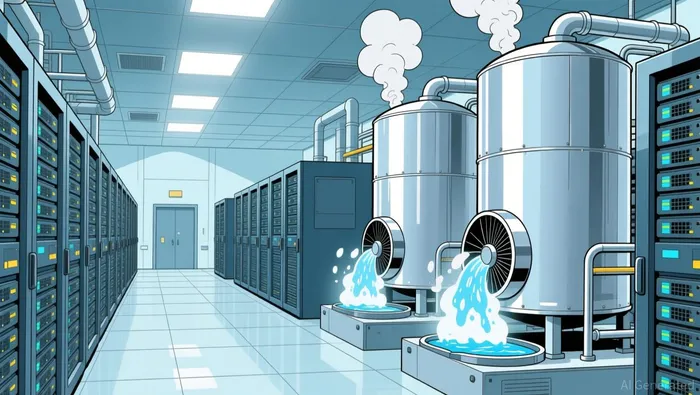
data center salesmore than tripled compared with the prior year, representing8%of total sales in the first half of 2026. - The increase was due to strong demand for cooling solutions, particularly the CoolVol thermal storage tanks, and the company's expanding global data center organization.
Margin and Earnings Improvement:
- Watts Water achieved an
adjusted operating marginof21%, with anadjusted operating incomeof$160 million, a15%increase. - Margin performance was supported by favorable price, volume leverage, and productivity gains, despite anticipated dilution from recent acquisitions and a difficult comparison against prior year benefits.
Outlook and Strategic Positioning:
- The company raised its full-year sales and margin outlook, anticipating organic sales growth of
8% to 11%, driven by data center growth, price realization, and performance in Europe and APMIA. - The positive outlook is based on the company's strong first-half performance and expectations for Q3, despite ongoing macroeconomic challenges such as higher inflation and geopolitical disruptions.
Product Rationalization and Acquisition Impact:
- The
80-20 product rationalizationinitiative resulted in a sales reduction of approximately$8 million, impacting organic growth by1%. - Acquisitions contributed
$28 millionin sales, enhancing regional growth, particularly in the Americas and APMIA.
Sentiment Analysis:
Overall Tone: Positive
- "We delivered another quarter of better than expected results, including record sales, operating income, and earnings per share." "Based on our strong first-half performance and third-quarter expectations, we are increasing our full-year sales and margin outlook." "Our balance sheet remains strong and provides ample capacity to support our disciplined capital allocation strategy."
Q&A:
- Question from Andrew Creel (Deutsche Bank): Could you give more color on why the data center TAM expanded from $1B to $2B so quickly? Does this include Europe? Have you made any data center sales there?
Response: The increase reflects a global opportunity (including Europe/Middle East/Southeast Asia) and a shift towards liquid cooling with new products like CoolVol thermal storage tanks driving higher content per megawatt.
- Question from William Gripen (Barclays): Where are you seeing the most success in data centers? How is new product adoption? What's next in development? What drives the mid-to-high single-digit revenue mix guidance?
Response: Growth is driven by quality, on-time delivery, and new products like CoolVol. R&D is focused on stainless steel products for liquid cooling. The revenue mix range accounts for the lumpy, project-based nature with visibility strongest in Q3.
- Question from Mike Halloran (RW Beard): What are you seeing in legacy non-data center construction markets (e.g., multifamily)? How are pricing actions positioning you for price-cost dynamics in the back half?
Response: Residential single-family is worsening slightly; multifamily and institutional (healthcare/education) remain soft. Price was ~6% in Q2, expected to sequentially decline in H2, but the company feels okay about current price-cost dynamics.
- Question from Jeff Hammond (KeyBank Capital Markets): Can you unpack the data center TAM expansion to $2B? How much is Europe? What's the thermal tank TAM? What's the outgrowth vs. the 15-20% market growth?
Response: The expansion is global, not just Europe, and reflects a shift towards liquid cooling and higher content from new products. The company is focused on profitable, disciplined growth rather than chasing the entire market.
- Question from Brian Lee (Goldman Sachs): What is the geographic mix of data center revenue and how is it expected to evolve? Are there margin differences between regions?
Response: The Americas are currently growing faster than Asia-Pacific (due to CoolVol) but margins are accretive across all regions, so mix shifts are not a concern.
- Question from James Cole (Jefferies): Do you have multi-year visibility into the data center pipeline? How do you go to market (direct, distribution)?
Response: Visibility varies by product (longer for large CoolVol tanks, shorter for others). The company uses a multi-channel approach with reps, contractors, and direct work with hyperscalers, often involving multiple sourcing per project.
Contradiction Point 1
Definition and Components of the Data Center TAM Expansion
Contradiction on whether the TAM increase is a new global estimate or a refinement of a previous figure.
Andrew Creel (Deutsche Bank) - Andrew Creel (Deutsche Bank)
2026Q2: The TAM was refined from 'greater than $1B' to $2B, now a global number (including Europe, Middle East, and Southeast Asia)... - [Bob](CEO)
Why did the data center TAM expand from ~$1B to $2B, and does this include Europe, where have there been data center sales? - Andrew Krill (Deutsche Bank)
2026Q2: The TAM increase to $2 billion reflects a more global view (including Europe, Middle East, and Southeast Asia) and incorporates a shift toward liquid cooling and the contribution from the new CoolVault thermal storage tanks. - [Bob](CEO)
Contradiction Point 2
Business Visibility and Data Center Order Pipeline
Contradiction on the level of long-term visibility and order lead times for the data center business.
James Cole (Jefferies) - James Cole (Jefferies)
2026Q2: Visibility varies. For large items like CoolVault tanks, visibility can be up to five months, but overall it's not a multi-year backlog. - [Diane](CFO)
2026Q2: For large items like CoolVault tanks, visibility can be longer (several months). For other products, visibility is shorter, often around five months or less. - [Bob](CEO)
Contradiction Point 3
Data Center Addressable Market (TAM) Size and Definition
Inconsistent characterization of the data center market's scale and geographic reach.
Andrew Creel (Deutsche Bank) - Andrew Creel (Deutsche Bank)
2026Q2: The TAM was refined from 'greater than $1B' to $2B, now a global number (including Europe, Middle East, and Southeast Asia)... - [Bob](CEO)
What factors contributed to the rapid expansion of the data center TAM from ~$1B to $2B, and have you made data center sales in Europe? - Nathan Jones (Stifel)
2026Q1: The data center addressable market is over $1 billion. - [Bob Pagano](CEO)
Contradiction Point 4
Visibility and Certainty of the Data Center Sales Pipeline
Contradiction on the predictability and firmness of the data center order pipeline.
What were the key factors driving the company's financial performance this quarter? - William Gripen (Barclays)
2026Q2: The business is lumpy and project-based. Schedules can shift, with some projects accelerating and others delaying. Visibility is clearest for Q3 but gets tougher in Q4. - [Bob](CEO)
Could you provide more color on the areas of success in data centers, adoption of new products, and developments driving the mid-to-high single-digit sales mix guidance, along with visibility into the second half? - Jeffrey Hammond (KeyBanc Capital Markets)
2026Q1: Currently, no significant slowing is observed. The order book aligns with the Q2 forecast. Data center growth is offsetting softness in the residential market. - [Bob Pagano](CEO)
Contradiction Point 5
Data Center Business Margin Profile
Inconsistent portrayal of whether the data center business is immediately accretive to overall margins.
What are your thoughts on the company's current financial strategy? - Jeffrey Reeves (J.P. Morgan)
2026Q2: The data center business has lower gross margin but is accretive to operating margin due to its low operating expense burden. - [Bob](CEO)
Can you help us understand where within the $25k-$100k per megawatt range your current mix sits, what the pipeline looks like, and whether gross margin compression is related to data center mix with a natural floor as the portfolio shifts? - Nathan Jones (Stifel)
2026Q1: Data center sales are accretive to overall operating income, with favorable gross profit margin movements and lower SG&A costs. - [Bob Pagano](CEO)

Discover what executives don't want to reveal in conference calls
Latest Articles
Stay ahead of the market.
Get curated U.S. market news, insights and key dates delivered to your inbox.


AInvest
PRO
AInvest
PRO




Comments
No comments yet